In this part we will try to complete the study for photon when it is attracted by a very massive body, which, as before, will be considered coinciding with the center of mass of the system, fixed.
We had seen in Part 4 that gravitational force exerted by a fixed body over a photon, when the latter is not aligned with, or cuts, gravitational field lines, Newton's force is modified as by the angular as by the normal velocity of the photon: F = (G.M.Po/r²).c/(w.r)². But, when the movement of the photon is aligned with field lines, w = 0, then, force is given by the Newton's expression: F = G.M.p/r².
Let's try to obtain the expression of the critical radius (in which, photon has a circular motion) for the photon, through the previouly presented development of photon deflection.
The excentricity e for photon deflection is defined as:
e = 1/(Ro.h) - 1, where h = G.M.p/[(Wo.Ro²)².Po]
Where, Ro is the minimum radius, or when photon is at its maximum proximity to the massive body. Also, this value of Ro is defined for radius at q = 0.
When trajectory of photon becomes circular, excentricity is null, momentum constant and Wo.Ro = c. Then, we obtain the following value for radius Ro:
Ro = G.M/c²
which is, probably, a correction for Schwartzchild radius.
When excentricity is less than zero the trajectory must be centripetal spiral, terminating in the center of mass of the massive body. Null excentricity gives a circular trajectory. If it is in between zero and unity, trajectory is elliptic, If it is unity, photon has a parabolical path, non stable, because of the variation of mass with its speed. And, if it is greater than unity trajectory is hyperbolic.
Nevertheless, when excentricity is less than zero, the equation for radius as a function of excentricity,
r = (1/h)/(1 + e.cos q)
is not the equation of a centripetal spiral!.
or, it can not be defined in all the rank of the 360 degrees of q (remember that, from infinitesimal calculus, this integral is only defined in the interval (0, p).
Let's discus it.
It can be realized that radius at q = 0 is a minimum, but because excentricity e is negative, radius, from q = 0 to q = 180 degrees, decreases, and, at q = 180 degrees radius is again minimum and trajectory is also again perpendicular to it. Let's call this radius doubleminimum, R'o. After this point, radius should decrease as it did after the first minimum due to excentricity has a negative value, and the equation governing the movement henceforth should be:
r = (1/h)/(1 + [1/(R'o.h) - 1].cos q)
where, R'o = (1/h)/[2 - 1/(Ro.h)]
where, angle should be measured starting again from a value of zero, as it had been in the original case. If volume of the mass is very small, when q = 180 degrees we have another minimum, repeating this process indefinitely, converting the trajectory in a centripetal spiral, as it should be.
This reasoning gives us the spiral trajectory that we expect!.
Are Black Holes visible?.
Let's make the following speculative reasoning, in order to enter deep in the theme: If a photon comes out from the center of a black hole in a radial movement (and Newton's definition holds), we suppose it cannot escape because its kinetic (K = p.c) energy equals its potential energy (Ep = G.M.p/(c.r)) when r = Ro (in which the value of Ro is Ro = G.M/c²), and it has no more energy to continue. Then either it would vanish, or come back to the origin. But, if it starts its radial movement at a radius greater than zero with enough energy, which means a high concentration of mass in a small volume, it could overcome the point of escape and black hole would emit light. Although, it is supposed that photon, coming out radially, is condemned to come back to its origin due to the permanent attraction exerted by the massive body onto the photon.
Let's analize this case in a more rigurous way, with the equations obtained in Part 4 and Part 5. We had obtained, for radial movement of photons, the following general relationship:
dp/p = -[G.M./(c.r)²].dr
which will allow us to obtain the equation of a photon's momentum that radially leaves the surface of the massive body with a radius Ra:
==> p = Pa.e(G.M/c²).(1/r -1/Ra) = Pa.e- (G.M/c²).(1/Ra -1/r)
From this expression, we observe that for Ra = 0 , p = 0, despite of any value of Pa. Namely, It is not possible, for the photon, to leave the center of the black hole for this mathematical situation.
But, if: 0 < Ra < Ro, momentum will have a positive and no null value for r = ¥, given by:
p = Pa.e- (G.M/c²).(1/Ra)
where, p < Pa. and e is the Euler's constant.
This result implies that a black hole, with a volume greater than zero, a real volume, can radially emit light.
Let's stop for a moment to say an obliged comment. In this obtained expression for Momentum p in its rectilinear movement, we did it by supposing that it has a variable behavior, contrary to its constant behavior in curvilinear motion used in Part 4. Well, this is so because if we give such constant feature to Momentum in rectilinear motion we arrive at inconsistences with expected results. Allways, in all this development our indicators are the expected results: We mantain them if they are logical and consistent results, and we discard them if they are not!. (Light is a very strange thing).
Nevertheless, the obtained results for the rectilinear and curvilinear photon's momenta are consistent between them, as we will realize after.
Let's see the case of a photon leaving the surface of a REAL black hole (Ra > 0), describing a curvilinear movement (not circular). We will see that it can reach a radius with infinite value with a momentum greater than zero but less than Pa. Namely, it becomes free of the black hole, similar to the radial case.
On the other hand, we know that a parabolical or hyperbolical trajectory requires that excentricity should be equal or greater than unity. Let's take the excentricity equal to unity as a limiting condition.
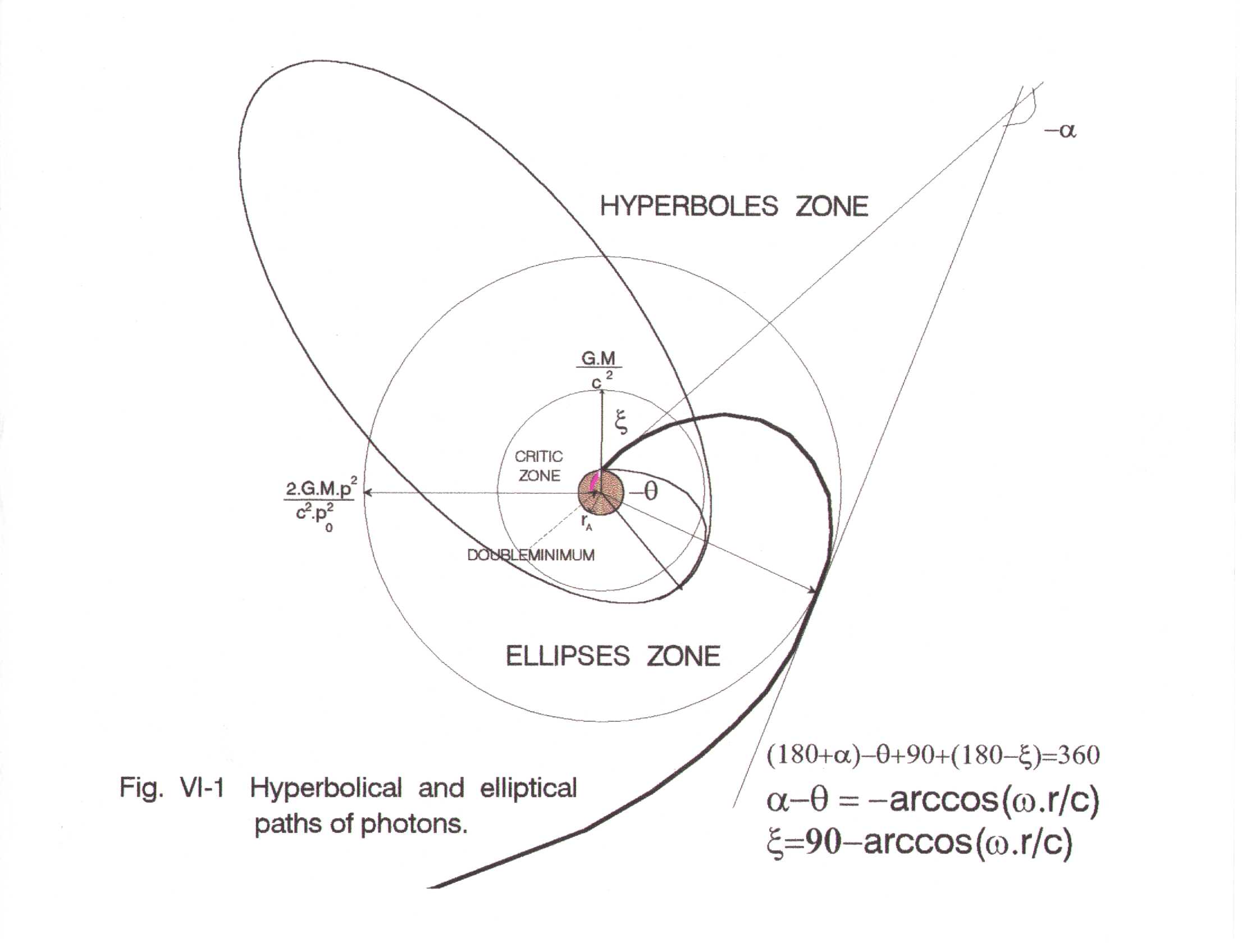
So, let's remember that in the analysis of photon´s deflection, when it is at its maximum proximity, the radius Ro and its trajectory form an angle of 90 degrees. By continuing, or extrapolating, photon's trajectory in contrary sense to its movement, there is another point of perpendicularity (inside the volume of the real black hole): the "doubleminimum", previously discussed. By taking this point as a new reference, or starting point, we observe that radius is permanently increasing. With this configuration applies the function arccos, and so, we can describe the complete trajectory equation of a photon leaving the black hole and its critical zone.
It can be shown (see Part 4) that the expression of the photon's momentum in its curvilinear movement is given by:
p = Po/[1 - (2.G.M/c²).(1/r - 1/Ro)]
Which for r = ¥, p = Po/[1 + (2.G.M/c²).( 1/Ro)]
Where p < Po, but with a positive value: A similar feature observed for photon's momentum in the rectilinear motion. From above we can calculate the value of momentum at the starting point at r = Ra.
Pa = Po/[1 - (2.G.M/c²).(1/Ra - 1/Ro)] where [1 - (2.G.M/c²).(1/Ra - 1/Ro)] < 1, and Pa > Po.
Now, let's try to calculate the angle, relative to the radial line at the starting point at Ra, for a hyperbolical path.
For the radius in where excentricity is unity the angle x is obtained from the geometry of the movement:
180 + aa - qa + 90 + 180 - x = 360, where aa -qa = - arccos (Wa.Ra/c)
As we can realize x is the maximum angle that the tangent to the hyperbolical trajectory, at the starting point at Ra on the surface of the real black hole, can have with the radial line.
In here the angles have the meaning defined in Part 4, and in this (x). The expression of the angular velocity can be obtained from the development done also in Part 4.
Thus, it has been demonstrated, that a photon, produced by a black hole, can leave the critical area, as in radial as in hyperbolical movement, with a maximum angle x less than 90 degrees, as it comes from equations.
Thus, black holes can emit light!.
It is possible to make the following speculations or inferences about the hyperbolical trajectories of photons. Let's discuss them.
How Black Holes looks like?
Photons leaving in all directions the surface of a real black hole along hyperbolical trajectories arriving at the ocular of a earth telescope, will almost coincide in their orientation, giving the image of a luminous ring. These hyperbolical photons come from all points of the surface of the black hole, included those leaving the back part. Radial photons and those almost radial, opposite to the ocular almost coincide at a central point, with a certain density, giving the image of a luminous point at the center of the black hole. But, those photons coming from the sides of the black hole, could be elliptic and they will never reach the ocular, or they could have hyperbolical or parabolical trajectories terminating at other locations in the space. The final effect of this combined trajectories is, an image of the black hole in the telescope of a luminous ring with light at the center, with less luminosity than the ring and a obscure or attenuated region between the center and the ring.
Other effect that can be deducted, is the following one: Photons emitted by a star behind a black hole, attracted and passing tangentially to it, at a distance less than the critical radius Ro, will never arrive at the ocular of a earth telescope because they will be absorbed by the black hole, but if tangentiality is out of this critical orbit, they will be deflected hyperbolically or parabolically and they could arrive at the ocular. The result is that the observer will see an image of another ring of high liminosity, higher than the proper of the black hole because photons of the star recover their original momentum, unlike those coming from the black hole which have photons with less momentum than they have at their starting points. In any case, it will depend upon the process that is developing in such black hole.
NOTE: The previous speculations had been done before we looked for the pictures and I didn't want to modify what it was written at that moment, in order to leave the things in the same manner it develope. You can see, that it is not so far apart about reality.
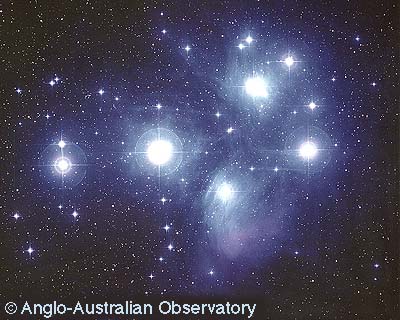
There are some examples of the first commented effect in the Pleyades, in the Taurus constellation (Fig. 5.11, ASTROFISICA, Manuel Rego & Maria José Fernández, Editorial Eudema, 1988).
But, the following picture of the pleyades, if you have good sight, can satisfy your curiosity about all these things.
(presented in the version 3.0, 1997, previous to this work)
A case of a star behind a black hole as it was described before in the discussion of the second effect, we believe can be seen in the ORION constellation (Refer, specially to the right side of the Fig. 8.1, ASTROFISICA, Manuel Rego & Maria José Fernández, Editorial Eudema, 1988).
In general, if this reasoning is the correct one, some of the bodies responding to the characteristics previously discussed are real black holes (0 < Ra < Ro), demostrating their existence.
Of course, if the massive body is not a black hole (Ra > Ro), it does not present rings. Thus, if all these considerations are valid, BLACK HOLES DO EXIST AND CAN BE SEEN.
 Get your own Free Home Page