Part 4. Effect of the Gravitational Field on Light. Correction to the Newton's Universal Gravitation Law.
In Part 2, we had previously arrived at the expressions of the Kinetic Energy, Momentum and Mass for photons: E = m.c²; p = m.c; m = p/c; respectively.
Bending of Light.
Although light photon does not have rest mass, when it is traveling with a speed c, it has a non zero mass given by m = E/c². Because of this feature of photons, they can be attracted by the gravitational field of a massive body and take a curvilinear path. We are going to extend to curvilinear the following assumption: Light has constant speed also in curvilinear motion.
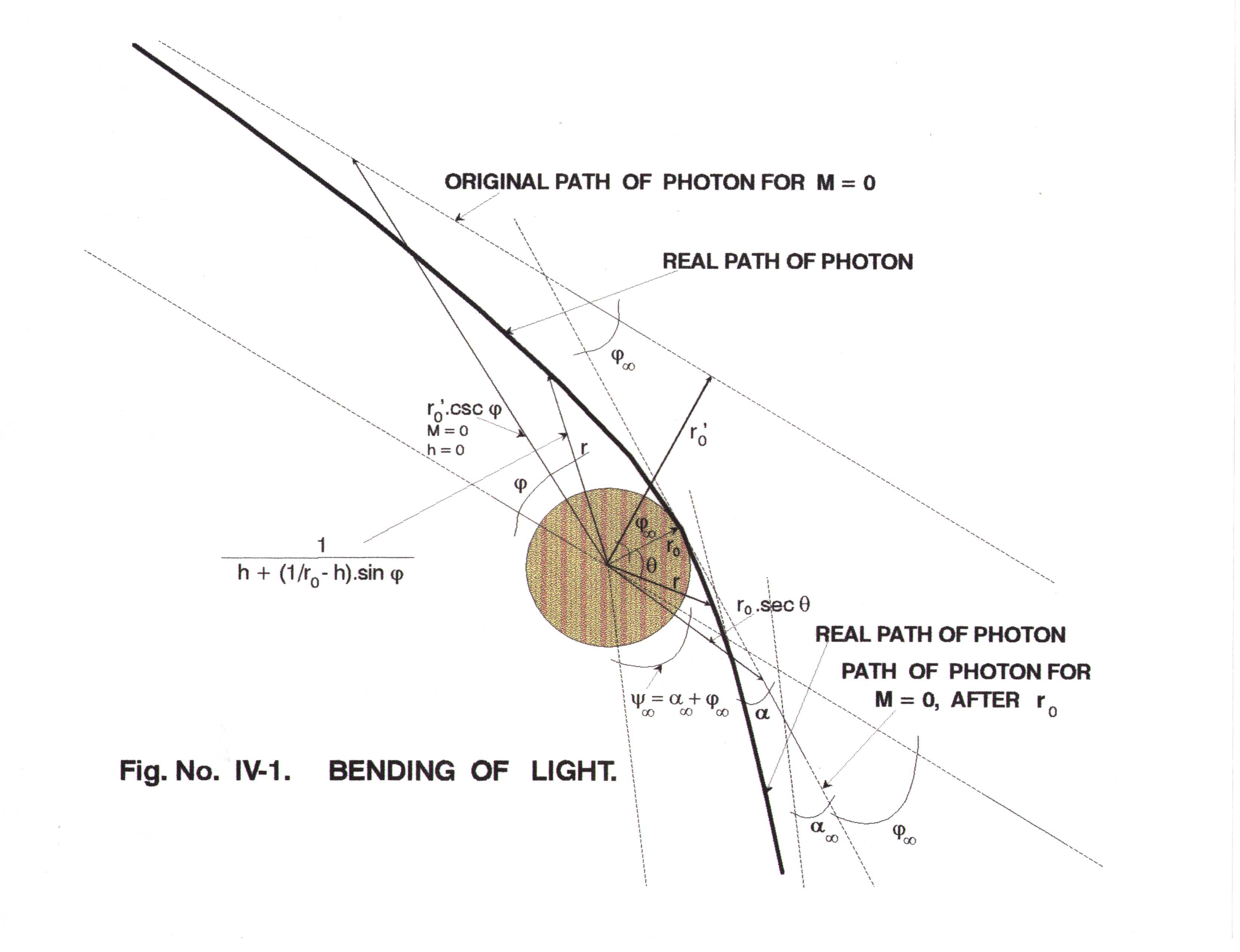
Let's establish the problem in the following way: Let's suppose that a photon, attracted by a massive body, approaches onto it at a minimum distance given by the radiovector Ro, measured from the center of mass of the system to a point Po, in which this center of mass coincides with that of the massive body. Such radiovector forms an angle of 90 degrees with the vector velocity c at the point Po.
Let's try to find the deflection of the photon, produced onto it by the gravitational field of the massive body:
By considering the gravitational force as central and that its expression is given by Newton's definition, we can write:
dp/dt = -[G.(M.p/c)/r²].Ur
Where, G is the gravitational constant, M is the massive body mass, and Ur is the unit vector on the direction of the gravitational central force. Making p = (p/c).c, we have:
From this vectorial equation, what is multiplied by Uq must be zero (central gravitational force) and what is multiplied by Ur equals -[G.M/r²]. From the first condition, we obtain:
In here mo is the mass of photon when it is at the minimum distance Ro from the massive body, and Wo its angular velocity.
Which shows that the angular momentum of light is constant, confirming once more the law of conservation of the angular momentum, when no other external forces are considered and by considering central the gravitational force (which implies also the instantaneity of the field effect. See Part 3.
Field Displacement ).
Now we will try to obtain the differential relationship between the the radiovector r, from the center of mass to a generic point P and the angle q.
Let's analize this result. When there is not a massive body (M = 0) attracting the photon, the equation of its trajectory, measured from the same point where the center of mass of the massive body had been before, actually is:
r = Ro.sec q
But the previous encountered relationship does not reduce to this expected result. So, the obtained relation between the generic radius r and the angle q is incorrect and this result is an inconsistence of the procedure, then something is wrong in all of this.
Let's check what had been assumed in this development:
1) Speed of light is constant in curvilinear motion. It is a logical assumption, and we will keep it.
2) Gravitational forces are central, which implies that conservation of angular momentum holds, We sustain it because this is a general accepted law.
3) The definition of Gravitational Force given by Newton has been accepted as it was enunciated. We believe that it is not valid for varying masses or, in the case of photon for varying momenta.
Let's try to adapt and generalize Newton's definition of the gravitational force in order to fulfil requirements of expected results.
Particular correction to Newton's Universal Gravitation Law.
The classical equation encountered by Kepler for attracting masses, considering them constant, was:
d²r/dt² - r.w² = -G.M/r²
and its general solution:
r = 1/[h + ((1/Ro - h).cos q]
where, h = constant = G.M/(Ro².Wo)²
When M = 0 ==> h = 0, this equation gives for radius the expected expression of Ro.sec q.
We will assume that we should arrive at a differential equation similar to that of Kepler, which, in the case of a moving photon attracted by a fixed massive body, we see that this differential equation does not directly depend upon the photon mass m = p/c. We are going to establish unknown the expression of the magnitude of the gravitational force, and we will call it F. Our problem reduces to find out what is the actual expression of F, for this case. We will try to encounter in this Part 4 the correction of the Newton's definition of gravitational force for the case of a photon, rotating around a fixed massive body with mass M. We will call it the first correction of Newton's definition. After, in Part 5, we will see that for two masses with non zero rest mass, both varying and rotating around the center of mass of the system, we will obtain the complete correction to the Newton's definition of gravitational force.
Let's denote with the scalar F the unknown magnitude of the gravitational force exerted by the massive body, considered fixed with mass M, onto the moving photon's mass m. By making some necessary previous relationships:
So, dp = -(F/c).dr ==> (1/p).dp/dt = -[F/(p.c)].dr/dt
On the other hand,
dp = v.dm + m.dv ==> dp/p = dm/m + dv/v
Starting from the begining, with the second condition, and using the unknown F:
d²r/dt² - r.w² + (1/p).(dp/dt).(dr/dt) = -F.c/p
Substituting (1/p).(dp/dt) by -[F/(p.c)].dr/dt, we obtain:
d²r/dt² - r.w² - [F/(p.c)].(dr/dt)² + F.c/p = 0
From here, and using (dr/dt)² = v² - w².r², we obtain the following important relationship that will be used after finding the value of F:
d²r/dt² - w².[r - r².F/(p.c)] = 0
(for circular motion we will see that F = G.(M.p/c)/r², and r = G.M/c²)
On the other hand, let's make the equation:
d²r/dt² - r.w² + w².r².F/(p.c) = 0
to be equal to the Kepler's equation (which is our main assumption in this development. Obviously, if this is not so, somewhere in the next developments we will find a contradiction!):
d²r/dt² - r.w² + G.M/r² = 0
Then, - w².r².F/(p.c) must be equal to G.M/r²
Which produces the following final result:
F = (G.M/r²).(p.c)/(w².r²)
In this way, we have arrived at the first correction for the Newton's definition of the gravitational force, when this is applied onto a photon, by a massive body. Let's discuss it.
With this relationship we force the final equation of movement to be equal to that of Kepler:
d²r/dt² - r.w² + G.M/r² = 0
For an uniform circular movement of the photon, where its mass is constant, radius is constant ==> dr/dt = 0, dc/dt = 0 and c = w.r and F reduces to G.M.p/(c.r²) (say, Newton's definition holds). Thus, from the last equation:
r.w² = r. c²/r² = G.M/r² ==> r =G.M/c² (Correction to Schwartzchild radius?)
But, when photon is completely aligned with the gravitational force, its has a rectilinear movement towards the center of mass of the massive body and a null angular velocity. In this case c² = (dr/dt)² + (w.r)² = (dr/dt)² ==> dr/dt = c, and d²r/dt² = 0. Say, we are just in the known situation in which Newton defined the gravitational force as F = G.M.m/r², and gravity, which has been checked many times until satiety. Then, in this case, we have another treatment of the differential equation that governs this radial movement, and originates the following result:
Namely, when the direction of movement of photon coincides with the direction of field lines, in a rectilinear motion, gravitational force is that of Newton without modifications nor additional terms or factors. Namely, gravitational force doesn't depend on the angular velocity. Then, in the equation, for w = 0:
d²r/dt² - w².[r - r².F/(p.c)] = 0
gives the identity d²r/dt² = 0, which is true because dr/dt = c, a constant. and dc/dt = 0.
But, when photon moves in a curvilinear manner cutting field lines, a factor appears in the expression of the gravitational force that had not been taken in account in classical analysis, which had lead to the observed inconsistence in the previous treatment. With these tools in hand we can start facing the problem of light deflection, consistently (we hope so!).
(For those thinking of a gravitational force with an infinite value for w = 0, remember that in a curvilinear motion radius and angular velocity are interdependent between them through the angular moment conservation law. Say, a very small value of angular velocity implies a very big value of radius. The situation for radial or rectilinear motion, is solved through the original Newton's definition as it was suggested before.)
Our starting point, must be then the Kepler's equation, because we worked the new definition of gravitational force based on this equation. By putting w² as w² = [Wo.Ro².Po/(p.r²)]², we have:
At this moment, we have to say some words. Do you remember that in part 1, we have encountered that Lorentz transformation compacts or expands a variable physical magnitude independent of it is the proper one or its differential?. This property seems to have a very great importance in this mathematical-physical development.
Observe that in the Lorentz transformation of mass, it depends only upon this transformation factor through the constant rest mass Mo. There are not any other variables inside: m = Mo/(1 - v²/c²)³/². Then, the mass measured by the fixed observer is only referred to the constant rest mass Mo, multiplied by this companding factor, the same constant rest mass measured by the moving observer. Thus, unlike other magnitudes measured that can have real variable values (r', v', w', dx', dt') for both observers, from which the derivation and integration processes depend, the mass is only referred to a constant (Mo), times a Lorentz factor. This double feature of the Lorentz Transformation, in the case of a complex expression with a mixture of constant and variable magnitudes, leads to the domination of the variable magnitude feature: The independence of the Lorentz factor on the mathematical processes of derivation and integration. From this discussion, we can infere or assume that the mass, for curvilinear motion, should behave as it were a "constant" when integrations or derivations are done over any expression containing it together with other variable magnitudes (at least one) present in such expression, in order to allow in the expression the Lorentz factor (which is inside the expression of mass) be independent of the integration and derivation processes. Well, precisely, this will be the situation that we are going to face in the next steps in this development. We are going to assume that photon's momentum will behave also in this way because it differs from the photon mass only on the constant speed of light. Say, it will behave in the next derivations or integrations as it were a "constant". With this in mind, let's continue (however, future results will tell us if this assumption is, or is not, correct).
Multiplying by dr, and integrating between (0, q) and (Ro, r), we have:
Making h = [(G.M.p²)/(Wo.Ro².Po)²], completing squares and reordering:
(1/r²)².(dr/dq)² = (1/Ro - h)² - (1/r - h)²
If we do: u = 1/r ==> du/dq = -(1/r²).(dr/dq), then:
(du/dq)² = (Uo - h)² - (u - h)²
du/dq = ±[(Uo - h)² - (u - h)²]¹/²
Given that radius, after its minimum value Ro, increases in a parabolical or hyperbolical movement (or in half of the elliptical one), the function u, inverse of radius, decreases. Then the negative sign of the square root holds. The obtained function is an arccos(.). Then:
q = arccos[(u - h)/(Uo - h)] ==> u = h + (Uo - h).cos q
==> r = 1/[ h + (1/Ro - h).cos q]
As we realize, in doing the integration, it requires that h must be constant. But, because momentum behaves as a constant, the requirement is met.
This result is very similar to that of Kepler, except for h, which has inside the effect of the variation of momentum in the factor (p/Po)². So, we can see that this equation fulfils the condition that when q = 0, r = Ro, and if M = 0, then r = Ro.sec q. If photon motion is circular then 1/Ro = h and r = Ro, and also p = Po, and Ro = 1/h = 1/[G.M/(Wo.Ro²)²], where Wo.Ro = c, then Ro = G.M/c², the same result (correction of the Schwartzchild radius) previously found at the beginning of this part, with the original Kepler equation). These last checks of the expression of r (for M = 0, and for M different of zero, which reduces to Newtonian expression for p = Po) and Ro at its starting point at t =0, and for a circular movement of the photon, could be a confirmation of the taken asumption of considering the constant behavior of the momentum, because when we had calculated it before, we had not have taken this assumption. Say, until now all these ones are expected results. But, if we make the following change in the equation:
and evaluate at aphelio, where r = R, W.R = V = c, we obtain that :
(W.R²)².(1/Ro + 1/R) = 2.G.M
V² = c² = 2.G.M/[R².(1/Ro + 1/R)]
Doing the same but coming from R to Ro, where r = Ro, Wo.Ro = Vo = c, we obtain:
Vo² = c² = 2.G.M/[Ro².(1/Ro + 1/R)]
From which, we arrive at the following result c².Ro² = c².R² (?) which is an inconsistency.
But, we know that the actual valid relationship is that of the constancy of angular momentum along all the movement:
mo².Vo².Ro² = (m.w.r²)², which at aphelio becomes mo².c².Ro² = m².c².R²
Thus, we observe that the previous obtained result, obviously, does not arrive to the conservation of angular momentum. This means that the Newton's force definition must be an expression more complex than that obtained. In this sense, let's think of a factor, (po/p), which, times the Newton's force for curvilinear motion, could solve this inconsistency (for circular motion this factor is unity):
F = (mo/m).(G.M/r²).(p.c)/(w².r²) = (G.M/r²).(po.c)/(w².r²)
Where, (mo/m) = (po/p).
and Kepler's equation, changes to:
d²r/dt² - r.w² + (po/p).G.M/r² = 0
and then h changes to h = (G.M.p)/[(Wo.Ro²)².Po]
In this way the expressions for velocities that meet the equality of momenta, become:
V² = c² = 2.(po/p).G.M/[R².(1/Ro + 1/R)]
Vo² = c² = 2.(p/po).G.M/[Ro².(1/R + 1/Ro)]
===> mo².c².Ro² = m².c².R² = G.M/(1/R + 1/Ro)
As it should be!
Thus, the last correction done to the Newton's Gravitational Law seems to complete its definition!. For this particular case of Photon, all the expected results are now consistent as in circular as in elliptycal, parabolical or hyperbolical movement, and additionally, meets the Angular Moment conservation Law. I have checked them. Nevertheless, in all this development I have made the assumption, for simplicity, of the independence of the integration and derivation processes of the Lorentz fator in the case of mass, or momentum, but it will be necessary to analize (Part 5) the more general case of attraction among moving masses with velocities less than that of light, in order to see if the procedure is consistent.
With these last results, and reflections, we will obtain for Photon's Momentum and Angular Velocity the following expressions, before or after its maximum proximity to the massive body:
p = Po.[(b² + 1)1/2 - b]
w = (c.Ro/r²).1/[(b² + 1)1/2 - b]
for b = (G.M/c²).(1/Ro - 1/r)
which leads to that at infinite dr/dt = q equals the speed of light, as it is expected.
(These results will be also applied applied in Part 6 for the analisys of Black holes).
Now, let's calculate, in hyperbolic movement, the angle deflected by the photon from Ro until r = ¥
Because the deflection of photon is measured relative to its rectilinear movement, for r = Ro the deflection should be zero degrees (in where, vector velocity forms an angle of 90 degrees with radius). Thus, we can write that the deflection of the vector velocity, relative to the photon's rectilinear movement, will be the angle q¥ (which is greater than 90 degrees) minus 90 degrees. Then, by denoting this deflection value as a¥, we have:
a¥ = q¥ - p/2
The value of q¥ can be calculated, for r = infinite, from:
A similar analysis can be done for the case in which a photon travels free in the space in rectilinear motion and suddenly is attracted by a massive body. After this, radius starts to decrease until it reaches its minimum value Ro (in a hyperbolic movement of the photon). In this case applies the function arcsin(.). By integrating from infinite radius to a generic radius in the expression:
By observing that, j¥ = arcsin[( - h¥)/(Uo - h¥)], we finally have the absolute expression of the angle j:
j = arcsin[(u - h)/(Uo - h)]
==> r = 1/[ h + (1/Ro - h).sin j ]
Which, for the value of r = Ro, j = arcsin (1) = p/2, and the equation for radius gives consistently r = Ro. Additionally, when M = 0, radius takes the value r = Ro.csc j, as it was expected.
Observe that starting point for measuring the deflected angle is for r = ¥, in which the angle j has a negative value:
When 1/Ro = h, j = 0 degrees, and after this value the angle has a positive value until it reaches the value of p/2, when r = Ro.
Now, let's analyze the total angle swept by the radius from infinite to Ro. As we can observe, this is greater than 90 degrees.
Let's say that it is:
jo - j¥ = arcsin[(1/Ro - h)/(1/Ro - h)] - arcsin[( - h¥)/(1/Ro - h¥)]
jo - j¥ = p/2 + arcsin[(h¥)/(1/Ro - h¥)]
The deflected angle by the photon from infinite until Ro, b¥ , relative to the previous rectilinear movement of the photon, will be, precisely, the excess to the previously mentioned 90 degrees, Namely,
Thus, the total and exact deflected angle by the photon respect to its rectilinear motion from and to infinite, without any approximation, d¥,¥, will be the summation of a¥ plus b¥ :
d¥,¥ = 2.arcsin[h¥/(1/Ro - h¥)]
Then, The total deflection of Photon attracted by a massive body for (h.Ro) << 1, and for p approximately equal to Po, will be:
d¥,¥ » 2.G.M/(c².Ro)
Half of what Einstein established!.
Let's look at the relationship given by the Einstein's General Theory (after some assumptions, aproximations and discarded terms, as it appears in Foster&Nightingale, "A short course in General Relativity", 1979, Longman Inc. New York, page 119), from where the referred double value of light deflection was obtained:
u = Uo.(1 - eUo/2).sinf + (e.Uo²/2)(1 - cosf)²
Where u = 1/r, Uo = 1/Ro, e = 2.G.M/c² and f is the angle deflected by the photon from infinite, at zero degrees, to infinite, at p + a, where a is the total deflected angle.
First of all, I don't like so much this relationship because it doesn't resemble exactly the path of the photon from infinite to infinite. For instance, if you give the value of p/2 to angle f, where sinp/2 = 1 and cosp/2 = 0, u takes the value:
u = Uo - e.Uo²/2 + e.Uo²/2 = Uo
This is not true, as you can observe it in the presented graphic referred to this equation in the same page 119, because u should take such value (Uo) a little bit after, when f = p/2 + a/2. It would mean that the path given by the previous relationship, amplifies the angle deflected by the photon in a cumulative manner. In fact, this equation is consistent, only, for the case that M = 0. Say, what this indicates is that the deflection from infinite to infinite for the photon, calculated from such relationship, is greater than what it should be. This fact makes me not to be confident on its results!.
CONCLUSION: The obtained results in this work with a simple math and a simple physical approach indicate that the result of the photon's deflection produced by the attraction of a massive body, given by the Einstein's general theory of relativity is not correct (double of what actually it is).

 Get your own Free Home Page