Let's start our discussion of relativity from the same point all have started: the Lorentz Transformation for distances, time and velocities between two observers located in different reference systems, one of them fixed and the other moving at a velocity "v", by considering the speed of light constant in a vacuum space. This development was done by Lorentz for a rectilinear movement of the moving reference system. Einstein started with this feature in mind, and never changed it, developing all his theory based on this rectilinear movement. He overcame all the problems of curvilinear movement by applying the rectilinear movement to differential displacements of the moving reference system. May be an elegant and simple way to avoid the complexities of the curvilinear movement. But, nevertheless, it is possible to work with curvilinear motion by using a procedure similar to that of Lorentz Transformation!. This is an approach we will try to follow in this study and try also to convince you that it is a correct one. We think that this approach is a natural one, because earth moves following an "elliptical" path, and that all the measurements of the speed of light have been made in the earth reference system, which moves in a curvilinear movement.
Lorentz transformation applied to rectilinear motion.
In order to enter in the basics of this subject, let's say that the Lorentz Transformation applied to a rectilinear motion along the X' axis in the moving reference system O' (with velocity v, relative to a fixed reference system O), gives us the known transformations of distances, time and velocities (see Physics of Alonso&Finn):
dx - v.dt
dx' = ¾¾¾¾¾¾
Ö1 - v²/c²
dy' = dy
dz' = dz
dt - v.dx/c²
dt' = ¾¾¾¾¾¾
Ö1 - v²/c²
1 - v.Vx/c²
dt' = ¾¾¾¾¾¾ dt
Ö1 - v²/c²
Vx - v
(Vx)' = dx'/dt' = ¾¾¾¾
1 - v²/c²
Vy.(1 - v²/c²)1/2
(Vy)' = dy'/dt' = ¾¾¾¾¾¾
(1-v.Vx/c²)
Vz.(1 - v²/c²)1/2
(Vz)' = dz'/dt' = ¾¾¾¾¾¾
(1-v.Vx/c²)
where Vx is the velocity of the moving system in the X direction, measured from the fixed reference system O.
These results are easily obtained only by establishing the constancy of the speed of light in the equations and no other assumption. This was the key assumption done by Lorentz in order to make his transformations consistent with Maxwell equations (Galilean transformations had not been consistent).
Lorentz transformation applied to curvilinear motion in two dimensions.
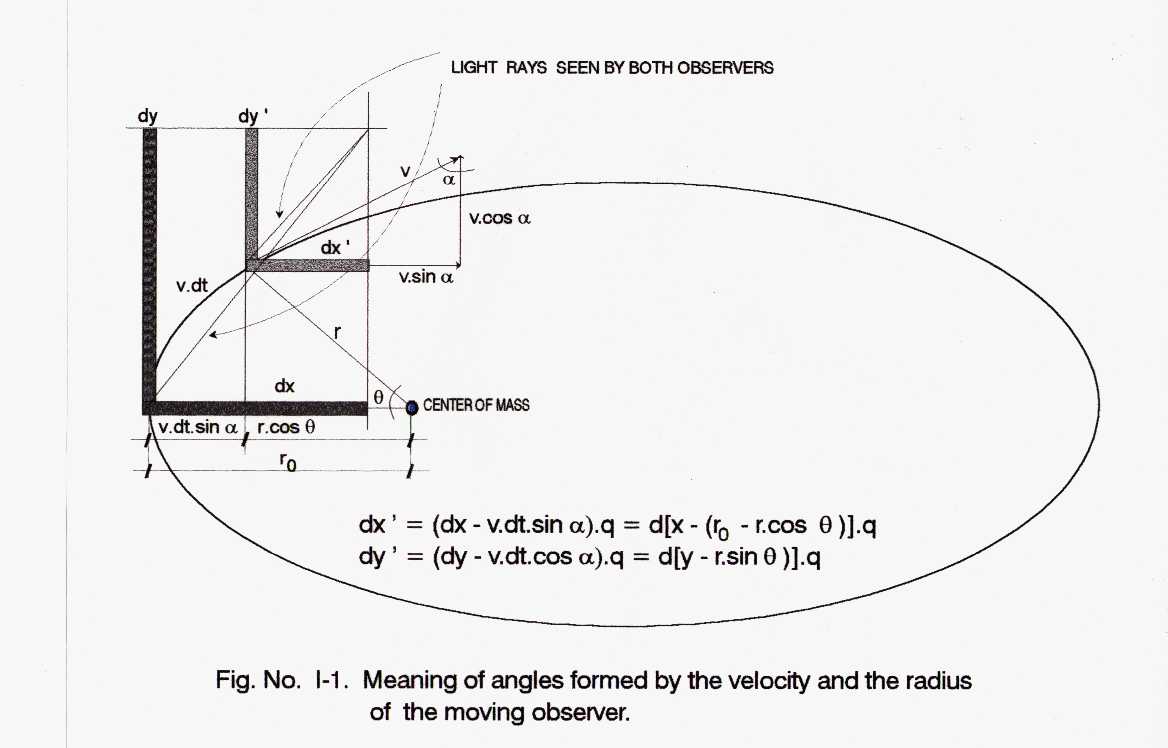
In order to make more general the Lorentz Transformation let's consider a curvilinear movement of the moving system, which is the normal way to establish the problem. We will consider, as before, the constancy of the speed of light as the main assumption and measurements of its magnitude will be then the same for both observers. Let's establish for example, that the moving reference system O' is on Earth, following the path of the Earth motion around the Sun, and the fixed reference system O is located on one point of such path, fixed relative to the center of mass of the Earth and the Sun, at a distance Ro from this center of mass. Namely, because the fixed reference system is also on the path of the Earth at some instant both systems will coincide. Let's establish that both observers start measuring the time and the angle q (the angle described by O' relative to the vertex located at the center of mass and also relative to the fixed position of O) at this instant, where both observers are onto the same point of the Earth path. By using a similar procedure as that of Lorentz, let's say that at this instant a light signal is emitted from this common position towards a point P in the X-Y plane. Let's try to develope the complete procedure:
Along all this work we will consider bodies moving in a vacuum space. Let's express the distance reached by the light signal measured by both observers in function of the components of their coordinate systems:
where i, j and k are vectors in the direction of the system coordinates (also c is a vector in this equation). Using a factor q, to be determined, we obtain the following scalar relationships:
dx' = (dx - v.dt.sin a).q and that: v.dt.sin a = d(Ro - r.cos q) (Eq. 1a)
dy' = (dy - v.dt.cos a).q and that: v.dt.cos a = d(r.sin q) (Eq. 1b)
dz' = dz
where a is the angle between the direction of the tangential velocity v of the moving system O', and the vertical (perpendicular to Ro).
The condition of the Lorentz transformation is that both observers should measure the same speed of Light:
Because this last equation is function of the measurements done by the observer in O, it must be equal to the first one in this development. By equaling coefficients, we obtain the following new system of equations:
And follow the solutions for q, b1 , b2 , a1 , a2 in curviliinear motion:
q = 1/(1-v²/c²)1/2
1
q =¾¾¾¾¾¾
Ö1-v²/c²
b1 = v/(c².sin a)
v
b1 = ¾¾¾¾
c².sin a
b2 = v/(c².cos a)
v
b2 = ¾¾¾¾
c².cos a
sin a
a1 = ¾¾¾¾¾
Ö 1 - v²/c²
a2 = cos a/(1-v²/c²)1/2
cos a
a2 = ¾¾¾¾¾
Ö 1 - v²/c²
Thus, by substituting the previous solutions in the original equations for distances and time (Equations 1a, 1b, 1c) we finally obtain, for curvilinear motion, the following Lorentz Transfomations between both observers:
dx' = (dx-v.dt.sin a)/(1-v²/c²)1/2
dx - v.dt.sin a
dx' = ¾¾¾¾¾¾¾
Ö 1 - v²/c²
dy' = (dy-v.dt.cos a)/(1-v²/c²)1/2
dy - v.dt.cos a
dy' = ¾¾¾¾¾¾¾
Ö 1 - v²/c²
dz' = dz
dt' = [(sin a.dt - v.dx/c²)² + (cos a.dt - v.dy/c²)²]1/2/(1-v²/c²)1/2
________________________________
Ö(sin a.dt - v.dx/c²)² + (cos a.dt - v.dy/c²)²
dt' = ¾¾¾¾¾¾¾¾¾¾¾¾¾¾¾¾¾¾¾
Ö 1 - v²/c²
By dividing the differentials of distance by the differential of time, follow the relationships among velocities measured by both observers:
dx'/dt' = V'x = (Vx - v.sen a)/ [(sin a - v.Vx/c²)² + (cos a - v.Vy/c²)²]1/2
dy'/dt' = V'y = (Vy - v.cos a)/ [(sin a - v.Vx/c²)² + (cos aa - v.Vy/c²)²]1/2
dz'/dt' = V'z = Vz.(1-v²/c²)1/2/ [(sin a - v.Vx/c²)² + (cos a - v.Vy/c²)²]1/2
As we can see, the used procedure is similar to that used by Lorentz in his development, only that in this case it is applied to curvilinear motion.

 Get your own Free Home Page