General Chicago History
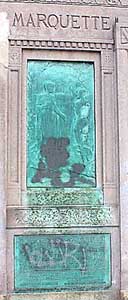 In 1673 the French explorers Jacques Marquette and
Louis Jolliet became the first Europeans to pass through what is now
Chicago. They found a swamp that the region’s Native Americans called
"Checagou," named after the wild onion that grew here. Marquette
overwintered in Pilsen from Dec. 12, 1674 until the Spring of 1675. There
is a neglected monument to Marquette on Damen Ave. just north of the bridge
over the river/Sanitary Ship Canal that commemorates his stay.
In 1673 the French explorers Jacques Marquette and
Louis Jolliet became the first Europeans to pass through what is now
Chicago. They found a swamp that the region’s Native Americans called
"Checagou," named after the wild onion that grew here. Marquette
overwintered in Pilsen from Dec. 12, 1674 until the Spring of 1675. There
is a neglected monument to Marquette on Damen Ave. just north of the bridge
over the river/Sanitary Ship Canal that commemorates his stay.
The reason a huge metropolis grew up in Chicago and not in another location is that this is the point where the Great Lakes Waterway links to the Mississippi river system. During wet seasons the water in this swampy area rose so high that it was possible to canoe from the great lakes 12 miles up the south branch of the Chicago river to the Des Plaines river and then down to the Illinois river and to the Mississippi without portaging. Thus it was theoretically once possible to canoe from the North Atlantic to the Gulf of Mexico without getting out of the canoe.
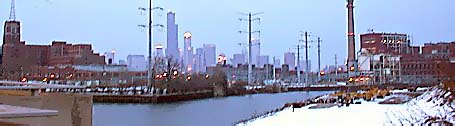
Cholera and typhoid epidemics had plagued Chicago's early history due to poor sanitation. In 1887 it was decided to solve the sanitation problem by putting sewage into the Chicago river and reversing the flow of the river. Then it would not contaminate the lake water that was and is used for drinking. This engineering feat was accomplished by creating the Sanitary and Ship Canal that forms the southern boundary of Pilsen. The creation of the canal created a channel that was big enough to send large barges down to the Mississippi River.
Because the water table in the swampy ground under Chicago was just below the surface, the city put the new sewers on top of the ground and built the roads on top of the sewers. The buildings in nearly the entire city were raised to permit proper drainage. The original ground level in most of Pilsen is about 5 feet lower than street level. That is why Pilsen has vaulted sidewalks with deep holes in them that could swallow a person. (historical note: The city suddenly patched most of the holes in the end of the 1990s when Pilsen was designated a TIFF zone for targeted development)
Pilsen MVS Home