The first Bohemian (Czech) families came to Chicago in 1853 and began settling in Pilsen in 1868 in large numbers. On April 20, 1857, this migration to Pilsen was increased when Chicago Mayor Wentworth led what was then called "The Battle of the Sands," a massive effort on the part of the city using the Chicago Police Department to purge poor Bohemian families out of the city's near north side, claiming their neighborhood was a "den of vice." These Bohemians, Czechs and other peoples from the old Czechoslovakian parts of Eastern Europe had settled on the north side and had begun to expand their cultural businesses and livelihoods. The police rampage through the neighborhoods killing, beating and arresting dozens of people. In the end, this poor group of people relocated to a neglected area that they later called Little Pilsen.
Ironically, it was to their own good fortune. In 1871, the Chicago Fire destroyed 1/3 of the city (about 4 sq. mi.). Although the fire had started just north of Pilsen at the O'Leary cottage, Pilsen escaped damage and the neighborhood received a large influx of people who became homeless because of the fire.� Bohemians continued to move to the neighborhood and by the 1880s, an estimated 45,000 Bohemians lived in the area bounded by Halsted, Ashland, 16th Street, and Cullerton (20th Street).� One of Pilsen's first Bohemian institutions was St. Procopius parish, established in 1875.� The membership grew so quickly that within 8 years they were able to build the large Romanesque church at 18th and Allport.
Blue Island Avenue became a major highway used for transporting manufactured goods out of Chicago and bringing farm goods in.� It began as a dirt path until 1854 when it became a plank road paved with wood from Western Ave. to downtown Chicago.� Later it became known as�the Black Road because it was covered with black cinders from nearby factories.� Carl Sandburg wrote a poem, "Blue Island Intersection", about�the corner of Loomis and 18th Street.
Chicago was a birthplace of the Labor movement in America and Pilsen was a recognized center for the Labor movement in Chicago.� This is partly due to the relocation of large industries to Pilsen after the Chicago Fire, and partly due to the residents.� More than any other ethnic group, the Bohemians were associated with socialism, anarchism and freethinkers.� This heritage remains evident today in Chicago's strong unions, many of which still have headquarters�near Pilsen�in the�vicinity of Ashland on the north side�of the Congress Expressway (I-290).
There were many events that occurred in Pilsen that affected the entire nation, including the Great Railroad strike of 1877, which began in Pilsen. This strike made the Pilsen neighborhood well known nationally for the first time. In July 1877, the federal government marched the US Army (22nd Infantry) into Pilsen to fight against the German, Bohemian, Swedish, Irish and Polish workers here and on the city's near south and west sides. The most notorious�confrontation of these labor wars happened at 16th and Halsted Street on July 26, called the Battle of the Viaduct. Police and soldiers beat and killed 30 residents in the area and injured 200 including women and children.
Pilsen has always been a port of entry for successive waves of poor foreign immigrants.� There were many problems.� Overcrowding exacerbated Smallpox epidemics.� There were many children in Pilsen (then as now) who lacked yards or parks to play in because all available land was built up.� In 1901 more than 7000 people lived on 9 blocks in Pilsen.� Chicago's Protestant churches established many missions in Pilsen to deal with the social problems of�these poor immigrants and to combat the influence of Bohemian freethinkers who denounced religion and promoted socialism. Many Settlement houses were established�which were modeled after Jane Addams' pioneering Hull�House�which was established in 1889 where UIC now stands. Casa Aztlan (formerly Howell Neighborhood House) Gads Hill Center and Erie Neighborhood house are former settlement houses that have placed many Pilsen MVS volunteers.� Gads Hill Center was founded in 1898 by a Protestant and a Catholic woman.� It was one of the few non-denominational settlements in Chicago and it took its name from its tough, rough neighborhood which a policeman named after Gads Hill, Missouri, the scene of a notoriously bold bank robbery.
Poles and other nationalities, mostly East European, also moved into this area in the early twentieth century.� Mexican families first moved into Pilsen in the 1950's.� A large influx of Mexicans moved into Pilsen when they were displaced from the area where the University of Illinois (UIC) was built.�Some neighborhood people still harbor bitterness about it and many are suspicions that UIC will expand into Pilsen and displace more people.� Pilsen continues to be a port of entry for many Mexican families from rural Mexico and Texas.
|
|
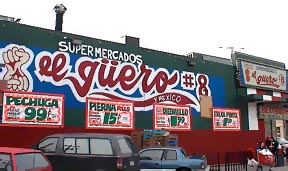
Guero Supermercado is an example of the thriving Mexican business community in Pilsen. Loosely translated the name means, "The White Guy Supermarket." Mexicans can be very blunt in commenting about racial and physical characteristics. However, nobody will question the cultural identity of the owner, the slogan over the door says, "Somos Mexicanos igual que Usted," which means, "We are Mexicans the same as you." |