 |
search engine here |
||
|
|||
FEASIBILITY OF FIXED SATELLITE
SERVICE AND LOCAL MULTIPOINT DISTRIBUTION SERVICE SHARING THE SAME
FREQUENCY BAND |
|
The Federal Communications Commission (FCC) is in the midst of a rule-making procedure that
may have a far-reaching effect on the future of Ka-band satellite services. In December 1992,
the FCC issued a Notice of Proposed Rule Making that proposed redesignating the 27.5- to
29.5-GHz band (referred to as the 28-GHz band) from fixed, point-to-point services to a new
local multipoint distribution service (LMDS). LMDS is a proposed terrestrial wireless communication service primarily directed at video distribution over small cells. LMDS proponents anticipate that the service would provide cost-effective competition to cable television systems in urban areas. The 27.5- to 29.5-GHz band also is allocated both domestically and internationally on a primary basis to the Fixed Satellite Service (FSS), and it is currently being used by the NASA Lewis Research Center's Advanced Communications Technology Satellite (ACTS) for uplink transmissions. Seventeen U.S. companies have now filed for commercial satellite communications systems that would utilize the band for uplink and/or feeder link operations. At the time that the FCC released the Notice of Proposed Rule Making on LMDS for comment, the satellite industry was embroiled in the Mobile Satellite Service (MSS) Above 1 GHz Negotiated Rule Making. NASA responded to the Notice of Proposed Rule Making and filed the first discussion regarding the potential for interference between Fixed Satellite Service and LMDS services. (The figure depicts interference paths between these two services.) NASA sensitized the satellite community to the LMDS issues which resulted in further industry opposition to the FCC proposal, citing the inability for future satellite systems to share the 28-GHz band on a cofrequency basis with proposed LMDS systems.
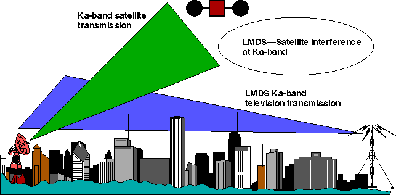
Interference scenario between Local Multipoint Distribution Service Lewis' Space Electronics Division personnel made significant analytical and experimental contributions to the work of the committee. Despite 60 days of concerted effort by the committee, no sharing solution was found. The primary interference issue centers around the inability to collocate Fixed Satellite Service uplink terminals within reasonable separation distances from LMDS subscriber receivers, and the proposed ubiquitous deployment of Fixed Satellite Service terminals and LMDS receivers within the same service areas. In an effort to reach a compromise solution that would allow both satellite and LMDS services in the band, the FCC now appears ready to propose segmenting the band. Several segmentation proposals have been filed with the FCC from both satellite and LMDS proponents. These proposals generally satisfy the minimum spectrum requirements of all interests who have filed to date with the FCC for LMDS and satellite systems. The long-term consequences of such a compromise, however, may have a far-reaching and lasting effect on the satellite industry and the future services that it can offer. Limiting the primary spectrum available for satellite services in the 27.5- to 29.5-GHz band will potentially impede the growth of the satellite industry, reduce competition among satellite providers, and preclude future service opportunities yet to be identified. NASA continues to work with the satellite industry to achieve an outcome that will not hinder the growth potential for Ka-band satellite systems.
|
courtesy of Lewis |
A Personal initiative of the author Engr.Jolan P. Formalejo.