|
|---|
| Home | History | Government | Education | Geography |
|---|
 |
The education system in Switzerland is very diverse, because the constitution of Switzerland delegates the authority for the school system to the cantons (Article 62). The Swiss constitution sets the foundations, namely that primary school is obligatory for every child and is free in public schools and that the confederation can run or support universities. The Swiss maintain a high standard for education that is world renowned. Because of its diversity, there are many private international schools in Switzerland that encourage respect for all cultures. Diversification of the education system in 26 cantons is viewed by many as being inefficient. Consequently, the Swiss people have voted on May 21 , 2006 to reform the education system in one common program for all the cantons. The Programme for International Student Assessment , coordinated by the OECD , currently ranks the Swiss education as the 16th best in the world, being significantly higher than the OECD average. Primary The obligatory school system usually includes primary education ( Primarschule in German , école primaire in French and scuola primaria in Italian ) and secondary education I ( Sekundarstufe I in German, secondaire I in French and scuola secondaria in Italian). Before that, children usually go to kindergarten . The minimum age for primary school is about six years in all cantons but Obwalden , where it is five years and three months. The cantons Thurgau and Nidwalden allow five year olds to start primary school in exceptional cases. Primary school continues until grade four or five, depending on the school. Any boy or girl can take part in school if they choose to, but kids are separated depending on whether they speak French, German or Italian. Secondary At the end of primary school (or at the beginning of secondary school), pupils are separated according to their capacities in several (often three) sections. The best students are taught advanced classes to be prepared for further studies and the matura , while students who assimilate a little bit more slowly receive an education more adapted to their needs. This separation can be summarized as follows:
The purpose of this system is to give every student an education that fits his or her needs and interests, but it is also criticized because it segregates children based on intellectual capacity. Secondary I school continues until grade nine, which marks the end of compulsory school. Tertiary Tertiary education depends on the education chosen in secondary education. For students with a matura, university is the most common one. Apprentices who did a vocational high school will often add a Fachhochschule or a Höhere Fachschule to their curriculum. Switzerland has the second highest rate of foreign students in tertiary education, after Australia . There are 14 Universities in Switzerland, 10 of which are maintained at cantonal level and usually offer a range of non-technical subjects. Most prominent of these, internationally, are the Universität Zürich and the Universität St. Gallen . The remaining 2 institutions are run by the Swiss Confederation and are known as "Swiss Federal Institutes of Technology". Of these the Eidgenössische Technische Hochschule Zürich (ETHZ) is renowned as a world leader in Science and Technology education and research. 2 Universities are run privatly but accredited by Cantones.
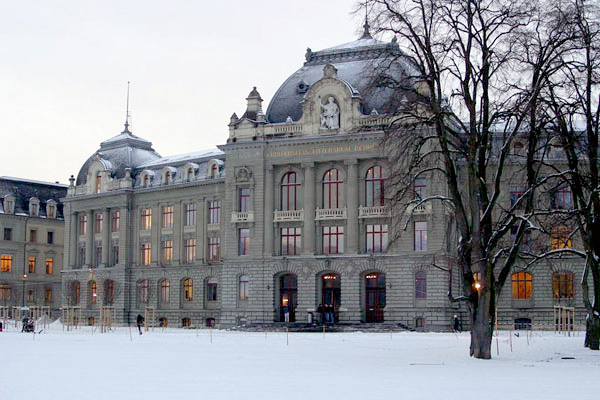
University of Bern
|