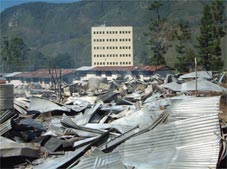
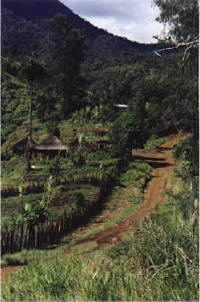
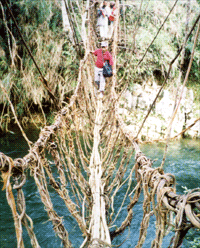
Southern Highlands is a foreseable land of lush, with waging high valleys rich in tribal culture and traditional magic. It is the home of the inrternationally known Huli Wigmen then called the "Papuan Wonderland" by the early Explorers when they first landed in the Lavani valley in 1935. Located in the heart of the New Guinea mainland, it is made up of flat early ice-age plains, plateaus and lush valleys wedged between impressive limestone peaks.
It is one of the wonderful undiscovered sites in Papua New Guinea with Mt. Giluwe (the second highest mountain in Papua New Guinea) situated right across the merging boarders with Western Highlands. Built below limestone peaks, the small town of Mendi is the provincial capital located at 5,600 feets above altitude, looked up by best white-water rafting Mendi and Magani Rivers. SHP is also known as "last Papua" and is one of the leading provinces supporting the country's economy with over 40% of the Gross Exports Income.
Yet SHP is one of the least developed provinces in Papua New Guinea with over 85% of its estimated 317 000 people still living on traditional shifting agriculture and domestic animal husbandry. Regarding transportation and efficiency in venturing, the only accessible route into SHP is by Highlands Highway from Mt.Hagen. Air access is also from Mt. Hagen with smaller third-level airlines [MAF, Southwest, AirLink] or by Air Niugini and PNG AirLines [formerly MBA] to Mendi or Tari from Port Moresby.
In spite of Nipa and Tari clans recent reputation as some of the fiercest uncivilized fighters in Papua New Guinea, Southern Highlanders are the skilled subsistence farmers largely dependent on sweet potato, greed vegetables, sugarcane and raise domestic animals like pigs for cash. Many [all] people are peace-loving and dare to uphold democracy with dignity as Papua New Guineans.
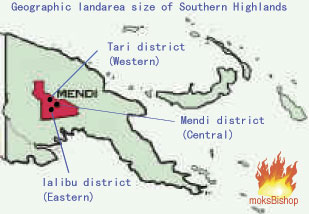
Souther Highlands is made up of three major zones (Eastern, Central and Western). The Central includes Mendi, Nipa, Kutubu; Western include Tari, Koroba, Lake Kopiago and the Eastern is made up of Ialibu/Pangia, Kagua and Imbounggu districts..The Kikori, Erave and Strictland Rivers cross the province beneath the towering Mt. Giluwe feeding the fertile mangroves of the Gulf waters of Papua. International caving expenditions have discovered caves of enormous depth and length where real men enters to meet the angry flying fox. South of Mendi town, the provincial capital is reknown Lake Kutubu at a much lower altitude (1,400m.asl).
In Kutubu area, crude oil and minor gases are produced from Iagifu and natural gas from Hides fields. Around Kutubu and Tari live the famous Huli and Duna wigmen, where women normally wear black for wedding and coat themselves with blue-gray clay when mourning. Clans in the Southern Highlands have a strong and intricate social system little affected by change. It is one of the few places where the traditional way of life can be seen in everyday living. Ceremonial rituals are strongly observed, where young men who obscure them are verbally casted out by village elders in a manner to advice and teaching. Men and women can still be seen in traditionl dress, tending their gadrens and pigs ( a trademark of wealth) , and building their bush material huts.
Visitors to the tribal wonderland of the Southern Highlands can stay in a variety of accommodation from basic guesthouse to luxurious cold mountain lodges. Such hospitality include the famous Ambua Lodge in the Tari basin, Kiburu lodge and Muruk Lodge within the vicinity of Mendi town. Other smaller and cheaper comfortable faces include the Luthern Guesthouse (along northkagua road) and Menduli Guesthouse within short distances of walk from the airport exit hall. People around Mendi speak the "Mendi language" ,English within the public workforce and Pidgin English outside bureaucracy by everyone. |