is the three hebrew letters Bet, Samech, and Daled. It is an abbreviation for b'siyata d'shmaya, which translates loosely to "with the grace of God".
We have placed this on our website to show respect for God and to demonstrate our awareness of God's presence.
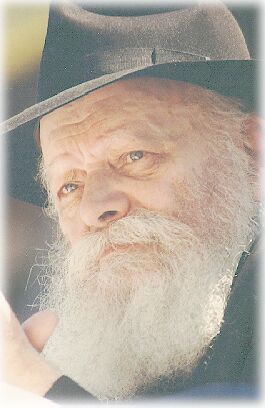
Click on image enlarge to see the face of a GREAT MAN
| Last update: 17/09/02 6:03:30 AM Rabbi Zalman Marazov's Messages Do Change |
| DIRECTORY
| bs"d. Tuesday, Tishrei 19, 5763 / September 25, 2002 Our sages say that rain during Sukkot is not a good sign. The Talmud compares rain during Sukkot to a servant who brings a glass of water to his master and the master throws it back in his face. Obviously this shows the master's displeasure. So too, rain when we are commanded to sit in the Sukkah, shows G-d's "displeasure" with our service. I hope and pray that we can take this year's beautiful Sukkot weather as a sign from heaven that G-d is indeed "pleased" with our service. In relating the story of the Exodus, the Torah tells us that the first place the Jewish people camped after being liberated was called Sukkot. Normally, the journey to Sukkot would take one person three days. However, G-d performed a miracle and over a million people, including children, arrived in Sukkot the same day they left Eypt. In Sukkot G-d sent Clouds to accompany the Jewish people throughout their 40-year journey in the desert. The Clouds protected them from cold and heat, cleaned their clothes and served many other functions. The Sukkot we build today commemorate the miracle of the Clouds. Q. If the Sukkah recalls the clouds which happened at the Exodus of Egypt, why don't we perform this mitzvah of dwelling in the Sukkah on Passover, when we celebrate the exodus? A. Our sgaes explain this as follows: When performing a mitzvah it is important to show that we do it for the sake of the mitzvah - i.e. for G-d's sake. Had we sat in the Sukkah in the spring, when the weather in Israel is nice and warm, a time when people spend more time outdoors, it would not be obvious that we are doing this act for the sake of the mitzvah. G-d gave us the mitzvah of Sukkot in the fall, when people normally go back into the home. This way it is clear that we are doing the act of sitting in the Sukkah-booth for the sake of a mitzvah. In addition to the mitzvah to dwell (e.g. to eat, study, and even, according to many, sleep) in the Sukkah, we also have a mitzvah to bless the "Four Kinds" each day of Sukkot (except Shabbat). The Torah commands, "And you shall take to you on the first day the fruit of goodly trees (Etrog), branches of palm trees (Lulav), and branches of thick trees (Hadasim) and willows of the brook (Aravot), and you shall rejoice before the L-rd your G-d seven days..." The Lulav, the three Hadasim and two Aravot which are bound together are held in the right hand, the Etrog in the left hand. We recite the special blessing, then we bring the four species together and gently wave them. One of the reasons given for this mitzvah is found in the Midrash. According to the Midrash the four species represent the four categories of the Jewish nation. The Etrog (citrus), which has a taste and fragrance, represents the Jew who is both a scholar in Torah and devout in the performance of mitzvot. The Lulav represents the Jew who excels in Torah, while the Hadasim represent Jews who excel in the performance of mitzvot. The Aravot (willow) which has neither taste nor fragrance represents Jews who, for one reason or another, have yet to reach the point of excelling in either Torah or mitzvot. Performing the mitzvah of joining the four species illustrates the concept of Jewish unity - that we are all together and in need of each other. For even if the Arava, the simplest Jew, is left out, we cannot fulfill the mitzvah. HAVE A VERY GOOD, HAPPY, HEALTHY AND SUCCESSFUL DAY ************************************ Mailing address: TorahFax TorahFax Web Page at: www.torahfax.net ************************************
|


 Shabbat Mitzva
 Baal Shem Tov
 Lounge