


The holiday of Pesach (Passover) is known by a variety of names. It is
called: 1. "Chag HaMatzot" - "Holiday of Matzot"; 2. "Chag Ha-Pesach" -
"Holiday of Pesach"; 3. "Chag Ha-Aviv" - "Holiday of Spring; 3. "Z'man
Cheiruteinu" - "Season of our Freedom".
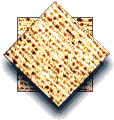
1. "Chag HaMatzot" - Holiday of Matzot. In the Torah the holiday is called
Chag HaMatzot since we are commanded to eat matzah at the Seder and also
during the rest of the holiday we are prohibited to eat bread ("Chametz")
only matzah.
2. "Chag Ha-Pesach" - Holiday of Pesach. We call the holiday "Pesach"
which means "pass-over." It recalls the time when G-d passed over the
Jewish homes while afflicting the first-born of the Egyptians. During the
era of the Holy Temples, a special Passover sacrifice was offered Erev
Pesach and later eaten roasted at the Seder together with the matzah and
maror. The sacrifice was called "Korban Pesach."
3. "Chag Ha-Aviv" - Holiday of Spring. Pesach is always celebrated in the
spring. For this reason, our sages fixed seven leap years in every
nineteen year cycle. This adjusts the Hebrew-Lunar year (354 days) to
coincide with the solar year (365 days) so that Pesach will always occur in
the spring.
4. "Z'man Cheiruteinu" - Season of our Freedom. Pesach is the holiday of
the exodus from Egypt in which we attained our freedom.
Q. What is the reason that the Torah calls the holiday "Chag Ha-Matzot,"
yet we call it "Pesach?"
A. Rabbi Levi Yitschak of Barditchev explains it based on the verse in
Shir HaShirim (Song of Songs 6:3) where King Solomon says, "I am to my
beloved and my beloved is to me." This refers to the expression of love
between Israel and G-d, who love and praise each other.
"Jews call the holiday Pesach (pass-over)," says Rabbi Levi Yitzchak, "in
order to praise G-d and express our love to Him for sparing his people by
passing over their homes, when afflicting the first-born Egyptians in
Egypt. G-d calls the holiday Chag Ha-Matzot in order to praise the people
of Israel for their trust in Him, which is expressed through the Matzot.
For the Torah tells us that upon leaving Egypt, the people of Israel didn't
prepare food for the way, but immediately took their dough on their
shoulders and followed Moshe into the desert with complete faith that G-d
would continue to provide for all their needs." In fact, the Zohar calls
matzah "food of faith."
"Pesach" can be made into two words; Peh (mouth) Sach (to speak). This
reminds us that although the mitzvah of remembering the Exodus applies
"each day of your life" (Deut. 16:3), yet on Pesach, it is not enough to
only remember, but we must tell the story of the exodus and "speak" about
it at length.
We also call the holiday "Pesach" to express our great wish for the
ultimate redemption and the rebuilding of the Holy Temple, when we will
again be able to perform the mitzvah of eating the Korban Pesach - Pesach
lamb.
20/04/00 7:50:57 AM
[email protected]
http://www.netaxis.qc.ca/torahfax
