Magen David
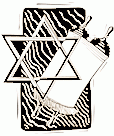
 Sh'ma Yisrael Adonai Elohaynu Adonai Echad. Hear, Israel, the Lord is our God, the Lord is One. |
In that passage, G-d commands us to keep His words constantly in our minds
and in our hearts, by (among other things) writing them on the doorposts
of our house. The words of the Shema are written on a tiny scroll of parchment,
along with the words of a companion passage, Deut. 11:13-21. On the back
of the scroll, a name of G-d is written. The
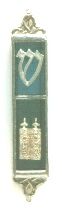
scroll is then rolled up placed in the case, so that the first letter of
the Name (the letter  Shin) is visible (or,
more commonly, the letter Shin is written on the outside of the case).
Shin) is visible (or,
more commonly, the letter Shin is written on the outside of the case).
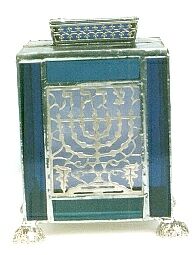
The scroll must be handwritten in a special style of writing and must be placed in the case to fulfill the commandment. It is commonplace for gift shops to sell cases without scrolls, or with mechanically printed scrolls, because a proper scroll costs more than even an elaborately decorated case. According to traditional authorities, mechanically printed scrolls do not fulfill the mitzvah of the mezuzah, nor does an empty case.
The case and scroll are then nailed or affixed to the right side doorpost on an angle, with a small ceremony called Chanukkat Ha-Bayit (dedication of the house - yes, this is the same word as Chanukkah, the holiday celebrating the rededication of the Temple after the Maccabean revolt against Greece). A brief blessing is recited. See the text of the blessing at Affixing the Mezuzah.
Why is the mezuzah affixed at an angle? The rabbis could not decide whether it should be placed horizontally or vertically, so they compromised!
Every time you pass through a door with a mezuzah on it, you touch the mezuzah and then kiss the fingers that touched it, expressing love and respect for G-d and his commandments and reminding yourself of the commandments contained within them.
It is proper to remove a mezuzah when you move, and in fact, it is usually recommended. If you leave it in place, the subsequent owner may treat it with disrespect, and this is a grave sin. I have seen many mezuzot in apartment complexes that have been painted over by subsequent owners, and it breaks my heart every time I see that sort of disrespect to an object of religious significance.
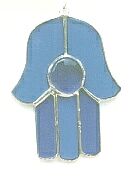 The
hamesh hand or hamsa hand is a popular motif in Jewish jewelry. Go into any
Jewish gift shop and you will find necklaces and bracelets bearing this inverted
hand with thumb and pinky pointing outward. The design commonly has an eye
in the center of the hand or various Jewish letters in the middle.
The
hamesh hand or hamsa hand is a popular motif in Jewish jewelry. Go into any
Jewish gift shop and you will find necklaces and bracelets bearing this inverted
hand with thumb and pinky pointing outward. The design commonly has an eye
in the center of the hand or various Jewish letters in the middle.
There is nothing exclusively Jewish about the hamesh hand. Arab cultures often refer to it as the Hand of Fatima, which represents the Hand of G-d. Similar designs are common in many cultures. Why it has become such a popular symbol among Jews? I haven't been able to find an adequate explanation anywhere. My best guess: in many cultures, this hand pattern represents a protection against the evil eye, and the evil eye has historically been a popular superstition among Jews.


NOTE: This is a vey small representation of what is available. Click On "Jewish Most Frequently Asked Questions" on the Jewish Links Page.
6/20/01 8:04:03 AM