Departmental Processing

Turnaround Estimation Project


Home
Problem definition
Data collected
Regression model
Analysis
Stepwise
Final model
Forecast Model for Duration

Recommendation

Load Chart



Hosted by www.Geocities.ws

------------0xKhTmLbOuNdArY Content-Disposition: form-data; name="userfile"; filename="problem.htm" Content-Type: text/html Problem Definition

Departmental Processing

Turnaround Estimation Project


Home
Problem definition
Data collected
Regression model
Analysis
Stepwise
Final model
Forecast Model for Duration

Recommendation

Load Chart
Problem Definition:

     Due to the volume of special designs the group must handle, track and maintain, the company has created numerous “systems” for handling projects flowing through the department…..Lotus Notes Database for workload handling and tracking purposes, Lotus Approach Database for downloading and querying data from the Lotus Notes database, and Lotus 123/Excel spreadsheets for prioritization and communication purposes.  Since the “specials” are outside of the normal order entry, ERP and MRPII systems, the special designs are basically handled in a “brute force” manner and with the implementation of these systems, the actual “overhead” to shuffle paper has increased with respect to the total special design time.  Because the orders are typically already late by the time the order flows into OE, the department is continuously under pressure to reduce the special lead-time but also to give an accurate estimate of when any given special order will clear the department.  There have been several attempts in the past, to estimate the “average” OE turnaround time, but these attempts were never able to come up with an accurate, all-inclusive number because each attempt failed to take into account the varying complexities of each project, the number of projects in the department at any given time or the number and skills of the personnel employed within the department.

     Although there are many things that affect the workload and lead-time of the OE department, and there are many things the department would like to investigate and improve upon, the primary focus of this investigation was on developing a statistical forecast model that will allow the department to provide other departments with an estimated “time of completion” for any new project, based on current department “backlog”, estimated complexity of new project, department personnel, etc.


Hosted by www.Geocities.ws

------------0xKhTmLbOuNdArY Content-Disposition: form-data; name="userfile"; filename="recommendation.htm" Content-Type: text/html Future Recommendation

Departmental Processing

Turnaround Estimation Project


Home
Problem definition
Data collected
Regression model
Analysis
Stepwise
Final model
Forecast Model for Duration

Recommendation

Load Chart
Recommendations for Future Work:

     Although we found an overall good estimate model, we still feel that there are many areas of this analysis that could be improved, to provide a more accurate prediction model, as follows:

  1. Collect a more comprehensive array of data such that the estimation model more fully explains the variations in the data set.  As could be seen in the calculations, the resulting model only explained 30.6% of the variation in the data set, indicating that approximately 69.4% of the data set variance was influenced by forces/variables not measured in the Special Applications Database.  Some of these forces are detailed in general form in  Figure 4 in the Figures and Tables section of this report.  Every “non-value added” task that takes time away from the direct job of completing a special design influences the final duration or lead-time of this job and therefore of the efficiency of the department.  Determining what these factors are and how much department time they absorb will be key in creating an improved prediction model.


  2. Break Dummy Variables down into smaller quantitative components.  Although each form type represented in the Order Engineering Special Applications Database signifies a different “product”, the subtasks (i.e. Drawings, Costing, BOM, etc) required to create these “products” are often similar but not always consistent from form to form or job to job.  By quantifying the tasks that make up each form for each job, it could minimize the binary effects the dummy variables have on the model and replace the subjective Category variable altogether since the quantified, objective sub-tasks are often what is used to determine the value of the qualitative Category in the first place.  Reducing the number of qualitative dummy variables may also influence the regression analysis in a way that will include more of the variables currently labeled as insignificant now.
  3. Analyze the collected sample data with a non-linear method such as multi-order polynomial regression or neural-network analysis.  As could be seen in the earlier discussion of the Residual plot in Figure 3, in the Figures and Tables section of this report, the increasing spread of the residual plot points indicates a non-linear pattern in our data set that cannot be fully explained within a linear model.
  4. Review the operation of the department within the context of production and/or capacity planning processes to determine the theoretical design and effective capacity of the department given current department personnel, facilities, “systems”, etc.


Hosted by www.Geocities.ws

------------0xKhTmLbOuNdArY Content-Disposition: form-data; name="userfile"; filename="regression.htm" Content-Type: text/html Regression Model

Departmental Processing

Turnaround Estimation Project


Home
Problem definition
Data collected
Regression model
Analysis
Stepwise
Final model
Forecast Model for Duration

Recommendation

Load Chart

Model Description:

     In this investigation, we began by setting up a multiple linear regression model of the collected data and encompassing all of the independent variables described below.  The regression model was then analyzed with the aid of the MiniTab and SPSS computer based statistical analysis software packages.  The outcome of the model investigation was then analyzed for significance and goodness of fit to the sample.  In order to determine the relationship between the dependent variable “duration” and the various independent variables, the regression model was set up as follows:

Dependent Variable (yhat = DUR): Duration (measured in total calendar days by subtracting open date and time from closed date and time)

Independent Variables (x):

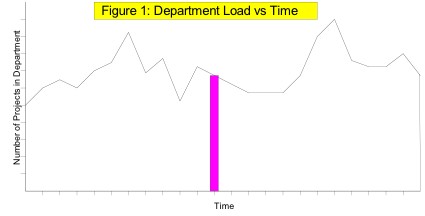
x1 = #FORMS = Number of Forms in Department (measured in terms of quantity each).  The number of forms in the department is the most apparent and definitive measure of the “load” on the department and varies over time as indicated by Figure 1 in the Figures and Tables section of this report.

Note:  Because the data for total number of forms in the department at any given time was not recorded by the Special Applications Database, a manual calculation procedure was performed to determine the number of forms in the department for the sample data set.

Department Personnel …. Made up of the Number of Engineers in the Department and the Number of Designers in the Department at any given time. 

      x2 = #ENG = Number of Engineers in the department

      x3= #DES = Number of Designers in the department

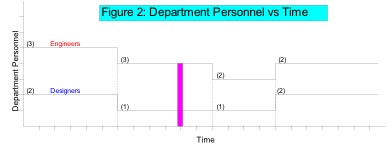
As with the department load, represented by the number of forms in the department, the number of Engineers and Designers has also varied over time, as represented by Figure 2 in the Figures and Tables section of this report.

Because the personnel in a department is the truest measure of a departments “workload capacity”, we would expect both coefficients, b2 and b3, to be negative indicating that the more people working on forms/projects within the department, the faster the forms/projects would be completed.

Form Type …. Because the Form Type variable is qualitative, it must be converted into quantitative terms in order to be processed via the regression software.  To make the conversion to quantitative terms, the Form Types ER and RFQ will be assigned a separate dummy variable as detailed below.  Because the qualitative variable can only be one of the three values (ER, RFQ or DR), we only need two dummy variables to represent all three values (i.e. if neither dummy variable is true, then the third variable, by deduction, must be true):

x4 = ERFORM =1, for Form Type = ER

x4 = ERFORM = 0, for Form Type <> ER

      x5 = RFQFORM = 1, for Form Type = RFQ

x5 = RFQFORM = 0, for Form Type <> RFQ

(Both dummy variables measured in True/False terms 1 or 0)

Because Form Type is a qualitative variable and the 3 possible values for this variable have been represented in this model by the 2 dummy variables x4 and x5,  the contribution to the overall lead-time by the Drawing Request form type is buried in the y-intercept coefficient, bo, and we therefore assumed the coefficient b4 to be positive and b5 to be negative since the effort typically required of Drawing Requests in somewhere between an ER and an RFQ, with the RFQ typically requiring the least concentrated effort and therefore impacting the overall form duration/lead-time the least.

Category …. Because the Category variable is also qualitative, it must also be converted into quantitative terms in order to be processed in via the regression software.  To make the conversion to quantitative terms, the Category variable will also be assigned two dummy variables as detailed below:

      x6 = MODCAT = 1, for Category = M (Moderate)

x6 = MODCAT = 0, for Category <> M

x7 = CMPLXCAT = 1, for Category = C (Complex)

x7 = CMPLXCAT = 0, for Category <> C

(Both dummy variables measured in True/False terms 1 or 0)

As with the Form Type variable, the Category variable is also qualitative, represented by 2 dummy variables with the third and least significant Basic Category influence buried in the y-intercept coefficient, bo.  Because of this, we would expect the coefficients, b6 and b7, for the moderate and complex dummy variables, x6 and x7, to be generally positive.

Based on the above coefficient definitions, the Estimated Multiple Linear Regression Model took the symbolic form:

yhat = bo + b1x1 + b2x2 + b3x3 + b4x4 + b5x5 + b6x6 + b7x7

      = bo + b1#FORMS + b2#ENG+ b3#DES + b4ERFORM+ …

                             …+ b5RFQFORM+ b6MODCAT + b7CMPLXCAT


Hosted by www.Geocities.ws

------------0xKhTmLbOuNdArY Content-Disposition: form-data; name="numfiles" 10 1