| Warwick University's Guide to all things Darts: |
|
|
|
Chapter 1 - The Basics of Throwing a Dart
Objects of Desire
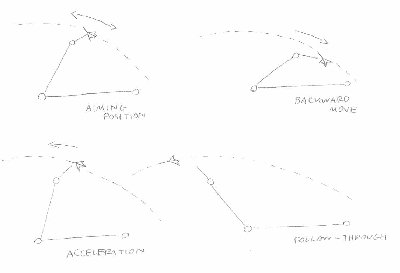
The dart: The real object of desire is at last here. Remember to guide the dart along the parabolic
curve. Keep your attention on the following things:
- The dart is pointed up in the aiming position.
- This angle is increased in the backward movement, and it then decrease steadily in the
- acceleration part.
- When the dart is released it is virtually horizontal, but there is still a bit of an angle.
- In all circumstances a dart that points down in ANY of the throwing phases is bad. Bad, bad,
BAD! So try not to do it.
Wobble: Almost every beginner's dart wobbles considerably, while pro's and experts' darts hardly
ever wobble. Wobbling can have the following reasons:
- The dart is accelerated in a curve that's rather anything else than parabolic.
- The dart's flight-shaft system does not meet the aerodynamic requirements. Use
standard form flights and middle length shafts for first-time trouble shooting and go from
there - see chapter 2 'Darts Tuning'.
- Somewhere in your throw there is a noticeable 'twitch' of the arm.
- Most probable: the dart points downwards somewhere in your throw.
- Highly unlikely: The dart points upwards too much.
|