"Collector's Choice: Rugs and Textiles
as Art."
On November 5th through the 20th of 2005,
the Philadelphia Rug and Textile Society held it's first-ever
public exhibit at Material Culture located at 4700 Wissahickon
Ave, Philadelphia, PA. The following is the original copy
of the advanced notice publicizing this sale, followed by a review
authored by Thoedore Mast that was published in HALI magazine.
"As part of the Philadelphia Rug and Textile Society's effort
to help promote a greater understanding and appreciation of antique
rugs and textiles, the public is invited to attend this first-ever
public exhibit showcasing some of the most interesting pieces
drawn entirely from the private collections of our members. On
display will be antique rugs and textiles from a diverse range
of weaving regions and formats. This exhibit will challege many
of your convential perceptions of rugs and textiles. Don't expect
to find any modern machine-made carpets on display here, think
instead of only antique weavings that have significant ethnographic
importance. Many are among the best of their type or region. All
were made by hand from all-natural materials by long-ago-forgotten
nomadic weavers. Many were never intended to be used for gracing
a floor, rather, they were made for far more utilitarian purposes
such as: door coverings or grain bags. Virtually all will challenge
your convential belief of seeing rugs as mere decorative floor
coverings. The pieces presented for exhibit here strongly suggest
that they should be treated as objects of art that need to be
appreciated on their own merit.
This exhibit is organized to appeal to
both the casual and avid admirer of antique rugs and textiles.
Don't worry if you don't know the difference between a torba and
a mafrash or a cicim versus a jijim, the folks here are so enthusiastic
to chat about antique rugs that you will never feel put-off; all
are made to feel most welcomed. Rarely is the public offered an
opportunity like this to experience a collection of this caliber
of antique rugs and textiles in one venue. If you thought modern
art started sometime in the 20th century, you will need to reconsider
your previously accepted notions by seeing the graphical power
and use of color present in so many of these antique rugs and
textiles. To many people, this will be a truly eye-opening experience.
Highly recommended."
Here are a few images of some of the highlights
from the exhibit...
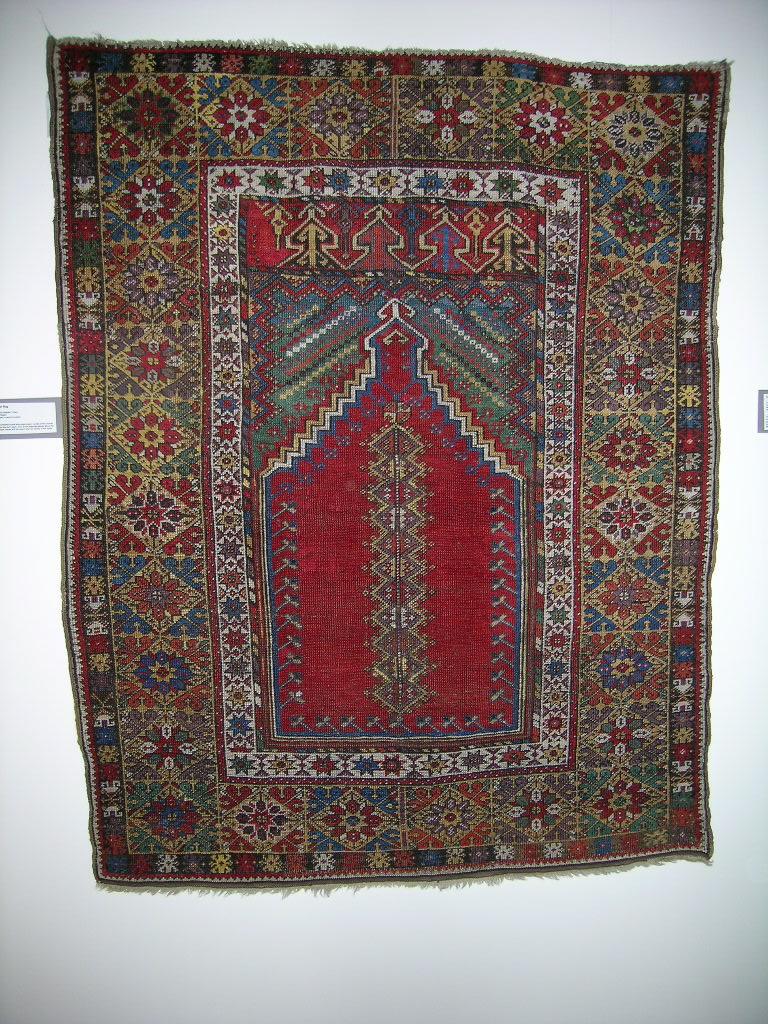
Mudjur prayer rug
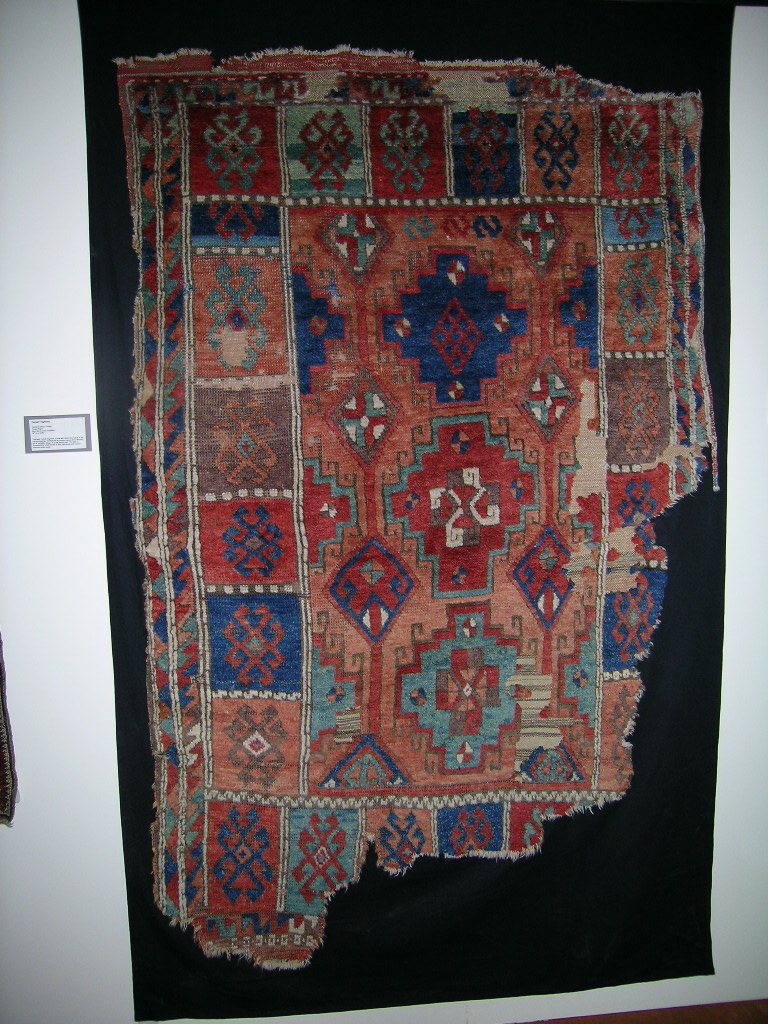
Konya fragment
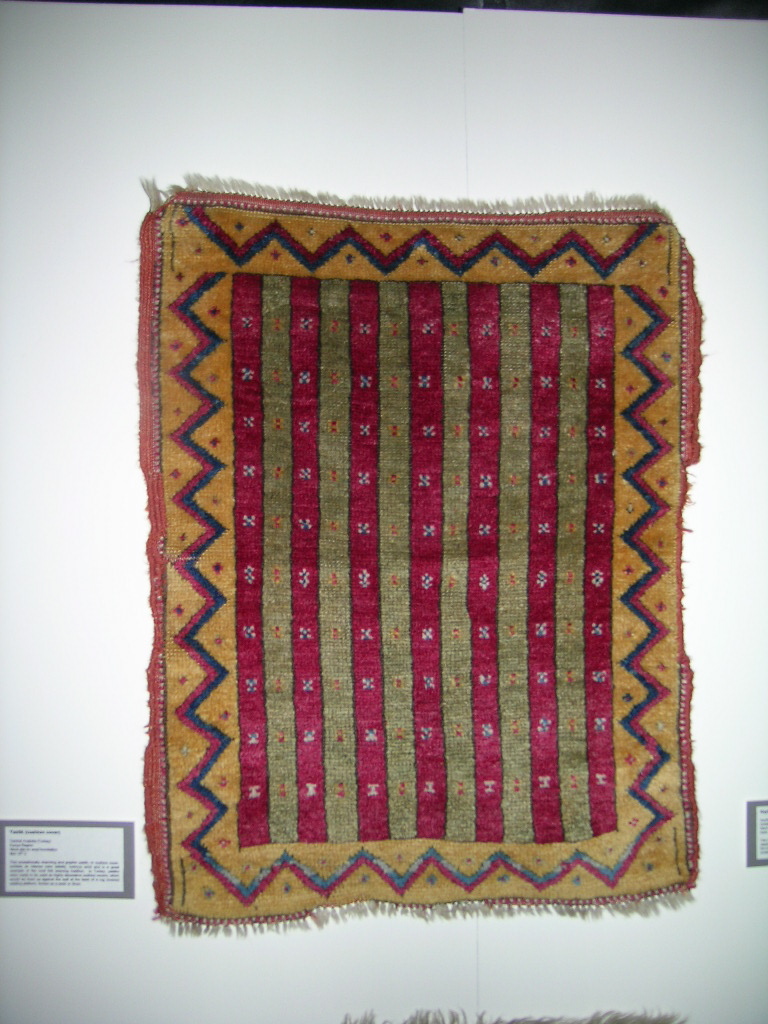
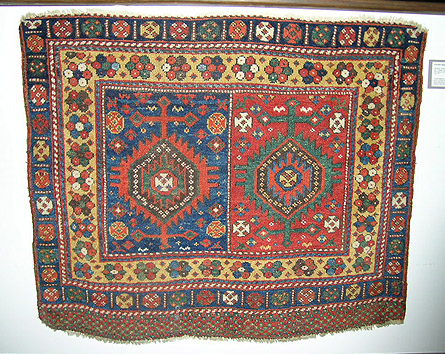
Kirshehir Yastik
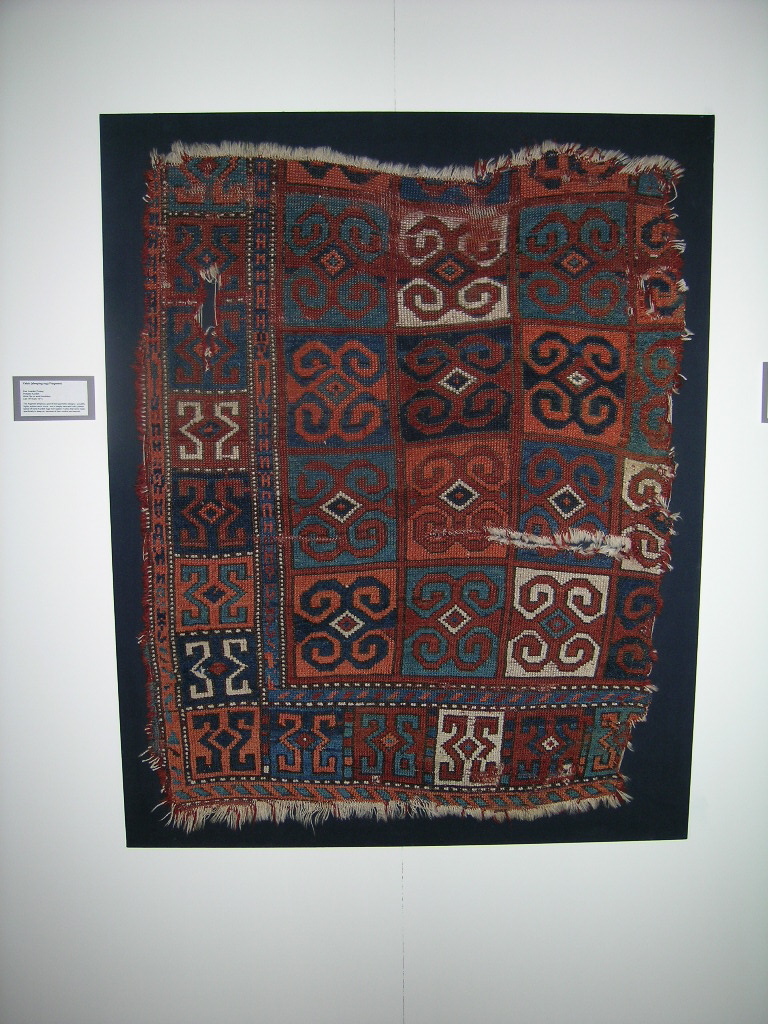
Eastern Anatolian fragment
Kurdish Bagface
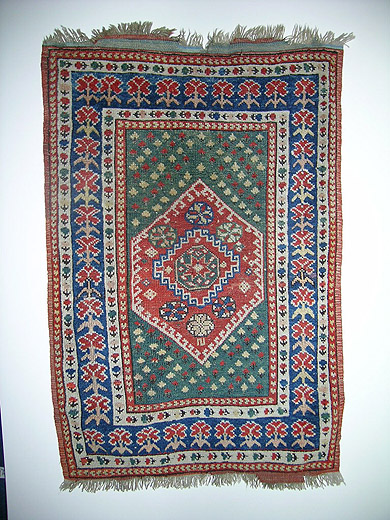
Mihalliccik Rug
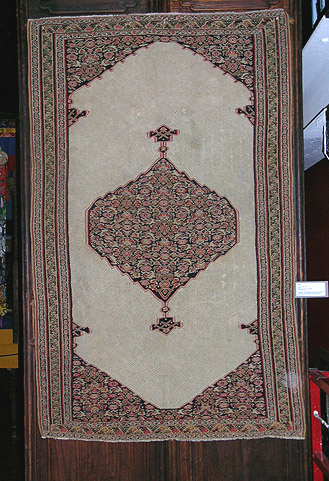
Senneh Kilim
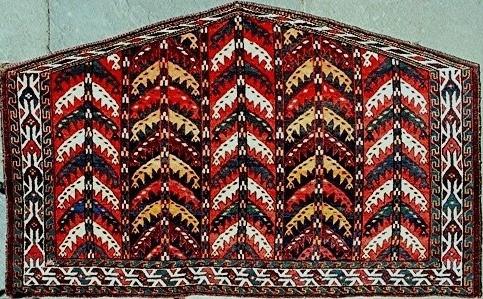
Yomut Tree Asmalyk
Turkoman Chirpy
Here is the review that appeared in HALI magazine.
Thursday, December 15, 2005
Over the past fifteen years, George Jevremovic has earned an enviable
reputation for, among other things, throwing memorable parties
of epic proportions. For many, the customary end-of-year party
is the highlight of the holiday season – an opportunity
to count your friends and share limitless conversations, libation
and food. This party marked the tenth anniversary of Material
Culture, George's cavernous (seventy thousand square feet) emporium
filled with handmade objects of unimaginable diversity, from Finnish
folk art to Mughal elephant gates.
Occasionally, when there is a need, George asks for affordable
donations, one hundred percent of which is given to the appropriate
organisations. This year, following the disastrous hurricane Katrina,
and the equally disastrous failure of federal government relief
efforts, the need was obvious and dire. This year the primary
recipient was Habitat for Humanity, to assist in their efforts
to rebuild homes in devastated areas. Other recipients this year
were Family Support Services (educational assistance) and the
Deprung Gomang Tibetan Monestary. A characteristic feature of
George's parties is food for thought in the form of lectures,
exhibitions or themes that promote intelligent conversation. Prior
to the party proper, there was a lecture, "Folk Potters of
the American South" by renowned folklorist Henry Glassie,
the focus of which was the "ugly jug" form, with exaggerated,
usually humorous facial features. They were traditionally whisky
jugs, but in modern times are primarily purchased by people who,
in the words of the late master potter Lanier Meader. "use
them as antiques". This lecture might seem to be tame fare
for what would be two hours hence a rip roaring party with three
live bands – Zydeco, Klezmer and African highlife –
but Dr Glassie, after many books and countless lectures, has achieved
near legendary status for his profound insight and ability to
express it in plain words (see HALI 76, p.117, for a review of
his Traditional Turkish Art Today).
Members of the Philadelphia Rug and Textile Society mounted an
ambitious juried exhibition for this event (and remained up for
the following 2 weeks) that showed the public what types of antique
rugs, trappings and textiles are presently of interest to regional
collectors. The quality was high and the range impressive, but
with forty or so pieces in limited space, the exhibition was dense
to the point of being a virtual padded cell for incorrigible rug
addicts. Tribal and village material prevailed, but fashion should
never deny art, and there were outstanding city pieces as well.
An exemplary Sarouk "meditation" rug, so-called because
its vase-of-flowers composition presents direction, but without
a mihrab does not quite transcend to prayer level. Nearby and
not to be missed (or dismissed) was a fine ivory ground Senneh
kilim, a masterpiece of a type infrequently seen by budding collectors.
Turkish material included a previously unpublished 18th century
konya fragment with Memling guls, an unusual small Mihalacik rug,
and a couple of perennially popular prayer rugs.
Highlights of tribal weaving included a pristine Yomut asmylyk
with radiant colours, and a mid-19th century baluch rug with typical
field of bird forms but in near pastel shades. Rarest among Caucasian
rugs was a beautiful sumakh runner with palmettes on a teal ground
within Zeikhur borders, probably circa 1875. If there was a discernible
theme, it was how much this particular rug society has matured
and grown since its inception in 1999, largely due to the tireless
enthusiasm and event planning of its present president, Samy Rabinovic.
Stepping out of the rug exhibition, further along the upper corridor,
there was a live exhibition, ‘Beautiful Impermenance: Art
of the Tibetan Sand Mandala’, in which monks created an
image of nearly incomprehensible beauty from coloured sand that,
among infinite interpretations, reminded collectors that they
are far more ephemeral than the objects they collect. Fortunately
for those unable to come to grips with this, there were numerous
open bars throughout the party.
Two important contemporary artists were in attendance along with
substantial exhibitions of their works: Price Twins Seven-Seven
and Mr Imagination. Both, for better or worse, labelled "outsider"
artists, both undeniably visionary, self-taught and internationally
recognised. Nigerian born Price Twins Seven-Seven is a painter
and musician ostensibly rooted in Yoroban culture, but his works
are personal interpretations of a cosmology where the unified
field theory is fact – schools of fish or herds of animals
collectively morph into humans and even entire civilisations,
and people in turn emerge as plants or phantasmagoric tribal entities
that defy written or verbal description but hang in major museums.
The sculptures of Mr Imagination are constructed from reclaimed
or found materials in which he senses a measure of energy that
assists in empathetic reconfiguration. Old paint brushes and bits
of costume jewellery are anthropomorphised to the point that they
radiate humour and hopefulness. Sticks become sceptres topped
with faces that emanate innocence and dignity. His technique of
"weaving" bottlecaps yields unexpected objects: fish
so lifelike in form and motion that they hint at being replicant-hybrids
and the enormous and surprising bottlecap thrones are so meticulously
wrought as to make viewers wonder whether the King of Beers was
a real monarch.
Sceptics may dismiss these parties as elaborate advertising or
sales efforts, but after basic calculations, will realise that
the cost of such events far exceed any income produced. Regarding
New Orleans, at least, a party seemed the appropriate form of
fundraiser. In the end, the theme of this memorable and splendid
evening was that to give is also to receive, except in this case
it was literal – each guest received a voucher that assured
the amount of their donations would be deducted (or pay for) future
purchases. In the time when we must realise that government bureaucracies
may not be able to provide relief, the organisers of this event
are to be commended for their efforts, and we hope other businesses
close to our interest will follow in kind.
Theodore Mast