Foreign
Features
Following
history's footsteps in the Holy Land
As Israel and its neighbors
continue to take halting steps toward peace, the country is attracting
more visitors eager to see places that have inspired devotees
of three of the world's great religions.
Jarunee Taemsamran
When I told people I was planning to visit Israel, a few eyebrows
were raised. My mother tried to persuade me not to go; friends
warned me to be careful.
At
the time, the country was still reeling from the assassination
of Prime Minister Yitzhak Rabin, and there was concern about the
fragile peace process. Would if be safe.
But
life is a journey and the journey is life, I told myself. Don't
believe what you hear unless you see it.
I
was one of the six journalists who joined to trip co-hosted by
the Ministry of Tourism and El Al Israel Airlines, the national
flag carrier.
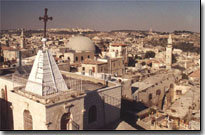 Israeli
time is five hours behind Thailand, but after we landed at Ben
Gurion Airport in Tel Aviv, I felt as if we had taken a time machine
back 4,000 years, so rich in history is the Jewish state. Israeli
time is five hours behind Thailand, but after we landed at Ben
Gurion Airport in Tel Aviv, I felt as if we had taken a time machine
back 4,000 years, so rich in history is the Jewish state.
From
the airport, we drove for half and hour and had lunch at a fish
restaurant in Jaffa port, one of the world's oldest.
Our
tour leader, Dalia Lipshitz, said Jaffa had existed for 4,000
years and had served sailors since the time of the ancient Egyptians.
It is believed to be the only port in the world that has been
inhabited continuously throughout its existence.
Jaffa
port has been an integral part of Tel Aviv, Israel's second largest
city, since the day it was liberated during the War of Independence.
There we could see the sea splashing against the old walls, small
fishing boats moored to the piers, calmly rising and falling with
the tide amid the chill wind of January. The scene offered a hint
of more historical sites to come.
Just
one-fifth the size of Thailand, Israel is surrounded by Arab nations
and at the crossroads of three continents-Asia, Europe and Africa.
It is home to more than five million people, most of them Jews.
It
is very much immigrant country, since the state's policy is to
embrace Jews from all corners of the world. To them it has long
been known as the "Promised Land."
Judaism
traces its roots back some 4,000 years to the story of Abraham,
who made of promise to God that he would follow his teachings.
In return, God promised Abraham and his descendants the land were
Israeli now lies.
To
other major faiths-Christianity and Muslim-also had their origins
in the Middle East, and to this day Israel and its many sacred
sites attract thousands of pilgrims annually-upto 25% of all visitors
to the state, according to tourism officials.
Visitors
who are not Jewish, Muslim or Christian may not experience the
same profound feelings when visiting these sites, but my own experience
proved that the journey back in history could bring its own pleasures.
To
get to all of the major sites around the country, visitors will
be constantly packing and unpacking their belongings. Most visits
will begin in Jelusalem, the capital city, where religious and
archeological sites of different ages are especially rich.
Jelusalem
is divided into and Old City and a New City, we saw modern structures
nestled beside many ancient buildings. What they all had in common,
though, were their natural brick colors.
We
had two days to get to know Jerusalem. Our guide led us on a walking
tour through the Old City, where the holy sites of three faiths
are to be found. We walked along the Via Dolorado (Road of Sorrows)
to the Church of the Holy Sepulchure, following the footsteps
of Jesus.
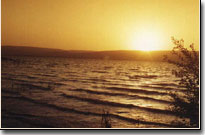 Along
the Via Dolorosa, which leads to the site where Jesus was crucified,
flagstones are arranged to indicate the 14 Stations of the Cross.
Each one marks a different stage in the suffering of Jesus as
he carried the heavy cross on which he would die. Ancient paving
stones are interspersed with newly cut Jerusalem stones, creating
a moving experience for Christian pilgrims. Along
the Via Dolorosa, which leads to the site where Jesus was crucified,
flagstones are arranged to indicate the 14 Stations of the Cross.
Each one marks a different stage in the suffering of Jesus as
he carried the heavy cross on which he would die. Ancient paving
stones are interspersed with newly cut Jerusalem stones, creating
a moving experience for Christian pilgrims.
As
the guide described the tribulations of Jesus at each stations
inside the Basilica of the Holy Sepulchure and in the Tomb of
Christ.
But
as we walked along this storied and holy route, we were also aware
of the very secular presence of the areas hustling, bustling commercial
market. From time to time our guide's explanations where almost
drowned out by the shouts of merchants seeking tourists to buy
their wares.
From
the Holy Sepulchure, we walked past the Jewish Quarter and the
Cardo and went to the Wailing Wall, one of the holiest sites of
the Jewish people. A huge crowd of worshippers had gathered, men
all on the left and women all on the right. As we moved closer
we saw many of the women praying, and some were weeping.
The
Wailing Wall or Western Wall is the only remaining part of the
Second Temple compound, where Jewish worshippers recall the tragedies
that befell their forbears in ancient times. Many people pray
and write messages on pieces of paper that they press into cracks
in wall, believing that God will hear their pleas.
The
six of us felt compelled to write down messages of our own and
place them in the wall, in the hope that God might take our wishes
into consideration.
It
may be hard for non-Jews to comprehend the depth of feeling Israelis
have for their lands. For historical context, a visit to Yad Vashem
is a must.
Yad
Vashem is the country's memorial to the martyrs of the Holocaust.
A walk through may bring to mind chilling scenes from the movie
Schindler's List, which depicts the massacre of some six million
Jews during Adolf Hitler's reign of terror in Europe.
Against
this background, it is easy to understand the powerful beliefs
that have shaped modern Israel.
To
understand more, Beth Hatefutsoth, the Jewish Diaspora Museum,
offers insights into how Jewish people survived centuries of hardship
and hatred. The history, traditions and heritage of Jewish people
around the world are brought to life in murals, reconstructions,
dioramas, audio visual displays, documentary films and interactive
multi-media presentations.
Separate
sections ranged from Family, Community, Faith, Among The Nations
(an instructive history of how the Jewish people have always adapted
to their environment) and Return to Zion.
As we followed the tour guide, we saw several big groups of young
people. The guide said most of them were new immigrants eager
to learn. "Nobody forces them to come here but they do it."
For
Muslims, the Dome of the Rock on the Temple Mount in the Old City
is a major religious pilgrimage site.
Israel
is also a haven for archeologists. Several continuing dig sites
can be found throughout the country. Among those worth a visit
is Caesarea National Park on the Mediteranean coast, site of the
most ancient theater found in Israel. This ancient site was the
largest fortified city in the country during the Byzantine period
toward the end of the sixth century A.D.
Other
interesting archaeological sites include the Bet She'an National
Park, excavations of the Roman-Byzantine city, and Akko, an ancient
Phoenecian crusader seaport.
Extensive
excavations are being conducted at many of these sites as part
of plans to develop more tourist attractions in the future.
Getting
There
El Al Israel Airlines operates flights from Bangkok to Tel Aviv
via Bombay three times a week: LY086 leaves every Wednesday at
12:20 a.m; and LY082 every Sunday at 12:10 a.m. For bookings,
call 249-8818-9 or 671-6145-7
|