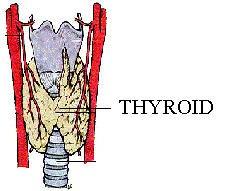
Thyroid gland
 |
Thyroid is a gland which lies at the front of the neck. |
|
|
It usually weighs about 30 g. |
|
|
It is made up of two lobes connected in the middle by a narrow connection. |
|
|
Each lobe is about 5 cm long, a maximum of 3 cm wide, and usually about 2 cm thick. |
|
|
The thyroid gland is slightly heavier in women than in men. |
|
|
It becomes bigger during pregnancy. |
|
|
The thyroid gland releases the hormone thyroxin directly into the blood, and is part of the endocrine system of ductless glands. |
|
|
The principal role of the thyroid gland is to regulate tissue metabolism through production of the thyroid hormones thyroxine (T4) and in smaller amounts Triiodothyronine (T3 ). |
|
|
In infants and children thyroid hormones are also needed for normal growth and development. |
|
|
Its removal greatly lessens the oxidative processes of the body. This causes a lower metabolic rate characteristic of hypothyroidism. |
|
|
The thyroid is activated by the pituitary thyrotrophic hormone. |
|
|
It needs iodine to make thyroxine. |
Hypothyroidism
 |
Hypothyroidism, a clinical state resulting from a deficiency of thyroid hormones due to decreased activity of the thyroid gland. |
|
|
Hypothyroidism is the most common disorder of thyroid function. |
|
|
It is reported to be more common in women than in men. |
|
|
In hypothyroidism, there is decreased production and secretion of the thyroid honnones by the thyroid gland. |
|
|
It is sometimes caused by surgical removal of all or part of the gland. |
|
|
An overdose of antithyroid medicine, decreased release of thyroid stimulating hormone by the pituitary gland, or atrophy of the thyroid gland itself can also be responsible. |
|
|
Weight gain, sluggishness, dryness of the skin, constipation, arthritis, and slowing of the processes of the body may occur. |
|
|
Untreated, hypothyroidism leads to severe facial swelling, coma, and death. |
|
|
Treatment is by giving the deficient hormone. Dosage is adjusted to maintain normal levels of thyroid hormones. |
Causes and Incidence
 |
The cause of some hypothyroidism is unknown but is thought to be autoimmune in origin. |
|
|
Other hypothyroidism is caused by destruction of thyroid or pituitary tissue by underlying disease, surgery, or radiation treatment. |
|
|
Hypothyroidism is a common disorder that affects all age groups. |
|
|
Women between 30 and 60 years of age are most often affected. |
|
|
It also occurs in approximately 1 of every 4,500 live births. |
|
|
The incidence is rising in the elderly population. |
Disease Process
 |
When the supply of thyroid hormone is inadequate, a general depression of most cellular enzyme systems and oxidative processes results, reducing the metabolic activity of the cells. |
|
|
This in turn reduces oxygen consumption, decreases energy production, and lessens body heat. |
|
|
Tissues are infiltrated by mucopolysaccharides, carotene is deposited in epidermal layers, adrenergic stimulation is decreased, protein effusion collects in the pericardial and pleural sacs, and proteinaceous ground substances are deposited in tissues. |
Symptoms
|
|
Signs and symptoms are often insidious in onset. |
|
|
They include fatigue and lethargy; mild weight gain; cold, pale, dry, rough hands and feet; reduced attention span with memory impairment, slowed speech, and loss of initiative; swelling in extremities and around the eyes, eyelids, and face; menstrual irregularities; muscle aches and weakness; joint aches and stiffness; clumsiness; hyperstiff reflexes; decreased pulse; decreased blood pressure; agitation; depression; and paranoia. |
Potential Complications
|
|
Myxedema coma is a life-threatening complication of hypothyroidism that requires immediate treatment. |
|
|
Other complications include ischemic heart disease, congestive failure, pleural and pericardial effusion, deafness, psychosis, and anemia. |
Diagnostic
Tests
|
|
Serum free triiodothyronine and thyroxine are decreased; |
|
|
Serum thyroid-stimulating hormone is increased in primary hypothyroidism and decreased in secondary hypothyroidism. |
Treatments
Surgery . None
Drugs
|
|
Oral replacement thyroid hormone; IV form is used for myxedemic coma |
|
|
General Lifelong monitoring; instruction about lifelong thyroid hormone replacement therapy and the importance of consistent and timely use |
Thyroid hormone
|
|
Thyroid hormone , thyronine, an iodine-containing compound released by the thyroid gland, mainly as thyroxine (T4), and in smaller amounts as four times more potent triiodothyronine (T3). |
|
|
These hormones increase the rate of processing, affect body temperature, regulate protein, fat, and carbohydrate catabolism in all cells. |
|
|
They keep up growth hormone release, skeletal maturation, and the heart rate, force, and output. |
|
|
They promote central nervous system growth, stimulate the making of many enzymes, and are necessary for muscle tone and vigor. |
|
|
All phases of the making and the release of T4 and T3 are regulated by the thyroid-stimulating hormone (TSH) released by the front pituitary gland. |
|
|
The production of thyroid hormones is too high in excess thyroid gland activity (hyperthyroidism) and related diseases. |
|
|
The production is too low in swelling of the face (myxedema), and absent in blocked development (cretinism). |
|
|
T4's normal 6 to 7-day half-life in blood is reduced to 3 or 4 days in hyperthyroidism and extended to 9 or 10 days in myxedema. |
|
|
T3 has a normal half-life of 2 days or less and, like T4, is used most actively in the liver. |
Hormone replacement therapy in hypothyroidism.
 |
Pharmaceutical preparations of thyroid hormones gotten from animal glands and the synthetic compounds levothyroxine sodium and liothyronine sodium are used as in patients with hypothyroidism. |
|
|
The dosage is initially low. |
|
|
It is slowly increased to the optimal level based on the patient's clinical response. |
|
|
Overdosage or a rapid increase in the dosage may result in signs of excess thyroid gland activity, as nervousness, tremor, rapid heart beat (tachycardia), irregular heartbeat (cardiac arrhythmia), and menstrual irregularity. |
Thyroid stimulating hormone (TSH)
|
|
Thyroid stimulating hormone (TSH), also called thyrotropin. A substance released by the front lobe of the pituitary gland. |
|
|
It controls the release of thyroid hormone and is necessary for the growth and function of the thyroid gland. |
Thyrotropin releasing hormone
|
|
Thyrotropin releasing hormone, thyroid releasing hormone, TSH releasing factor, also called thyrotropin releasing factor (TRF), TSH releasing factor. |
|
|
A substance of the hypothalamus that stimulates the release of thyrotropin (thyroid stimulating hormone) from the front pituitary gland. |
Myxedema,
The most severe form of decreased activity of the thryroid (hypothyroidism).
|
|
Signs include swelling of the hands, face, feet, and tissues around the eye. |
|
|
The disease may lead to coma and death. |
Thyroiditis
 |
Inflammation of the thyroid gland. |
|
|
Sudden thyroiditis is caused by infections. |
|
|
It is marked by pus and abscess formation. |
|
|
It may progress to the less sudden (subacute) disease of the gland. |
|
|
Subacute thyroiditis is marked by fever, weakness, sore throat, and a painfully large gland with tumorlike lumps of tissue (granulomas). |
|
|
Long-term lymphocytic thyroiditis (Hashimoto's disease) is marked by lymphocyte and plasma cell infiltration of the gland and by a larger gland. It seems to be carried as a dominant trait. It may be linked to some autoimmune disorders. |
|
|
Another long-term form of thyroiditis is Riedel's struma, a rare progressive formation of fibers (fibrosis) usually of one lobe of the gland but sometimes involving both lobes, the windpipe, and surrounding muscles, nerves, and blood vessels. |
|
|
Radiation thyroiditis occasionally occurs 7 to 10 days after the treatment of hyperthyroidism with radioactive iodine 131. |