Hypothyroidism can affect body systems and organs



Heart may be enlarged Increased Diastolic blood pressure Anaemia

Weak,stiff,aching muscles Dry skin, brittle nails Impaired linear growth occurs.


Decreased. intellectual functions Pleural effusion, sleep apnoea Decreased renal filt

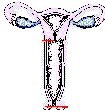

Constipation Decreased fertility Increased eye ball pressure
Hypothyroidism can affect all systems of the body, if not treated.
Cardiovascular system
 |
Cardiac output is reduced but peripheral vascular resistance is increased. |
|
Diastolic blood pressure may be increased and pulse pressure decreased. |
|
Heart may be enlarged and pericardial effusion may occur. |
|
Sinus bradycardia, low amplitude 'p' wave ST segment alterations may be obvious on the ECG |
|
Angina pectoris can occur rarely |
Central Nervous system
|
Deficiency in faetal /neonatal life leads to maldevelopment of CNS which is irreversible |
|
All intellectual functions are decreased. |
|
Lethargy, somonolence prevail. |
|
Headaches are frequent |
Skeletal system
|
Impaired linear growth occurs. |
|
Joint pain and stiffness |
|
In early life if hypothyroidism occurs epiphyseal dysgenesis is known to occur |
Muscular system
|
Stiffness and aching of muscles |
|
Slow muscle-stretch reflexes |
|
Muscle enlargement, or atrophy |
Gastrointestinal system
|
Appetite is decreased |
|
Gaseous distension of abdomen |
|
Constipation |
|
Rarely ascites is present |
|
Achlorhydria and pernicious anemia may be occasionally present |
Renal system
|
Decrease in GFR (Kidney Filtration Rate) |
|
Hyponatraemia |
Reproductive system
|
Sexual development may be arrested or it may be |
|
Decreased fertility or recurrent abortions |
|
In woman, decreased libido and anovulation are known to occur |
|
Menorrhagia, amenorrhoea |
|
In man there is decreased libido or impotence and/ or oligospermia. |
Skin
|
Myxedemotus appearance (thickened features and puffiness) due to accumulation of mucopoly- saccharides on dermis and other tissues |
|
Non-pitting edema, localised-around the eyes, on legs / Generalised. |
|
Enlarged tongue |
|
Dry, coarse icthyotic skin |
|
Hair-dry and brittle |
|
Loss of scalp hair and /or lateral eyebrow hair |
|
Nails-brittle-break easily and grow slowly |
|
In central hypothyroidism these changes are not seen. |
Haemopoetic system
|
Microcytic /macrocytic anaemia can occur |
|
Capillary fragility is seen |
Pituitary and adrenal
|
Longstanding hypothyroidism causes increase in size of the thyroid gland Hyperprolactinaemia can be present |
|
Increased turnover of cortisol |
Respiratory system
|
Pleural effusion may occur in hypothyroidism, |
|
Obstructive sleep apnoea is seen commonly |
OcularSystem
|
Increased intraocular pressure(pressure of eye balls) |
Metabolic system
|
Low metabolic rate |
|
Increased lipids cholesterol, LDL cholesterol, and triglycerides |