|

Exploring Housing Styles in Minneapolis
Page Three


Dutch Colonial - Early Gothic Revival - Eastlake.
- Dutch Colonial - The true Dutch Colonial
style was most likely to be found in New
Netherland (New York) and the Hudson River
valley as far north as Fort Orange (Albany).
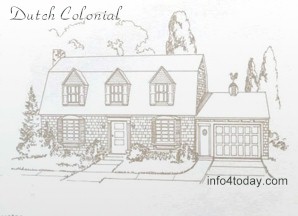 New Netherland was founded in 1625. This
style may have, itself, been influenced by
the settlers of New Sweden, earlier. Nobody
really knows for sure. New Netherland was founded in 1625. This
style may have, itself, been influenced by
the settlers of New Sweden, earlier. Nobody
really knows for sure.
- Today, the term "Dutch Colonial"
is often used to describe any home with a
gambrel roof. In New England, the term "English
Colonial" is sometimes used. The English version has a steeper-pitched
roof and does not curve or flare outward
as it descends to the top of the first floor.
The Dutch Colonial Revival period occurred
in 1890 to 1930 with adaptations of the style.
- Gothic Revival - Generally, these are two
or two-and-one-half-story houses
with steep
gable and gambrel roofs, substantial
"jig-saw'"decoration
as in the train station shown below.
The
Gothic Revivial house might even
have at
touch of stained-glass. Athough Gothic Revival was used for housing
around the year 1850, and then lost
popularity,
the Gothic Revival style was still
being
used for churches a hundred years
later.
 Note the simplified Gothic features of this
Southwest Community church: There are pointed and arched windows of stained
glass, a steeply-pitched roof (reminiscent
of slate), and the suggestion of
rib-like
flying buttresses on the sides of
the building. Note the simplified Gothic features of this
Southwest Community church: There are pointed and arched windows of stained
glass, a steeply-pitched roof (reminiscent
of slate), and the suggestion of
rib-like
flying buttresses on the sides of
the building.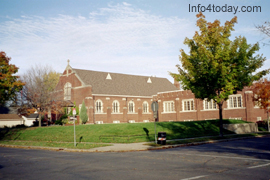
- Eastlake - Named for Charles Locke Eastlake
(1833-1906), a English furniture
designer
and architect.
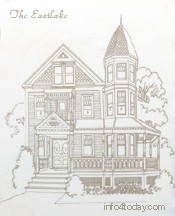 This style takes the Eastlake furniture
designs and applies them to spindles,
posts,
and railings: All of these items
were created
by power tools and applied to an
eclectic
assortment of houses. The Minnehaha Depot (1875), located in Minneapolis,
is known as "the Princess"
because
of the intricately-sawn decorative
work.
Steam-driven saws and lathes are used to
create the intricate railings, moldings,
and window trim. These decorations
are intended
to cast striking shadows under the
overhangs. Located along the route from Minneapolis
to Chicago, train passengers at the
Minneahaha
Depot enjoyed the convenience of
16 daily
departures. This style takes the Eastlake furniture
designs and applies them to spindles,
posts,
and railings: All of these items
were created
by power tools and applied to an
eclectic
assortment of houses. The Minnehaha Depot (1875), located in Minneapolis,
is known as "the Princess"
because
of the intricately-sawn decorative
work.
Steam-driven saws and lathes are used to
create the intricate railings, moldings,
and window trim. These decorations
are intended
to cast striking shadows under the
overhangs. Located along the route from Minneapolis
to Chicago, train passengers at the
Minneahaha
Depot enjoyed the convenience of
16 daily
departures.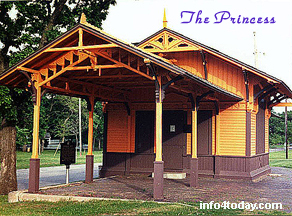
Click here to go to the next page.

Copyright, © 2005 Dave Malas |