 |
|
|
|
|
|
|
|
|
|
|
|
|
|
|
|
|
|
|
|
|
|
|
|
|
|
|
|
|
|
|
|
|
|
|
|
|
|
|
|
|
|
|
|
|
|
|
|
|
|
|
 |
|
|
|
|
|
Helping others to be born again
Now in the process of becoming born again as already described, the key element from a human perspective is what word from God shall we as Christians preach or communicate such that the listener will 'hear' and thus repent.
Whilst not diminishing the work of the Holy Spirit, of whom we are told that He will inspire us at the right times with the right words to say and the right actions to perform, and whilst also not diminishing the ability of the hearer to reject a word for them (as Jesus said "He who has ears to hear, let him hear"), we are able to examine the Scriptures to discern how the Holy Spirit acted on different occasions, thus discerning more effective from less effective ways of helping another person come to repentance.
Whilst the overall message to be preached is the good news that the Kingdom of God is here, and the kernel of the message to be communicated to all nations is repentance and forgiveness of sins in the name of Jesus because Christ died for our sins and was raised from the dead on the third day, this all, however, must be done in the context of how much the hearer already understands of the Gospel and what issues may be blocking that person from 'hearing' and thus believing the Gospel.
When we turn to the New Testament (NT) we can find a number of models of Gospel presentation, along with the 'results' of this preaching, to help us in our own day discern how to preach the Gospel. The following tables show us how the Gospel was preached pre- and post- Pentecost (being a succinct summary of the way Jesus and the apostles dealt with specific people groups):
|
|
|
|
|
|
|
|
|
|
|
|
|
|
|
|
|
|
|
|
|
|
|
|
|
|
|
|
|
|
|
|
|
|
|
|
|
|
|
|
|
|
|
|
|
|
|
|
|
|
|
|
|
|
|
|
|
|
|
|
|
|
|
|
|
|
|
|
|
|
|
|
|
|
|
|
|
|
These tables show us that Jesus and the apostles were lead by the Holy Spirit to preach according to how much the hearers already knew of the biblical meta-narrative, and to act in ways which would tangibly demonstrate the presence of the Kingdom. For example, note how in the above the Jews did not need it to be explained that the Messiah would be both Judge and Saviour, but that the Gentiles did need that aspect of the messianic mission explained. Furthermore, note that miracles were not done as 'show acts', but were rather demonstrations of compassion and responses to seeds of faith.
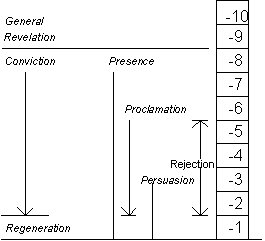
In the above we can also note the range of different responses depending on how much the hearers were truly God-fearing or not in their hearts, and that God seems to allow people time to change and grow in their outlook towards Him. This 'process of change' has been codified to some extent by James F. Engel:
|
|
|
|
|
|
|
|
|
|
|
|
|
Spiritual Decision Process
|
|
|
|
|
|
|
|
|
|
|
|
|
|
|
|
|
|
|
|
|
|
|
|
 |
|
|
|
|
|
-10 Awareness of the supernatural
-9 No effective knowledge of Christianity
-8 Initial awareness of Christianity
-7 Interest in Christianity
-6 Awareness of the basic facts of the Gospel
-5 Grasp of implications of the Gospel
-4 Positive attitude to the Gospel
-3 Awareness of personal need
-2 Challenge and decision to act
-1 Repentance, faith, baptism, Holy Spirit
|
|
|
|
|
|
|
|
|
|
|
|
|
|
|
|
 |
|
|
|
|
|
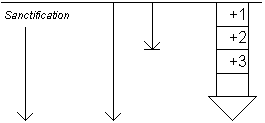
+1 Evaluation of decision
+2 Initiation into the church
+3 Become part of the process of making other disciples
+4 Ongoing Christian growth
|
|
|
|
|
|
|
|
|
|
|
|
|
|
|
|
Adapted from: "What's gone wrong with the harvest?" by James F. Engel and Wilbert Norton--Zondervan 1975
|
|
|
|
|
|
|
|
|
|
|
|
|
|
Combining all the above information, it seems that a good way to communicate the 'appropriate word of God' is to first of all assume nothing and be prepared to start at the bottom. Secondly, we must realize that it is not just what we say that will lead a person to repentance, but also our actions and lifestyle (as we noted earlier, when Jesus came to earth he had a holistic ministry - not only teaching but also modeling and living congruently to what He proclaimed). This can be done through what are Five Basic Evangelistic Steps in the context of a Spirit-Soul-Body Dynamic.
|
|
|
|
|