|
 Xerxes Coin:
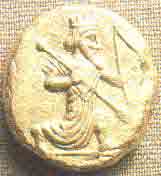
Xerxes (meaning
"ruler of heroes" although his real name was Ahasuerus)
was king of Persia from 486-465 BCE. He was son of Darius the Great
and Atossa, daugher of Cyrus the Great. During his reign he put down
uprisings in both Egypt and Babylon, but his efforts to invade Europe were
thrown back by Greece in 480. He was assassinated by his chief
minister, Artabarus, in 465 and succeeded by
his son Artaxerxes I.
Artaxerxes
continued building work at Persepolis. It was
completed during the reign of Artaxerxes III, around 338 BC.
In 334 BC,Alexander the Great defeated the Persian armies of the third
Darius. He marched into Iran and, once there, he turned his attention to
Persepolis, and that magnificent complex of buildings was burnt down.
This act of destruction for revenge of the Acropolis, was surprising from
one who prided himself on being a pupil of Aristotle. This was the
end of the Persian Empire.
Xerxes's Hall
of the 100 Columns is the most impressive building
in the complex. It is also the most crowded--a jumble of fallen columns,
column heads, and column bases.
Gate of Xerxes:
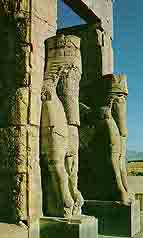
The Gate of
Xerxes at Perespolis shows that the Winged Lion was placed
at the corner of one entrance. When you stood in front of the gate you
saw a lion with four legs and when you were inside the gate you also
saw a lion with four legs.
WINGED
LION OF BABYLON:
Built in the
Near Middle East c. 600 BCE this style remained
popular through the Persian Empire.

Points To Ponder:
-- What is most
obviously powerful about this image?
-- Why would it have such a strange body? Why a beard?
-- Why does it seem to have five legs?
-- Can you tell what purpose this being served?
-- Does the shape and design of the carving suggest possible answers?
|

 Xerxes (Ruler of
Heroes), king of Persia (486-465 BC)
Xerxes (Ruler of
Heroes), king of Persia (486-465 BC)

