|
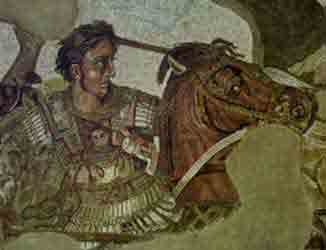
Alexander was born in Macedon,
a province of ancient Greece,
in 356 B.C. He seemed destined at a young age for power.
(For more information on Alexander's early life).He assumed the throne
of Macedon at the young age of twenty. At the age of twenty-two he
attacked and conquered the Greek-occupied portion of the Achaemenid
Empire,
unifying the territories and becoming the great king of Greece. He then
peacefully acquired most of Egypt and was made a pharaoh, which to
the Egyptians meant he was the son of a god,
therefore like a god himself.
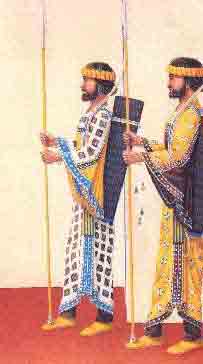
Alexander then set his sights on
Persia, possibly for reasons of
protection for Greece but mainly just for conquest. Any doubts
Alexander might have had about the success of his Persian campaign
were put to rest when he consulted the Oracle at Delphi, who told him,
"Thou art invincible, my son." He invaded Persia in the year of 334 B.C.
and quickly gained victory upon victory in war. Along the way he
exercised such faculties as sharp intellect, discernment, knowledge of
warfare and politics, and human nature. He treated his generals well and
commanded their respect. However in spite of being admired for his
generosity, mastery, and loyalty, he was feared for his terrible temper.
He once caught a traitorous lieutenant and cut off his ears and nose
before killing him. He even slew one of his most capable generals and a
loyal
friends, Cleitus, over a drunken misunderstanding.
Alexander
rapidly conquered Persia and declared himself the lord of Asia.
He adopted a policy of fusion between his own kingdom of Greece and the
vanquished Persia. He left the previous Persian rulers in control whenever
possible. He encouraged the flow of ideas, customs, and even preferred a
Persian style of dress, and took a Persian wife Roxanne. Alexander's
conquests, in addition to bringing him great fame and untold riches( The
historian Callisthenes began a rumor asserting that Alexander was the
son of Zeus), significantly contributed and enriched Greek and Western
culture in the areas of thought, science generally and specifically
founded
at least sixeteen cities, created new coinage, and pioneered methods for
ruling and administrating government.
Alexander's
next and final conquest would be what is now known as India.
He began in 327 B.C. and eventually acquired a significant portion.
Alexander
dreamed of continuing eastward where he hoped to find a great eastern
ocean.
But facing a minor political disturbance at home, he returned to Greece in
324 B.C. and died in 323 B.C. of fever due to exhaustion and wounds
recieved in previous battles, leaving his dream unfulfilled. He was
hirty-two years old and had ruled for twelve years
and eight months.
Alexander had
succeeded, as Columbus did much later, in opening
up a new world for western culture. Alexander amassed a territory
from Greece to the Caspian sea. He was unquestionably the
strongest power that the world at that point had ever seen. He
seemed to be able to do just as he wished. He was one part
realist and one part visionary and
excelled at making war.
|

 Alexander the
Great, King of Macedonia
Alexander the
Great, King of Macedonia

