|
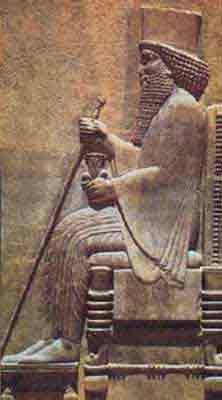
Enthroned in Peresepolis, the
magnificent city that he built, Darius I
firmly
grasps the royal scepter in his right hand. In the left, he is holding
a
lotus blossom with
two buds, the symbol of royalty.
Darius (Greek form Dareios) is a
classicized form of the
Old Persian
Daraya-Vohumanah, Darayavahush or Darayavaush,
which was the name of
three kings of the Achaemenid Dynasty of Persia:
Darius I (the Great),
ruled 522-486 BCE,
Darius II (Ochos), ruled
423-405/4 BCE, and Darius III (Kodomannos), ruled
336-330 BCE.
In addition
to these, the oldest son of Xerxes I was named Darius, but he
was murdered
before
he ever came to the throne, and Darius, the son of Artaxerxes II,
was
executed for
treason against his own father.
According to A. T. Olmstead's book
History of the Persian Empire,
Darius the
Great's father Vishtaspa (Hystaspes) and mother Hutaosa (Atossa)
knew the
prophet
Zarathustra (Zoroaster) personally and were converted
by him to the new
religion he
preached, Zoroastrianism.
The empire of
Darius the Great extended from Egypt in the west to
the Indus River in the east. The major satrapies or provinces of his
Empire
were connected
to the center
at Persepolis, in the Fars Province of present-day
Iran. The Royal Road
connected 111
stations to each other. Messengers
riding swift horses informed the king
within days of
turmoil brewing
in lands as distant as Egypt and Sughdiana.
|
|
One of the most awe-inspiring monuments of the ancient world,
Persepolis was the ceremonial capital of the Achaemenian empire.
It was built during the reign of Darius I, known as Darius the Great
(522-485 BC), and developed further by successive kings. The various
temples and monuments are located upon a vast platform, some 450
metres by 300 metres and 20 metres in height. At the head of the
ceremonial staircase leading to the terrace is the Gateway
of All Nations built by Xerxes I and guarded by two
colossal bull-like figures.
Darius was the
greatest of all the Persian kings. He extended
the empires borders into India and Europe. He also fought two wars
with the Greeks which were disastrous.
He established
a government which became a model for many future governments.
 Darius Goverment:
(A) Established a
tax-collection system;
(B) Allowed locals to keep customs and religions;
(C) Divided his empire into districts known as Satrapies;
(D) Built a system of roads still used today;
(E) Established a complex postal system;
(F) Established a network of spies he called the "Eyes and Ears of the
King."
(G) Built two new capital cities, one at Susa and one at Persepolis.
From 499 to 493
BC he engaged in crushing a revolt of the Ionian
Greeks living under Persian rule in Asia, and then launched a punitive
campaign against the European Greeks for supporting the rebels.
His forces were disastrously defeated by the Greeks at the historic
Battle of Marathon in 490 BC. Darius died
while preparing a new expedition against the Greeks;
his son and successor, Xerxes I, attempted to fulfill his plan.
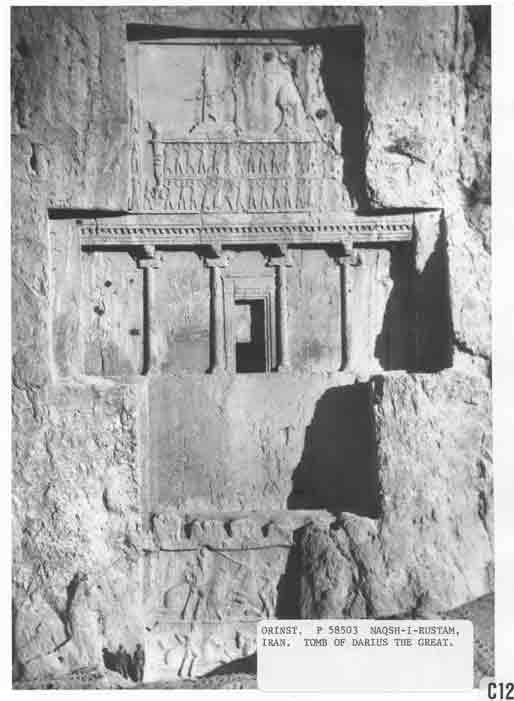
Tomb of Dariush:
|

 Darius I -
Darius the Great, The Symbol Of Power (521-486 BC)
Darius I -
Darius the Great, The Symbol Of Power (521-486 BC)