|
BISSAU LEADERS |
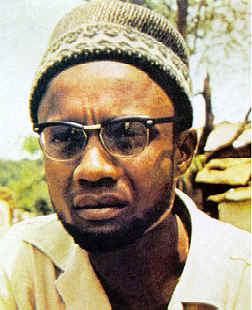
Amilcar Cabral
Born: 1924
Died: January 20, 1973
Architect and undispited leader of the PAIGC &
the national liberation movement in Guinea-Bissau.
In the early 1950s, Cabral was employed as an
Agronomist. Using this position, he went to every village in the entire
country and from this direct observation, he came up with an analysis
and strategy for the national liberation movement.
With others, he founded the PAIGC in 1956, and in
1963 their full-blown military campaign to overthrown Portuguese
colonialism began.
Within two years they had extensive liberated zones
where effectively they were in power.
In 1971 Cabral argued for the creation of the
National People's Assembly, which was created in 1972 and based on
popular vote in the liberated territories.
In January 1973, just months before the victory of
the national liberation struggle, Cabral was assassinated with the help
of Portuguese agents operating within the PAIGC.
|
Chairman of the Council of State (*)
Luís de Almeida Cabral 10 Sep 1974 - 14 Nov 1980          [picture] PAIGC

Chairman of the Council of the Revolution (military)
João Bernardo Vieira   14 Nov 1980 - 14 May 1984          [picture1] PAIGC

Chairman of the National People's Assembly
Carmen Pereira         14 May 1984 - 16 May 1984          [picture] PAIGC

Chairman of the Council of State
João Bernardo Vieira   16 May 1984 - 29 Sep 1994          [picture2] PAIGC

President of the Republic
João Bernardo Vieira   29 Sep 1994 -  7 May 1999          [picture2] PAIGC

Chairman of the Supreme Command of the Military Junta
Ansumane Mané           7 May 1999 - 13 May 1999 (+2000)a [picture] military

Presidents of the Republic
Malam Bacai Sanhá      13 May 1999 - 17 Feb 2000 (acting) [picture] PAIGC
Kumba Ialá             17 Feb 2000 -                      [picture] PRS
|
(*) In office since 24 Sep 1973; the independence
proclaimed on that date but not recognized up to 10 Sep 1974.
 Prime Ministers
 |
Francisco Mendès          24 Sep 1973 -  7 Jul 1978 (+)
Constantino Teixeira       7 Jul 1978 - 28 Sep 1978
João Bernardo Vieira      28 Sep 1978 - 14 Nov 1980         [picture 1]
Victor Saúde Maria        14 May 1982 - 10 Mar 1984 (+1999)
Carlos Correia            27 Dec 1991 - 26 Oct 1994         [picture]
Manuel Saturnino da Costa 26 Oct 1994 -  6 Jun 1997
Carlos Correia             6 Jun 1997 -  3 Dec 1998         [picture]
Francisco Fadul            3 Dec 1998 - 19 Feb 2000         [picture]
Caetano N'Tchama          19 Feb 2000 - 21 Mar 2001
Faustino Imbali           21 Mar 2001 -  9 Dec 2001
Alamara Ntchia Nhassé      9 Dec 2001 -
|
A BRIEF HISTORY OF
GUINEA-BISSAU
Between the 13th and 15th centuries part of Guinea-Bissau fell under the
Sahel Empire of Mali. Whilst the local Naula and Landurna tribes grew rice and
traded salt, the empire masterminded the trans-Saharan gold trade, upon which
several European powers depended. Eager to get to the source of this gold, in
the 1400s Prince Henry of Portugal encouraged European explorers to check out
West Africa. In 1450 Portuguese ships arrived in Guinea-Bissau to trade slaves,
gold, ivory and pepper. The Sahel lost their trade monopoly on gold and whilst
the interior suffered, coastal towns prospered.
By the late 17th century British, French and Dutch slave traders had joined
the party and taken over the surrounding territories. The Berlin Conference of
1884-85 divided Africa between the European powers, leaving Portugal with
Guinea-Bissau, Cape Verde, Equatorial Guinea and what are now Mozambique and
Angola. (The Europeans were pleased with the results; the Africans were not
invited to the conference.) Portugal started spreading inland shortly
thereafter, although it didn't gain full control of the area until 1915, after a
long series of wars with the local people.
The colonial administration was weak but repressive, and became even more
brutal when the dictator Salazar came to power in Portugal in 1926. The end of
WWII heralded cries of nationalism and independence from West African colonies
and by the 1960s many Europeans had withdrawn, with some, particularly the
British and French, maintaining good relations and trade links. But Portugal
refused to budge. This refusal, coupled with anger over the Pidjiguiti massacre
in 1959 (in which police shot 50 striking dockworkers in Bissau), prompted a
bloody battle for liberation that was to last years.
With support from the Soviet Union and Cuba, the PAIGC (Partido Africano da
Independêcia da Guiné e Cabo Verde), led by socialist Amílcar Cabral from
Cape Verde, mobilised the peasants and waged a war on the Portuguese. The PAIGC
gained ground and despite the assassination of their leader in 1973 proclaimed
independence in their conquered territories, electing Amílcar Cabral's half
brother, Luiz, president. Eighty countries quickly recognized the new
government, although it wasn't until Salazar's government was overthrown a year
later that Portugal did the same.
Portugal's legacy to Guinea-Bissau was dismal: poor infrastructure, high
mortality rate, low literacy levels, diminished industry and substantial
national debt. The new government didn't really help, allocating Bissau over
half the country's resources and leaving destitute rural areas already ravaged
by drought. When the PAIGC tried to implement their plan of union with Cape
Verde, Cabral was overthrown and unification abandoned.
João ('Nino') Vieira (also of the PAIGC) became president in 1980. The
country remained socialist, with arms provided by the Soviet Union and aid by
the West. But Vieira's government didn't fare much better than Cabral's, and in
1986, after an attempted coup, Vieira began to reverse his policies. He devalued
the currency and began selling off almost all the state businesses. Around this
time he also cut the PAIGC/army relationship, resulting in resentment on the
part of the army. Despite these seeds of trouble, Vieira narrowly won the
presidential election in 1994. Life for civilians improved and the country
enjoyed relative political stability.
But Guinea-Bissau was still one of the 10 poorest countries in the world and
in 1997 teachers, health workers and students demonstrated about development
funds that had apparently gone missing. In 1998, a coup was attempted by General
Ansumane Mane, the former head of the military. Mane, who had been sacked for
allegedly supplying arms to rebels in Senegal, was backed by the army and many
locals. President Vieira relied on support from Senegal and Guinea. The
resulting civil war killed many civilians and displaced hundreds of thousands
more. Fighting continued until February 1999's ceasefire and the subsequent
arrival of a peacekeeping force. When they left, Mane's forces staged a final
coup to overthrow Vieira in May of 1999 and PAIGC's Malam Balai Sanhá was
appointed acting president.
January 16, 2000 Kumba Ialá of the Social Renewal Party (PRS) was elected
president in what was seen by many as a positive sign of change. However, his
young administration has been rocked by scandal, with ranking leaders including
the prime minister, the attorney general and the interior minister sacked and
replaced at an alarming rate.
Guinea-Bissau's political stability is fragile, and accusations of corruption
and injustice are commonplace. Amnesty International is currently investigating
human rights transgressions that allegedly took place during an attempted
military coup in November 2000. Guinea-Bissau is inextricably linked to the
guerrilla fighting that continues on the Casamance border with Senegal. The
government cannot afford to pay its officials and despite a functioning
agricultural industry, the economy is essentially propped up by foreign aid.
Although onlookers are cautiously optimistic, Guinea-Bissau's future is far from
certain.
|
GUINEA-BISSAU FACTS
|
| Population: 1.2
million |
| Capital: Bissau |
| Major languages: Portuguese,
Crioulo, African languages |
| Major religions: Indigenous
beliefs, Islam, Christianity |
| Life expectancy: 43
years (men), 48 years (women) |
| Monetary unit: 1 CFA (Communaute
Financiere Africaine) = 100 centimes |
| Main exports: Cashew
nuts, shrimp, peanuts, palm kernels, sawn timber |
| Average annual income: US
$180 |
| Internet domain: .gw |
| International dialling
code: +245 |
|
Home | History |
War/Independence |
Overview |
Civil War |
Back to the top |
|