A military coup was attempted on June 7, 1998.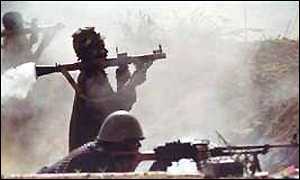 The rebels failed to oust the government, which then received
significant aid from neighboring Senegal and Guinea-Conakry. Nearly
1,200 Senegalese and 400 Conakry troops flew into Bissau to help
suppress the rebellion. Despite the efforts of government loyalists
and the foreign troops, the rebellion against President Vieira not
only continued, but grew as the countryside erupted in revolt
against the government as guerilla veterans of Bissau's War of
Independence took up arms against the the President, citing the
nation's poverty and government corruption, rather than a fondness
for Mane.
The rebels failed to oust the government, which then received
significant aid from neighboring Senegal and Guinea-Conakry. Nearly
1,200 Senegalese and 400 Conakry troops flew into Bissau to help
suppress the rebellion. Despite the efforts of government loyalists
and the foreign troops, the rebellion against President Vieira not
only continued, but grew as the countryside erupted in revolt
against the government as guerilla veterans of Bissau's War of
Independence took up arms against the the President, citing the
nation's poverty and government corruption, rather than a fondness
for Mane.
Fighting in the capital caused many of the
300,000 inhabitants to flee the city, while artillery duels created
great damage to the downtown areas.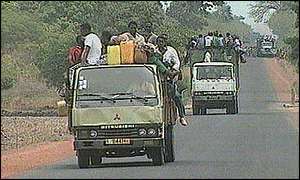
The two sides agreed to a cease-fire July
26, while negotiations continued with Portuguese assistance.
Violence ruptured the cease-fire several times, but usually in
isolated incidents as on October 19, when both sides engaged in
artillery duels in Bissau.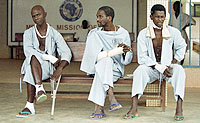
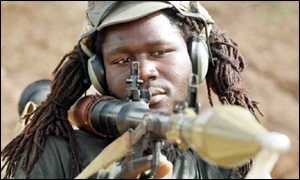
Vieira and Mane signed a peace agreement
November 2, 1998 in Abuja, Nigeria. After intense negotiations
involving the leaders of Gambia and Nigeria, the two sides agreed to
an arrangement which called for new elections in March and the
pullout of Senegalese and Guinea-Conakry troops who were replaced by
a regional peacekeeping force. The terms of the peace deal
established an interim government of national unity featuring
supporters of President Joao Vieira and of the rebel faction. The
new 10-person government, were to have led the country until
elections scheduled for later in 1999.
 The
peace deal showed serious signs of breaking down in February, 1999
as both sides engaged in renewed fighting, but further work on the
part of Togolese diplomats soon halted the combat.
The
peace deal showed serious signs of breaking down in February, 1999
as both sides engaged in renewed fighting, but further work on the
part of Togolese diplomats soon halted the combat.
After the Senegalese and Guinea-Conakry
troops left, forces from the West African organization called ECOMOG
(Economic Community of West African States), moved in to keep the
peace.
 On
Thursday, May 6, 1999, Mane's forces struck out against the
government troops, capturing Bissau and forcing Vieira to flee to a
foreign embassy for safety. Apparently, Mane was concerned that
ECOMOG had failed to disarm Vieira's Presidential Guard, and feared
the repercussions of this supposed breach of the peace pact.
Vieira's Presidential Guard was formed from members of his own
ethnic group, the Pepel.
On
Thursday, May 6, 1999, Mane's forces struck out against the
government troops, capturing Bissau and forcing Vieira to flee to a
foreign embassy for safety. Apparently, Mane was concerned that
ECOMOG had failed to disarm Vieira's Presidential Guard, and feared
the repercussions of this supposed breach of the peace pact.
Vieira's Presidential Guard was formed from members of his own
ethnic group, the Pepel.
Devastation in the capital city.
The overthrow of President Vieira.
Possible political and military tension
between the new Bissau government and neighboring Senegal and
Guinea-Conakry.
Elections were held and the new civilian
government of President Kumba Yalla (the first democratically
elected leader in Bissau history) took power in February 2000.
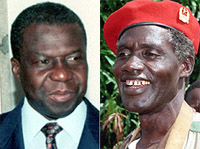 Former
Brigadier General Ansumane Mane attempted a coup against President
Joao Bernardo Vieira, who has ruled Guinea-Bissau since 1980. Mane
accused the President of corruption and leading the nation into
poverty. Vieira fired Mane from command of the armed forces on charges
of selling weapons to the Casamance rebels of southern Senegal. The
army rebellion also may have originated in part due to the
government's inability to properly pay its soldiers.
Former
Brigadier General Ansumane Mane attempted a coup against President
Joao Bernardo Vieira, who has ruled Guinea-Bissau since 1980. Mane
accused the President of corruption and leading the nation into
poverty. Vieira fired Mane from command of the armed forces on charges
of selling weapons to the Casamance rebels of southern Senegal. The
army rebellion also may have originated in part due to the
government's inability to properly pay its soldiers.