|
BISSAU WAR FOR INDEPENDENCE |
|
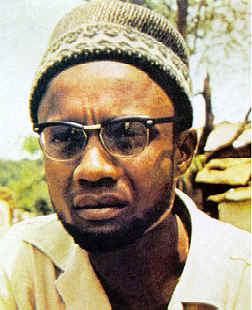
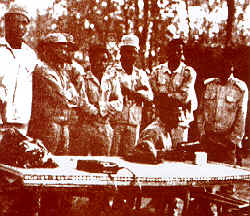
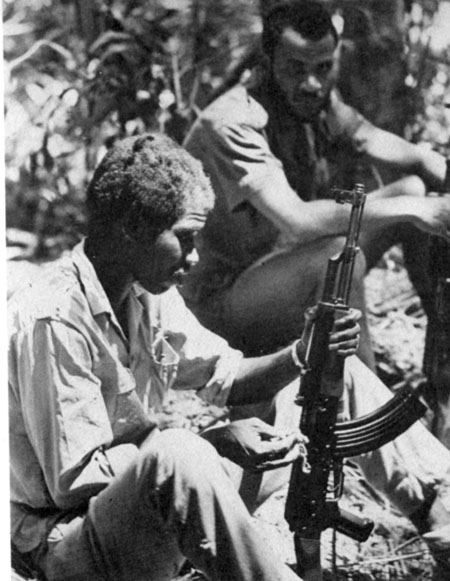
1924: Amílcar Cabral was born on September 12, in Bafatá, Guinea. – 1932: Moves to Cabo Verde. – 1943: Finished secondary school in Mindelo, on the island of São Vicente. – 1944: Obtains a job at the National Printing Office, in Praia, the capital of Cape Verde, on São Tiago Island. – 1945: was awarded a scholarship and begins his studies at the Agronomy Institute, in Lisbon. – 1950: Graduated from the institute and started working at the Agronomy Center, in Santarém. – 1952: Returned to Bissau under contract with the Agricultural and Forestry Services of Portuguese Guinea. – 1955: The Governor demanded that he should leave the colony; Cabral went to work in Angola; he joined the Movement for the Liberation of Angola (MPLA). – 1956: The African Party for the Independence of Cape Verde and Guinea (PAIGC) was founded in Bissau. – 1960: The PAIGC established a delegation in Conakry, capital of the Republic of Guinea; China gives support to the training of members of the PAIGC. – 1961: Morocco welcomed members of the PAIGC. – 1963: Open warfare breaks out on January 23, with an attack on the military installations at Tite, in southern Guinea-Bissau; the PAIGC sets up a northern battlefront in July. – 1970: Pope Paul VI grants an audience on July 1 to Amílcar Cabral, Agostinho Neto and Marcelino dos Santos. On November 22, the Governor of Guinea-Bissau decides to establish a “commando” operation to which he gives the name of “Mar Verde” (Green Sea), whose goal is to capture or eliminate the leaders of the PAIGC located in Conakry: it fails! – 1973: Amílcar Cabral is assassinated in Conakry on January 20.
Setting:
a
one-story house, painted white, stands alone at the center of a wide
courtyard;
a huge mango tree grows in front of the house;
a shed used as a garage; the place is in Conakry, capital of the
Republic of Guinea, whose president is Séku Turé.
Time:
3 o’clock in the morning, January 20, 1973.
Action:
A car, a VW, is being parked under the shed.
Two spotlights focus on the car occupants – Amílcar Cabral and
his second wife, Ana Maria.
Out of the darkness a stern voice orders that Amílcar be tied
up. He struggles and refuses to be subdued.
The leader of the raid presses the trigger and hits Amílcar in
the region of the liver.
Amílcar, crouching on the ground, suggests that
they talk.
The reply: a burst of machine gun fire aimed at the head of the
founder of the PAIGC.
Death is immediate.
The perpetrators:
Inocêncio Kani, the first to shoot, a guerrilla war veteran and
former PAIGC navy commander; the others are members of the party, all
Guineans.
In
other points of the city where the some 500 PAIGC militants are living,
the remaining leaders of the party stationed in Conakry are arrested by
groups participating in the uprising.
Among those arrested are Aristides Pereira, Vasco Cabral, José
Araújo. They are all taken
to a scouting boat that heads for Bissau.
On January 21, Séku Turé receives the leaders of the party
uprising at the presidential palace.
Everything indicates that he supports Cabral’s assassins.
But, surprisingly, the President of
Guinea-Conakry gives them no protection.
He orders that the conspirators be arrested, instructs the Army
to temporarily hold all members of the PAIGC and intercepts the boat
that was taking the imprisoned leaders to Bissau.
Séku Turé then sets up an international commission to
investigate all of these events. Gradually,
the old leaders of the PAIGC are granted their freedom.
The party’s Superior Council for Liberation decides to go
further in the investigation. From
that point on, conclusions are reached fairly quickly because of a web
of intrigue, denouncements,
accusations and betrayals. Approximately
100 party members are indicted, tried and executed.
This number includes the majority of those who participated in
the crime. But it also
includes a number of innocent people.
This type of occurrence is inevitable.
The death of Amílcar Cabral, the almost uncontested leader,
gives rise to a chain reaction of hatred and passionate reprisals.
In such an atmosphere, it is difficult for justice to be
impartially served, especially at a time when no one is interested in
abating the war against Portuguese colonialism. The truth is that the assassination brings about no benefits for the Portuguese Army; the guerrillas intensify their activities. As of March 1973, the rebels have a new weapon at their disposal – the ground-to-air missile Stella – which effectively cancels out the air supremacy of the Portuguese armed forces. In May of that year, the Governor of Guinea-Bissau, General António Spínola, advises Joaquim da Silva Cunha, Minister of National Defense, that “...we are getting closer and closer to the possibility of a military collapse.” Then, on September 24, in the forests of Madina do Boé, the PAIGC unilaterally declares the independence of Guinea-Bissau.
Under
the dim light of a kerosene lamp, Juvenal Cabral sits at home, in Cape
Verde, writing a memorandum to Vieira Machado, Salazar’s minister in
charge of colonial affairs. We
are in December of 1941 and the minister is paying a visit to the city
of Praia, capital of Cape Verde, on the island of
São Tiago. Cabral’s
letter reaches the hands of that government official who, most likely,
doesn’t read it. Why
bother with the opinions of an obscure Cape Verdean elementary school
teacher? Nevertheless,
the document is quite significant.
In it, Cabral expresses his worries about the drought and the
famine ravaging the archipelago and proposes that the minister adopt
some policies to improve the situation:
locate and harness water sources, establish an intensive
reforestation program, protect agriculture, do away with land taxes,
create a line of credit for farmers, protect the humble civil servant. His
son, Amílcar, is now 17 and attends high school in Mindelo.
He does not yet feel confident enough to help his father in his
crusade in favor of Cape Verde. But,
through his father, he has been made quite aware, since an early age, of
all the problems that affect his country. By
now, Amílcar has an assumed name.
He is Larbac. That’s
how he signs his love poems: Quando
Cupido acerta no alvo (When Cupid Hits the Bull’s-eye), Devaneios
(Daydreams), Arte de Minerva (Minerva’s Art), among others.
The themes indicate classical influences.
His inspiration comes from the poets he studies in school:
Gonçalves Crespo, Guerra Junqueiro, Casimiro de Abreu.
Amílcar’s lyricism (Larbac is Cabral spelled backwards) is not
noted for its originality. It
does, however, reveal a romantic sensitivity that is present in his
adolescent prose writings, his short stories, annotations and
commentaries, where we can already detect a strong awareness of what is
happening and a desire to participate in the life of his island world.
A while later, in Lisbon, these feelings will become even
stronger.
“He was born with politics in his head. He was the son of a politician. Juvenal used to talk to him about averything.” These words are pronounced in 1976, a year before Amílcar’s death, by his mother, Mrs. Iva Pinhel Évora, wife of Juvenal Lopes Cabral.
Memórias
e Reflexões (Memories and Reflections), published in 1947 by
Amílcar's father, is a singular book in which the author recollects his
life, discusses the problems of his times and the environment in which
he lived, describes facts and events that clarify historical
developments and shed light on the social origins of the future leader
of the PAIGC. Juvenal
is born in Cape Verde in 1889. One
of his grandparents is an important landowner.
But his fortune doesn’t last long in view of the natural
disasters that afflict the islands.
His paternal grandfather is a cultured man, also of some means,
who names the child Juvenal, after the Latin poet of the same name.
Juvenal doesn’t get to know his father, who meets a tragic death when
the boy is a mere two months old. At
first, the child remains under the care of his grandfather, but later
goes to live with his godmother, Simoa Borges, who will pay for his
education. First, he
studies at the Viseu Seminary, in Portugal.
Juvenal is destined for the priesthood.
But a prolonged drought at the turn of the century makes it
financially impossible to keep him studying there.
So, he returns to Cape Verde and, in 1906, we find him studying
at the St. Nicolau Seminary. But
at the age of 18 he abandons his studies and leaves for Guinea in search
of a job. First, he manages to become a civil servant in Bolama and,
later, begins his activities as a teacher, even though he has no
diploma. The
family is living in Bafatá when Amílcar Cabral is born on September
12, 1924. The birth
certificate, however, states that the newborn’s name is Hamílcar, his
father’s way of paying homage to the famous Carthaginian Hamílcar
Barca. Simoa,
the godmother, dies in 1932 and leaves Juvenal a few tracts of land in
Cape Verde. He, his wife
Iva and Amílcar return to the islands, where they remain throughout the
difficult years of World War II. Under
Salazar’s regime, the cost of living soars and goods and supplies
become scarce. In 1940, a
particularly severe drought causes widespread starvation, resulting in
the death of more than 20,000 Cape Verdeans.
Then, between 1942 and 1948, a new calamity ravages the islands,
killing 30,000 more. In
the meantime, the Portuguese military contingent on the islands has
grown considerably, giving rise to innumerable conflicts with the local
population and bringing into greater focus the underlying feelings of
racism and colonialism. There
are practically no public assistance services to relieve the effects of
drought and famine. The
islands become underpopulated as the result of emigration to S. Tomé
and Angola and, later, to América. Juvenal
never remained silent. In
1940, he sends a memorandum to the governor in which, based on
historical data, he predicts that there would be a drought in the years
to follow. His predictions
come true. Later, he will
write a document to the minister in charge of colonial affairs. (This
terrible period of successive calamities in Cape Verde is masterly
described by Manuel Ferreira in his novel Hora
di Bai). This
is the atmosphere in which Amílcar Cabral spends his early childhood
and adolescent years. If,
on one hand, his father gives the example of public conscience and civic
engagement, within the limits permitted by Salazar’s fascism, his
mother, Iva Évora, on the other, is for young Amílcar an example of
love and affection, of family protection and of dedication to her work.
Iva labors all day on a sewing machine to help the family
overcome, as wel as possible, the many crises they have to face.
Later in addition to her activities as a seamstress, she gets a
job a in a fish-packing factory. Amílcar’s
mother and her capacity for self-sacrifice will serve as an example
which he will pass to the young militants of the PAIGC.
At
age 20, Amílcar is thoroughly familiar with the degrading living
conditions of the Cape Verdean people.
He is immersed in political idealism, absolutely convinced that
there will be better tomorrows, that there will be inevitable changes in
the world through a new order arising out of the post-war chaos. In
high school, Amílcar is a brilliant student and graduates with
outstanding grades, 17 out of a possible 18 point total.
He leaves for the capital, Praia, where he gets a job as an
apprentice at the National Printing Office, while he awaits the result
of his application for a scholarship so he can continue his studies.
At long last, he leaves for Lisbon in 1945. Amílcar
Cabral arrives in Portugal in 1945.
This is a year of great hopes and expectations for Portuguese
democrats. But such hopes
soon vanish when Salazar manages to continue his dictatorial regime with
the tacit approval and support of the victors of World War II. Cabral’s
first wife, Maria Helena de Athayde Vilhena Rodrigues, was his classmate
at the Agronomy Institute. This
is how she describes her first meeting with her future husband, with
whom she would have two children, Iva Maria and Ana Luísa.
The description was written by Mário de Andrade: “I
met Amílcar during our freshman year at the Agronomy Institute, in
1945. School had begun in
November and he arrived in December...I didn’t belong to his group but
I remember very well seeing him among the other students.
He stood out, since he was the only negro in the group...Amílcar
had not taken the college entrance examination...Everybody talked about
him...they praised his intelligence and, on top of that, he was very
pleasant and easygoing.
As far as his political activities were concerned, I remember
that my fellow students were gathering signatures in support of
democratic movements. Amílcar
was actively engaged in these antifascist student organizations.
Whenever there was a general meeting, he acted as moderator
because he expressed himself so well...In the beginning of our third
year, in October, 1948, we were in the same group, which was composed of
the last twenty-five students who had passed the examinations.” Amílcar
is remembered by his classmates and friends as a person of contagious
energy, a great sense of humor, and an enormous capacity for making
friends. He is charming and
women are easily attracted to him. “He
was the best dressed and groomed of all of us,” recalls his friend,
the journalist Carlos Veiga Pereira. “My
brother could make friends anywhere,” says Luís Cabral,
Guinea-Bissau’s first president.
In an interview to the newspaper Diário
Popular, he revealed that “...It was because of Amílcar’s charm
that the soviets gave us the missiles to control the Portuguese Air
Force. The Italian tycoon
Perelli was his friend and gave us the officer uniforms we used.
It was all because of friendship and affection.” Even
having to attend to his studies, his political activities and his
romantic affairs, he still found time to practice his favorite sport:
soccer. And,
according to the sports columnists, he could have made a career of it,
if he had wanted to. His
performance with the institute’s football team was so impressive that
he was invited to play for Benfica, one of the top teams in Portugal.
But Amílcar doesn’t accept the offer and prefers to stick with
the informal games at school. He
feels an irresistible calling during his college years, a feeling that
affected other Negro students as well:
it was necessary to return
to Africa.
Not only because of his family, which he loves so deeply, but
because “...millions of people need my contribution in the hard
struggle against nature and against man, himself...There, in Africa, in
spite of the beautiful and modern cities on the coast, there are still
thousands of human beings who live in the utmost darkness."
In 1949, he writes: “I
live life intensely and from life I have extracted experiences that have
given me a direction, a road that I must follow, whatever the personal
losses that I might come to suffer.
That is my reason for living.” The
life he is referring to is lived in Lisbon, at the Agronomy Institute,
in the Casa dos Estudantes do Império and through the books that open
up horizons for the understanding of the world of his times.
One of such books has a fundamental influence:
Anthologie de la nouvelle
poésie négre et malgache (Anthology of the New Black and Malagasy
Poetry), edited by Léopold Sédar Senghor.
This book convinces him that “...the Negro is awakening
everywhere in the world.” He
theorizes on the condition of the Cape Verdean man, the result of the
miscegenation of the archipelago’s first inhabitants, black and white.
He knows that the number of mestiços
(people of mixed races) is already six times that of the whites and
three times that of the Negros. From
a psychological point of view there is a “Cape Verdean spirit,” a cape-verdeanness.
This profession of faith must be brought into harmony with his
militancy. During
his fifth year at school, Amílcar returns to the archipelago for a
summer vacation. He wants
to teach and pass along to his fellow Cape Verdeans all the knowledge at
his disposal, whether it be in his special field of studies, soil
erosion, or in general culture. He
delivers several lectures on the Radio Clube de Cabo Verde, in the city
of Praia, covering the soil characteristics of the islands.
He recognizes that, despite the difficulties, the economy of Cape
Verde is based on agriculture. As
such, it is essential that the man
in the street be elucidated, be well-informed, be made aware.
Amílcar discusses the problems of the elite
in Cape Verdean society. There
is a need for the creation of an intellectual
vanguard that will give the anonymous Cape Verdean citizen all the
information about his traditional problems.
As he says: “The
members of the organization must bring light to those who live in
ignorance.” Such
information must travel beyond the borders of Cape Verde and become
global in nature so as to be available anywhere in the world.
This is Amílcar’s task as a militant:
to make Cape Verdeans aware. But
the Portuguese authorities are quick to forbid his access to the radio
waves. In the same fashion,
they forbid him to give a night course at the Central School, in Praia. “Make
Cape Verdeans aware of Cape Verde,” is a slogan that also reflects
what is happening in Angola, where a group of young intellectuals has
gathered around the poet Viriato da Cruz and has adopted the motto:
“Let’s discover Angola.” Back
in Lisbon, Amílcar makes connections that put him in close contact with
other students from the Portuguese colonies.
This is a group of young people, members of the urban African
lower middle-class, who are conscious of the rebellious feelings against
colonialism and who have the advantage of being well-educated and
cultured. They are active
in the Portuguese democratic youth movement known as MUD Juvenil, the
Movement for Peace. As Amílcar
Cabral put it, they have an ideal that distinguishes them from the
Europeans - it’s: the
reafricanization of the spirits.
After
graduating from the institute in 1950, Amílcar goes through a period of
apprenticeship at the Agronomy Center, in Santarém.
Shortly thereafter, Juvenal Cabral dies. Then, in 1952, Amílcar
returns to Bissau, under contract with the Agricultural and Forestry
Services of Portuguese Guinea. The
man who arrives in Bissau is a 28-year-old agricultural engineer whose
goals are not limited to those connected with his profession (in which,
incidentally, he has always shown great competence).
The most important of these goals:
to raise the awareness of the Guinean common masses.
As he says is a memorandum to the members of the organization,
during the struggle for liberation, in 1969:
“I didn’t come to Guinea by mere chance.
My return to my native land was not occasioned by any material
need. Everything was
carefully planned, step by step. I
had great possibilities of working in other Portuguese colonies and even
in Portugal itself. I left
a good job as a researcher at the Agronomy Center to take a job as a
second class engineer in Guinea...This was done following a plan, an
objective, based on the idea of doing something, of contributing to the
betterment of the people, to fight against the Portuguese.
That’s what I have done since the day I arrived in Guinea.”
The
“Engineer,” as he will be called by his compatriots, is in the best
position to carry out the task of “raising
awareness.” As manager of the agricultural station at Pessubé, he is
able to contact rural workers, including Cape Verdeans.
But it’s difficult to bring the Cape Verdeans and the Guineans
together to form a common front. It
will be difficult to the very end, even though a number of Cape Verdeans
gather around him (Aristides Pereira, Fernando Fortes, Abílio Duarte,
among others). His
political activities run parallel to his professional work.
He is in charge of the planning and implementation of Guinea’s
agricultural sensus; his final report is, to this day, the first
dependable collection of data for a more accurate knowledge of
Guinean agriculture. In
the beginning, Amílcar tries to act in strict observance of the law.
He drafts the by-laws of a club dedicated to sports and cultural
activities open to all Guineans. The
Portuguese authorities do not permit it to function because the signers
of the document do not have a government issued identity card. In
1955, Governor Melo e Alvim forces Cabral to leave Guinea, although he
permits him to return once a year for family reasons. That
very same year, a group of Asian and African countries hold a conference
at Bandung, Indonesia, the Bandung Conference, which gives birth to the
movement of nonaligned countries in world politics.
That year also marks the end of the first Vietnamese war of
independence and the beginning of open warfare by the National
Liberation Front (FLN) of Algeria.
Amílcar Cabral has been transferred to Angola and is working in
Cassequel, as an engineer...and coming into direct contact with the
founders of the MPLA (Popular Movement for the Liberation of Angola), of
which he becomes a member. During
one of his visits to Bissau, on September 19, 1959, a new party comes
into existence founded by Amílcar Cabral, Aristides Pereira, Luís
Cabral, Júlio de Almeira, Fernando Fortes and Elisée Turpin.
Its name: African Party for the Independence and Union of Guinea
and Cape Verde (known by
its Portuguese acronym PAIGC). It
is, obviously, an underground organization that will acquire legal
status only four years later when it establishes a foreign delegation in
Conakry. This
is a period of exhausting
activities for Amílcar Cabral. He
continues his botanical and agricultural studies that force him to
travel frequently between Portugal, Angola and Guinea.
In
November, 1957, he attends
a meeting in Paris called to discuss and plan the struggle against
Portuguese colonialism; he makes contact with anticolonialists in
Lisbon; goes to Accra, capital of Ghana, for a Pan-African meeting and
then heads for Luanda when the Pidjiguiti massacre occurs.
In January of 1960, he attends the Second Conference of African
Peoples, in Tunis, and goes to Conakry in May.
That same year, he goes to an international conference in London
where, for the first time, he denounces Portuguese colonialism.
But here he leaves it quite clear, as he did throughout the years
of struggle, that he is not against the Portuguese people.
His battle is exclusively against the colonial system. Historical
research and the testimonials of many of the participants in the events
show that the PAIGC’s leader always made himself available for
negotiations with the Portuguese government, but such openness was never
accepted by the dictatorship regime. Between
1960 and 1962, the PAIGC operates out of the Republic of Guinea.
Its activities are developed along three courses of action:
to prepare militants and party workers to spread the party line
in the interior of Guinea; to obtain the support of neighboring
countries (a very complicated affair because the Republic of Guinea
intended to use Amílcar Cabral’s Guinean supporters to carry out its
own political agenda and because Senegal showed its hostility for six
years) and, finally, to marshal international support. 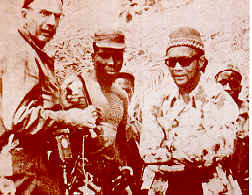
War breaks out in 1962 against the Portuguese Establishment. Seventeen years have gone by since Juvenal Cabral’s son arrived in Lisbon to attend college. In
an article published in the Expresso,
of January 16, 1993, José
Pedro Castanheira describes many of the circumstances surrounding Amílcar
Cabral’s death. Three
years later, Castanheira delves deeper into the subject in his book Quem
mandou matar Amílcar Cabral?(Who Ordered Amílcar Cabral’s Death?). There
are several acceptable possibilities.
Using the tactics of “divide and conquer,” Portuguese
policies had been able to separate the Cape Verdeans from the Guineans.
The former are, by and large, the children of mixed races (mestiços),
are better educated and are favored by the central government.
They occupy positions which are less demeaning and enjoy
preferential treatment. When
the PAIGC is founded, the
top echelon is made up of Cape Verdeans, while the foot soldiers are
Guineans. Amílcar Cabral,
himself, is considered to be a Cape Verdean, even though he was born in
Guinea. As a result, there
were always conflicts and tensions within the PAIGC.
In 1973, the war of national liberation is approaching its moment
of victory. The political
leaders are still Cape Verdeans. Probably,
the impending success in the struggle exacerbated the confrontation
within the party. Séku
Turé, who had been an African leader of great prestige since 1958, is
now losing influence. On
the other hand, Amílcar Cabral has become a well-known personality in
the African and in the international political scenes, receiving support
from a wide range of sources that go from China and the Communist
regimes to the Scandinavian countries.
Turé’s big dream of taking over Guinea-Bissau and creating
“Great Guinea” is now in danger.
It is quite probable that he gave his nod of agreement to the
rebels – all Guineans – to carry out the assassination.
Cabral would be out of the way, the PAIGC would become divided
and would, for all practical purposes, come under
Turé’s control. (In
May, 1974, Leopold Senghor, President of Senegal, did not hesitate in
declaring to Colonel Carlos Fabião and to Ambassador Nunes Barata that
Séku Turé had been the instigator of Amílcar Cabral’s murder.) And,
finally, there is the PIDE/DGS, the secret Portuguese state police.
For a long time, at least since 1967, that organization had been
trying to kill Cabral. Some
of the guerrillas who had been taken prisoners were brain-washed into
collaborating with the police apparatus.
This was shown to be true in relation to some of the participants
in the assassination. Everything
leads one to believe that, to some unknown degree, the PIDE was not
unaware of the conspiracy. Amílcar
Cabral was buried in the cemetery of Conakry. Thus, the most enlightened
African leader of his generation, the principal theoretician of the
armed struggle for African liberation leaves the political scene. But
Amílcar would die several more times, considering that his life was
lived in accordance with his ideals, that he had led a guerrilla
movement with one goal in view, as so often stated and written by him
– the establishment of a fraternal community that would flourish when
the two peoples forced to engage in war freed themselves from their
common oppressor. On
November 14, 1980, Amílcar Cabral died a second time, as an undeserving
victim of a settlement of accounts.
On that day, Nino Vieira led a coup-d’état that destroyed Amílcar’s
great dream of making Guinea and Cape Verde one country or, at least, a
union of states that would be able to withstand the hegemonist ambitions
of the Dakar and Conakry governments.
As a result of the coup, the PAIGC, which he had founded, was
irremediably divided. Cabral
died once again as the result of the ostentation, the corruption and the
bloody hatred in the solution of political differences that ensnared
many of the Guinean leaders. He
died as the result of the utter poverty, disease and famine that
decimate the people twenty years after independence was so admirably
conquered in the forests of Madina do Boé. -
A poem by Amílcar Cabral – Praia, Cabo Verde, 1945 - Mother, in your perennial sleep, You live naked and forgotten and barren, thrashed by the winds, at the sound of songs without music sung by the waters that confine us... Island: Your hills and valleys haven’t felt the passage of time. They remain in your dreams - your children’s dreams – crying out your woes to the passing winds and to the carefree birds flying by. Island : Red earth shaped like a hill that never ends - rocky earth – ragged cliffs blocking all horizons while tying all our troubles to the winds!
|