pels for the luminance
component Y, and
pels for the luminance
component Y, and
 pels for each of the chrominance signals,
Cb and Cr. All images are sampled at 15 Hz, that is, the frame rate is
15 fps.
pels for each of the chrominance signals,
Cb and Cr. All images are sampled at 15 Hz, that is, the frame rate is
15 fps.
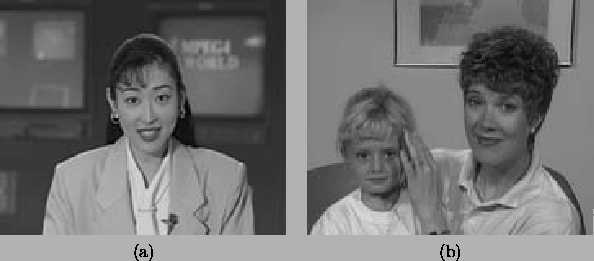
Therefore, the sequences differ only at the content. The first, named `Akiyo,' is a typical single person head and shoulders image with medium spatial detail and low foreground motion with stationary background. The second, named `Mother & Daughter' or `M&D,' differs only at the point that motion is not restricted in a small region, as it features two subjects. The third, which will be the toughest test for the experiments, is the `Foreman' sequence, featuring medium foreground and low background motion, as the camera is unstable and finally pans away from the subject's face.
Sample frames of the first two sequences are illustrated in
Figure 6.1, and for the Foreman sequence in
Figure 6.4a, page ![[*]](cross_ref_motif.gif) .
Note that these sequences are widely used by researchers for testing video
coding algorithms, particularly, they are all MPEG4 test sequences.
.
Note that these sequences are widely used by researchers for testing video
coding algorithms, particularly, they are all MPEG4 test sequences.