The video encoder operates in several modes. Some of them correspond to parameters which fine-tune the resulting bitstream, such as quantisation, motion vector search range. Others are toggling the use of H.263's advanced prediction options, including arithmetic coding, unrestricted block matching search and PB frames.
Advanced prediction mode provides considerable savings of bitrate for the same quality, as shown on Table 6.1. However, RTP packetisation is much more complex for this mode, and it was not used in the remaining experiments.
Some remarks have to be noted regarding Table 6.1. The first is that the Foreman sequence is the most demanding in terms of bitrate. This is expected, as in such scenes that feature relatively high levels of motion and the camera is moving,6.1 motion estimation errors are much higher. Non-zero motion estimation errors are encoded and transmitted for motion compensation, so they create the observed disparity in bitrate requirements.
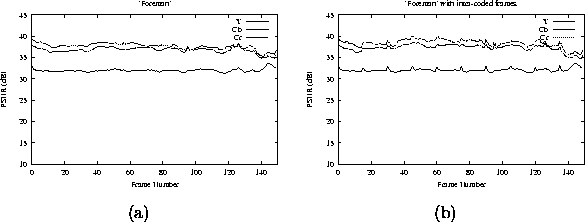
The second point is that only the luminance PSNR is used for comparison. This is the common practice in video-related simulations, as chrominance information follows the luminance information in predictions and errors, therefore it exhibits nearly the same statistical behaviour, as shown in Figure 6.2.
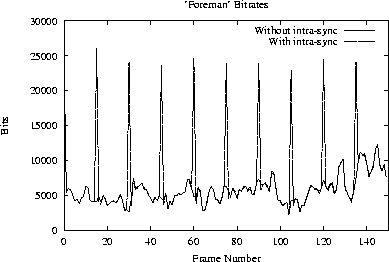
Third and last is the suffix `-I'. Normal H.263 bitstreams are using intra-coding only in the first frame of the sequence. These `-I' bitstreams are formed by forcing the encoder to insert at least 5% intra-coded information, in order to make the stream more error-resilient. This has the effect of increasing the required bitrate, as shown in Figure 6.3, without significant gain in the decoded picture quality for lossless transmission, as Table 6.1 suggests.
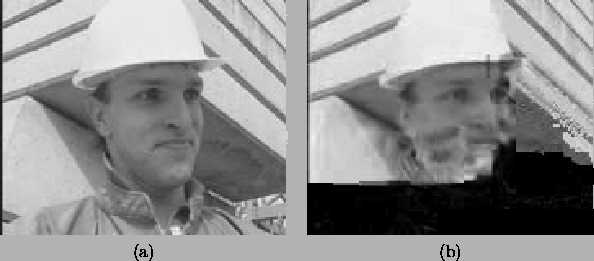
Another issue in the encoding is the use of GOB markers for resynchronisation. If they are used, packet loss affects only a GOB, that is, a row of macroblocks in the QCIF frame. The results if GOB resynchronisation is not used are illustrated in Figure 6.4. In the following experiments, GOB markers are always used.
 (dB)
(dB)