


Two methods of error control and concealment were tested. The one is adding intentionally redundancy by forcing a percentage of the encoded sequence to intra-coding. This makes the bitstream more robust, as all error propagation stops at the next intra-coded block. However, it is not the sender-receiver interactive error control scheme that was described above, as the insertion of the intra-coded information is done at random positions, and is not guided by the decoder.
Obviously, the tested scheme has the advantage that it can be applied when a decoder feedback channel is not available. This is a feature extremely desirable in multicasting applications. The drawback is its randomness, which means that the scheme does not detect errors and correct them, but acts preventively and, under certain conditions, might not provide the desired results. Two versions of the scheme were tested under 5% random packet loss, one forcing 5% and the other 15% intra-coding.
The second error concealment method is temporal prediction, that is, in the event of a packet loss, the error-struck current frame region is repaired using the corresponding region from previous frames. Unfortunately, there is no point in using this technique in conjunction with forced-intra coding, due to the randomness of the latter.
The sequences were all tested under 5% packet loss conditions. Packetisation is done according to RFC 2190 Mode A, that is, packets are aligned at GOB level. Therefore a lost packet corresponds to a lost row of macroblocks for the current frame.
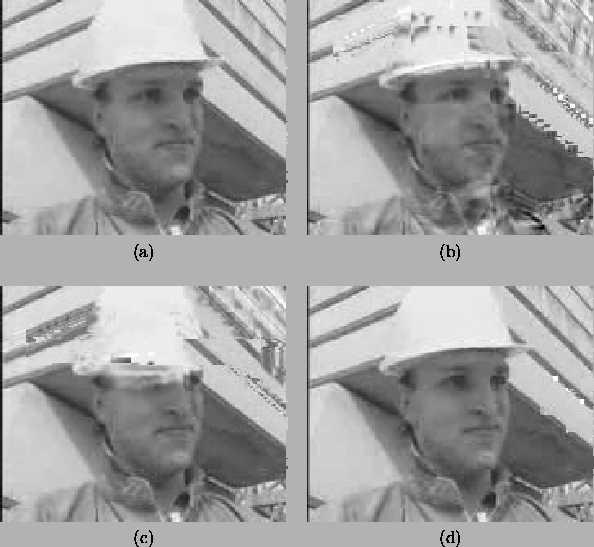
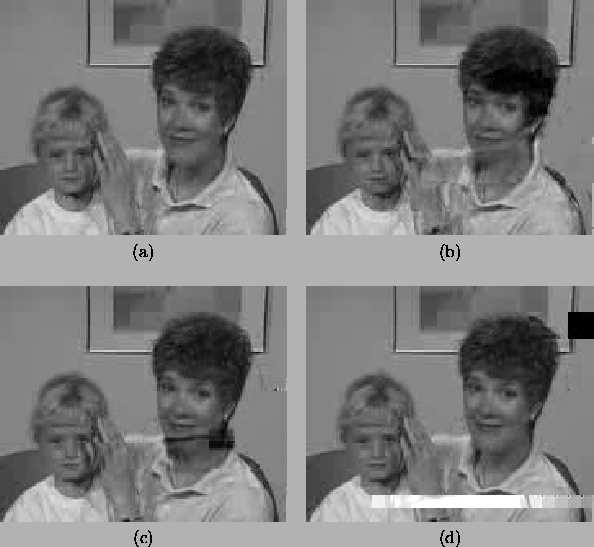
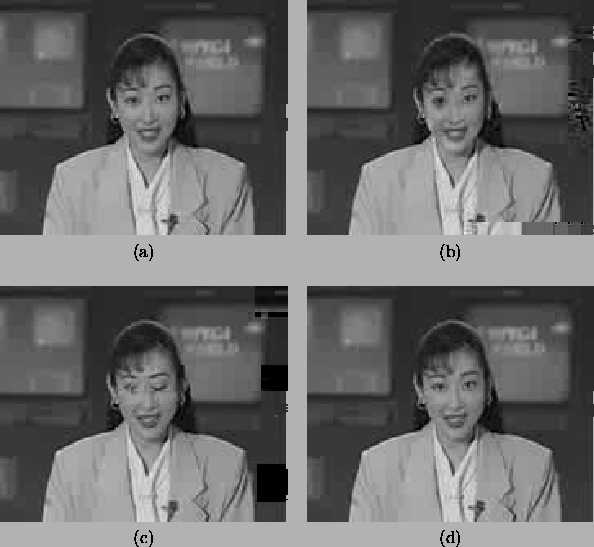
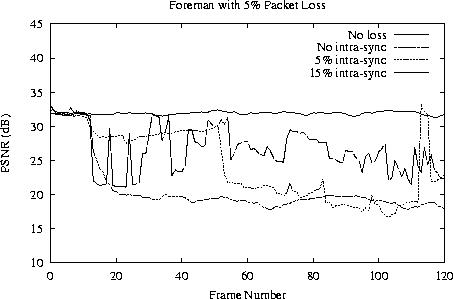
The variation of luminance PSNR for every decoded frame for the Foreman sequence, is depicted in Figure 6.5. A comparison of the average quality results of the tested techniques on all the sequences, is shown in Table 6.2. Comparative subjective results are also provided for all the sequences in Figures 6.6, 6.7, and 6.8, in the following pages.
 |
 |
 |
 (dB)
(dB)