|
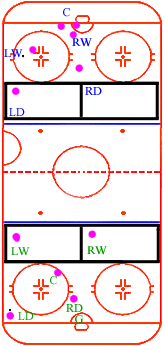
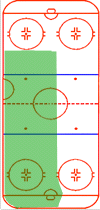
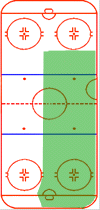
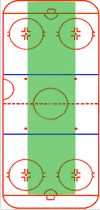
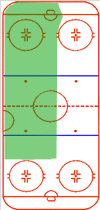
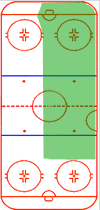
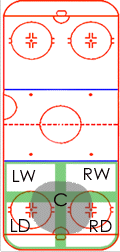
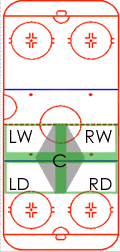
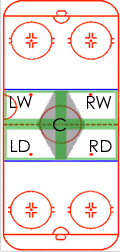
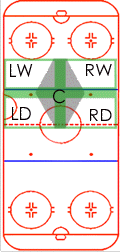
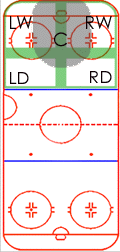
The above 5 diagrams
show, in a very general way, how the players should be distributed on the
ice.
Things to notice:
-
the centre occupies the
grey area, the other 4 players occupy the rectangles as outlined in green.
-
the thick green lines
are areas of overlapping responsibility. Note that the centre's area
overlaps all the other players areas.
-
all 5 players occupy an
area (the entire green rectangle) that's about 1/3 the length of the ice.
-
although the 5 positions
are labelled, any player could be in any of the 5 positions, as long as
there is only one player in each region
-
Consider the sequence
from left to right (1 to 5), and that any of the forwards are carrying
the puck up the ice and into the offensive zone:
-
In #2 the defence are
approaching our blue line as the forwards are approaching the red line.
-
In #3 the defence have
crossed our blue line as the forwards are approaching the other blue line.
-
In #4 the defence are
approaching the other blue line as the forwards have crossed the other
blue line.
-
In #5 the defence have
crossed the other blue line as the forwards are deep in the offensive zone.
-
Special note: if we have
control of the puck deep in their end (#5) this is the perfect time to
sub off.
-
Consider the sequence
from right to left (5 to 1), such that the other team is bringing the puck
into our end:
-
First, this is a bad time
to sub off.
-
The puck carrier is between
the LW and LD for example.
-
The defence simply back
up and make sure everyone stays in front of you (conversely: nobody gets
behind you).
-
The forwards are skating
as fast as you can to backcheck and hopefully disrupt the other team advancing
toward our end.
-
If the puck gets into
our end, the first forward back over our blue line will become the Centre,
the other two forwards will become wingers and cover the other team's defence.
Generally, the
defence should stay at defence and the forwards should stay at forward,
however, given the nature of the game, positions can change quickly and
you should be comfortable occupying any position on the ice. You
should also be constantly observing where everyone on your team is, and
where the puck is, so that you can ensure that every player region is occupied.
The two most important
regions to occupy are the defence, since, if there is only one defence,
this can lead to trouble. This makes it very important for the forwards
to be aware if a defencewoman has rushed up the ice (for whatever reason)
and, therefore, the forward has to cover that defencewoman's position.
Now, if a defencewoman has gone forward, you need to remain a forward as
long as necessary and continue playing until a whistle occurs or until
positions during the play change naturally.
Then, taking all of the positions
shown (from parts 1, 2 and 3 on this page),
you can play as a team to produce
good play.
|