.Flags of Austria
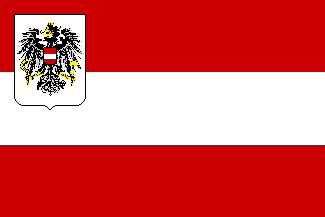
Austrian National Flag


Austrian Inland Vessel Flag
The Austrian flag red-white-red with a white shield in the canton containing
the coat of arms was adopted on May 31, 1929. According to the law,
this is not an army flag. It is for use on inland rivers on vessels
of the federal Austrian administration or government. The distance
from the upper-left part of the shield to the upper-left part of the flag
is one fifth of the height of one stripe. The height of one stripe,
the height of the shield is equal to 1.3 times the height and the length
equal to the height. The shield is of the 19th Century French style.
The bottom of the shield is on the middle of the white stripe. The
1929 eagle has no chains. Drawings are in the law.
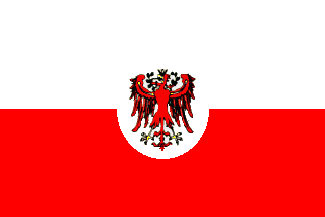
Tirol Flag
In white, a red eagle with a wreath around its head. This flag
usually has no shield, but has a white disc, visible only in the red part,
but it is possible that there are variations in use. The colors white
and green are also as the Tirolean colors. These are called "Schützen",
the plural of "Schütze" (archer) and derives from "schießen"
(to shoot). These can be also displayed as a flag. The flag
of Südtirol (South Tirol) in Italy is the same flag as the Austrian
Tirol (white over red) but is hung vertically (white on red). On
it appears the arms of Südtirol, which look like those of Tyrol, but
which are different. These arms are the very first arms of Tirol, and are
a reproduction of the arms of Tirol found on an altar in the castle of
Tirol. On the flag, under the arms, appear in black the letters "SÜDTIROL".
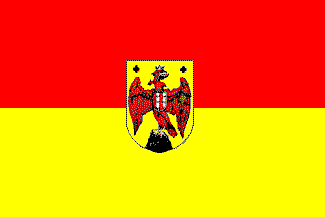
Burgenland Flag
In yellow, a red eagle standing on a black rock, escutcheon pally red
and white, over each wing a black Greek cross. In a variation, the
field of the arms is shown as gold, while the bottom field of the flag
is yellow.
Carinthia Flag
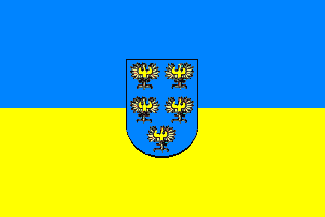
Lower Austria Flag
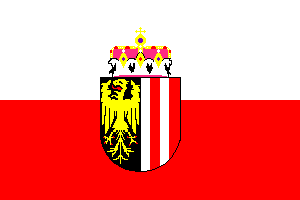
Upper Austria Flag
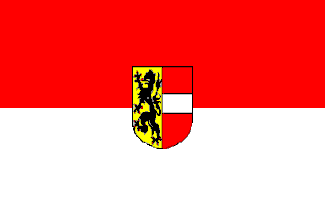
Salzburg Flag
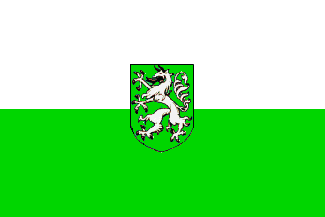
Steiermark Flag
A white panther on green. The state flag of Styria is crowned
with an archducal crown. The crowns on the flags of the Austrian
states are all different. The Steiermark flag shows the arms on it.
The state law reads: "The country's arms are on a green shield the red-horned
and armed silver panther, exhausting flames from his throat. The
shield is bearing the historical hat." In all the respective laws
and descriptions, the name of the fictive animal is always blazoned "Panther",
never "Tiger" or something else. The first historical evidence of
the panther was revealed on seals of Margrave Otakar III in 1160.
Soonafter, the sign became representative for Styria as well as for Carinthia.
The first time it was depicted was in the "Zuercher Wappenrolle" from 1340.
Today, Styria and Bavaria are the only states using the panther on their
arms. The original meaning of the phantastic animal is unknown, yet
it is assumed to be of Christian source, strengthened by the book "Physiologus".
Styria became a duchy in 1180. Because it was a Carantanian country
known at one point as a Carantanian March, Styria had a black panther in
the arms. Later, after the dispute with Carinthia, Styria changed
colours to green and white which are still in use today. Usually
there is also a crown or so called "archducal hat" over the arms of Styria.
The symbol of the panther is thousands of years old. It can be found on pictures in caverns from Stone Age and later in all early cultures from Asia Minor to Egypt and Greece. In Greek mythology, it is depicted together with the god Dionysius. Later, it appeared in the Roman Bachus, and with them it spread over all Mediterranean countries during the ancient times. In early Christianity, the writer Physiologus from Alexandria used the image of a panther in his book about animals, as a symbol for the Gospel diffusion. The idea was that the panther diffuses a sweet scent (which was a symbol of the Gospel), and animals that follow this scent are also caught by it. His only enemy was a dragon (a symbol of evil). The fact that the panther became the symbol and also the coat of arms of Carantania calls for another examination of the political history of this country and also its inclusion within the Roman Empire. Until now, this history has been interpreted as the German enslavement of Carantanians - i.e., Slovene people. The coat of arms with the panther and its symbolization discovers a completely different period of political happenings in the Middle Ages in this part of Central Europe.
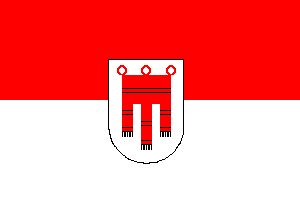
Voralberg
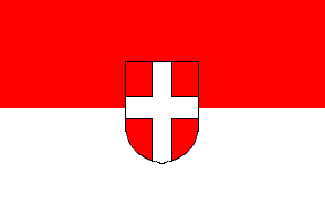
Vienna
.
These images are from Flags
of the World. Be sure to visit their web site.
.


