
Care for a chat? My MSN Messenger ID is [email protected]
LINKS:
Bakhabaru - Maldives Spoof News
Maldive Shores - Poetry, Art and Short Stories from Maldives
Realm of Infamy - Chatroom and forum for fantasy fans
From Billabong to Quiksilver: fast learner Ibu rides high in surfing
By Hilath Rasheed
"I've always
been a man of the sea," said Hussain Areef (Ibu), as he dug into a chocolate
cake at Alfresco Café in Male during an interview with The Evening
Weekly last week. 
At the age of 26, Ibu had the privilege of being then Billabong's and now Quiksilver's face in Maldives.
"It was quite natural for me to progress myself from freestyle swimming to surfing," said Ibu, in between mouthfuls of the high-fat cake.
But for Ibu, who does about three to four hours of surfing as a surfing guide at Atoll Adventures in Dhonveli Beach and Spa resort during the peak season, calories are actually what he needs.
Somewhat skinny, Ibu says that normal meals, even high-fat ones, were not enough when one does hours of surfing at a stretch every day. And he believes that a surfer also should drink a lot of water -- at least two liters a day.
Presently, he is in Male during the "off-season" of surfing, and will go back to his job as a surfing guide to Atoll Adventures sometime in February.
But he has no time to relax -- Ibu was recently chosen among three surfers and two bodyboarders who will represent Maldives at the International Surfing Association's (ISA) World Surfing Games in Equador beginning late March. Hence, this month and the next, he will be busy practicing and preparing for the World Games.
At a young age, Ibu is one of the luckiest surfers in Maldives. When his sponsorship as Billabong's face in Maldives ended last year, Ibu immediately got a sponsorship to be the new face of Quiksilver in Maldives. Starting on the 1st of this month, Ibu has been sponsored by Quiksilver to promote its products in the Maldives for the year 2004.
"I am extremely lucky to get this sponsorship. I greatly appreciate and thank Quiksilver for this opportunity. I believe that such opportunities by Quiksilver provides much encouragement to young people to pursue dreams and be examples to society," said Ibu.
Being Quiksilver's new face in Maldives, Ibu is required to set a good example for all Maldivian sports people. He has to abide laws and regulations, and even abstain from unhealthy practices such as smoking.
"I had already quit smoking a few months back," Ibu said. "I was never much of a smoker."
Ibu also gets to wear all those cool Quiksilver clothes at all times now.
Born to Raa atoll Rasmaadhoo island, Ibu migrated to Male at the age of 13, and at the age of 17, he first waded into the "Varunulaa" waves off Lonuziyaarai Kolhu with his good friend Azly and Hussain Shujau who are also great surfers.
Without failing to turn up on even a single day, over the next three months, Ibu would learn to get up and ride a board.
"At first I learnt to ride the foams. After three months, when I comfortably rode the foams, I aimed to take the drop at the peak," he said. Taking the drop is to paddle with a swell and catch the wave just as the top is about to tube over.
At that too Ibu proved a fast learner; in just a month, he comfortably began to take the drop, and ride the waves. In short, he learned to surf in just four months, which speaks volumes about his talent, taking into fact that most beginners learn to surf in about six months to a year.
But like most surfers, it would take a few more years before Ibu would advance to professional stages of surfing.
"I still cherish the day when I was able to make my first cutback," Ibu recalled. A cutback is when the surfer literally cuts back down to the bottom of the wave and then moves forward again to gain speed, with his back immediately to the break.
But Ibu's most memorable day in his surfing life was when he came first in the 1996 "Invitational Pasta Point Classic" contest held at Thari Village.
"I was quite new to the sport then. So to come first in such a prestigious tournament was overwhelming," he said.
Ibu's Billabong sponsorship was over last year after three years. Later last year, on a surfing trip to Huvadhu atoll with the executive team of Quiksilver, Ibu was offered a Quiksilver sponsorship for one year (2004) by Craig Stevenson, the Managing Director of Quiksilver International. Ibu's talents and personality had convinced the Quiksilver team that he is the right choice for Quiksilver's new face of Maldives for this year.
Ibu was two-time champion of the national surfing championship in 2001 and 2002, organized by Maldives Surfing Association. Last year, however, he came second in that championship.
Ibu's appearance in Equador in March will be his second time at the World Surfing Games by ISA; he was also in the Maldives team at the 2002 World Surfing Games in South Africa. The World Surfing Games are sponsored by Quiksilver.
Ibu came first at the Puket Quiksilver Surfing Contest in Thailand in 2001 but before that, he came fourth in the invitational surfing contest held in Sri Lanka in 2000, an event sponsored by Sri Lankan Airlines.
Ibu was also the only Maldivian to reach the third round of the O'Neill Deep Blue Open, the only international surfing event held in Maldives. He participated in the O'Neill Deep Blue Open in 2001 and 2003.
Asked whether he would give up surfing when he is too old for it, he said he will be still up for it.
"I've seen 70-year-old surfers in other countries," he said.
But he said that one day when he settled down with a family, he might not be able to devote so much time to surfing.
"Being married and having kids is a great responsibility. But I will never give up surfing though I might reduce the time I dedicate to it," he said.
(This article was published in The Evening Weekly on 18 Jan 2004)
The girls
hit the surf
Surfing helps to relax, stay in tiptop shape, and
appreciate life, say Chuppi and Zayo
By Shahla Ali
Each morning,
two young girls make their way to the surf off Lonuziyaarai Kolhu in Male.
With surfboards in hand, they wade out and prepare to tackle the relentless
waves which have aptly given the surf off Lonuziyaarai Kolhu the nickname
"Varunulaa Raalhugandu."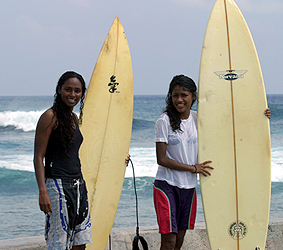
What is notable about them is that Fathmath Nazeer Jamal (Chuppi) and Aysha Zayo Hassan are one of the few girls who are taking surfing seriously, a traditionally male dominated sport in Maldives.
"We would like more girls to come here and surf with us, because it is great fun to surf together as a group."
Chuppi and Zayo say that the boys who come to Lonuziyaarai Kolhu to surf are very supportive and hang out together.
"We have a small community here. We see a lot of good kids, and other women surfers too, but only a few."
Though they had hit the water only just nine months before, visitors to the surfers' hangout can already see the great progress they have made, as Chuppi rides waves on backhand, while Zayo poses serious challenges to other beginner surfers.
Chuppi and Zayo were always fascinated by the sea.
"When we started surfing, it felt so right," says Zayo.
Chuppi says that she loves to dive but that due to physiological problems her doctor had restricted her from anything to do with the sea.
"But I couldn't stand without going out there, so the doctor finally gave in. And even from the time we were kids, we had this urge to surf," she says.
At first, you won't be knowing all of the things regarding surfing. You may refer an instruction book or an instruction video but the real thing can be learned once you hit the water, and practice as often as possible.
The currents and wave behavior also have to be observed before hitting the water (now you have the answer to the eternal mystery why some young people spend long hours on the 'thoshigandu' at Lonuziyaarai Kolhu without seemingly doing anything but just looking at the surf!)
You also have to be physically fit: cardiac exercises such as swimming and jogging will be of good help, while it pays off if you have strong muscles, especially of the arms as surfing requires a lot of paddling and swimming.
Looking on the bright side, not only does surfing make you feel relaxed, it also makes you look physically good, as that constant swimming and surfing can help you get into shape and bring improvements to your physique as well.
Chuppi had been studying in the UK but since falling ill after coming back here, she plans to continue her studies at Clique.
Zayo recently completed grade 12 from the University of Perth, Australia, and is now having a long break.
"However, I am going back next year to proceed on with my study of art," she says.
Both Chuppi and Zayo are artists. Zayo had her paintings displayed at Esjehi Gallery in Male, receiving much praise from visitors.
There is a saying that "only a surfer knows the feeling." How does Chuppi and Zayo describe that special feeling that only a surfer experiences when riding a wave?
"Surfing is really an amazing thing. When you are surfing, you feel so good and relaxed emotionally as well as physically. It clears up the mind and brings about a whole new way of thinking of life for us. It kind of a way made our lives full. We feel so happy when we surf."
Beware: surfing is addictive! The more you surf, the more you want to surf more!
Like all sports, there are risks, too, especially sea urchins ("hiyama") which can give you a bad sting. But there have been no report of any sharks attacking surfers in Maldives (though this is common in Australia).
"Sometimes we see small sharks and once I went out too far and had to come back swimming," says Chuppi.
Zayo once broke her nose, and more than once, you can get your feet cut by glass which has been thrown into the sea by people who litter, she says.
Hence, like all surfers, they are very concerned about the environment. They say that they are disturbed to see so much pollution of our seas.
"We really want to say to those who litter: think twice and think of the various bad impacts it will have on marine life. We find lots of plastic thrown into the sea."
Outside of Male, Chuppi and Zayo have surfed the waves off Kanuburudhoo island in Male atoll. They have also surfed the "Chickens", waves nicknamed after the former poultry farm at the uninhabited island of Villingili near Thulusdhoo.
What about their future plans in surfing?
"We are not doing this as a professional thing!" they echo together.
"Rather, we are doing this just for ourselves. But we might enter a competition just to have fun!"
(This article appeared in The Evening Weekly on 28 Dec 2003)
A surfing circuit needed for Maldives: MSA
By Hilath Rasheed
The "Lonuziyaarai Surfing Competition" which was scheduled to begin yesterday has been delayed, organizers said.
"We are now hoping that the competition can be started on Friday, Oct 24," Ahmed Midhshan, who initiated the event, told The Evening Weekly yesterday.
The competition was formerly called "Kaddevi" but officials this time refused to permit that name because the name referred to an evil spirit in Maldivian folk lore which inhabits graveyards and causes its victims to suffer from swelling.
Midhshan is organizing the competition in collaboration with Maldives Surfing Association (MSA), Male Opticals, De Ja Vu store and Sea Sports store. Sea sports is to give vouchers to the winners.
The winner is to get Rf1,000, while the runner-up gets Rf700. The third place winner gets Rf500 while Rf300 is given to the surfer who comes to fourth place. Trophies will also be given to the winners, according to Midhshan.
An opening ceremony was scheduled for yesterday at Lonuziyaarai Kolhu, Male's traditional surfing spot and hangout, but cancelled because official permission procedures failed to get through.
The Lonuziyaarai Surfing Competition is organized primarily by Midhshan, a surfing enthusiast, which underlines the importance of having continuous surfing competitions in the Maldives, an MSA official said.
"We are trying to set up a surfing circuit but we face funding problems. It is very difficult to get sponsorships," MSA's current chairman Shahid Amin told The Evening Weekly yesterday.
"If not for the few private donations, we will not be able to hold the few competitions we are now able to hold," he said.
A professional surfing circuit is necessary in order to hold a series of surfing contests, from which surfers can gather points, to ultimately stamp their place in Maldives' surfing ranks. This will also be a valuable system for local surfers for them to professionally join regional and renowned international surfing competitions.
Even now, a few local surfers have gone a long way in surfing at famous surfing competitions in California, etc.
Furthermore, Maldives has already marked its place as one of the premium surfing destinations in the world. Many international pros visit the Maldives to surf that "perfect wave."
In addition to Maldives' overseas fame as a surfer's dream, the sport is now enthusiastically taken up by locals as well. Notably, women are also joining the ranks of this earlier traditionally male-dominated sport. The line-up now sees enthusiastic girls alongside their male counterparts though this number may be a few at the moment.
"A surfing circuit may be the answer to encourage more people to take up this sport. By keeping the spirit of surfing always high, we can get amateurs to the scene while helping the pros improve their skills," commented an MSA official.
(Modified
from the original article which appeared in The Evening Weekly on 19 Oct 2003)
Discovering the sea 
"Discovering" the sea? You might be baffled as to what I am trying to say here, me being coming from a country that has 90,000 square kilometres of ocean, ocean, ocean.
What I mean is, how I truly discovered the magical thing that is the sea.
You can never get bored looking at the sea. It's an inspiration that can spur many things; lighten up your mood, provide inspiration, etc.
But the sea has other qualities, too, and you only know it once you get into the water. But you have to really get into it to discover the magic.
No words can describe what the surfer feels as he rides a wave. I once tried doing so in an English-language feature article I wrote for Haveeru Daily. The closest I could come to describing the feeling was to write about the surfer hearing "glass shattering" all around him as the surf breaks. But that is only stating the obvious.
So far I have only been surfing without a board--just riding the wave with what we call a "boogie board." And even that is a magical feeling. As ten-foot waves carry you along with it, in its caressing arms, with that "glass shattering" surf all around, it lifts your spirits to heights that only your imagination can begin to fathom. People say that surfers are carefree people; I now understand what that means -- when you are riding a wave, you don't have a care in this whole wide world--it's just you and the wave.
I learnt swimming as late as April 1991. I bet you are thinking "How can these guys who live in a country consisting of 99 percent sea possibly don't know how to swim?" The point is, some of our parents are still quite paranoid about letting us near the sea, fearful of "accidents." At least children living in the islands can secretly go to the sea when their parents are busy at house chores or work, but for us city dwellers it is very difficult to escape the round-the-clock prying eyes of our parents.
It was as late as 1992 when most young people in Male started learning to swim as a must -- for survival. It was a tragic accident in 1992 that sent schools scrambling to make it a must for their students to learn to swim: a higher secondary school graduate from Science Education Centre (SEC), a guy I was aquainted with, tragically drowned after falling into the coast off the southwestern harbour. Thus the "Every child swims" campaign took flight. And swimming became so popular that it became a fashion, a lifestyle. Even now the trend continues. You can spot swimmers round the clock at the artificial beach or around Male's southern and southwestern coast.
It was through a major effort in 1991 that I managed to convince my parents to let me go swim. I joined the swimming course organised by the Youth Centre. It was conducted by Maldives' national swimming coach who was a professional swimmer from India.
Imagine. At that time we beginners got to train under the national coach, something the present generation can never get the privilege of! I am not boasting; at that time the number of people who wanted to learn swimming -- not just professional swimming -- could be counted by hand. However, the scene has now changed, and there are so many people now into professional swimming that only the very top have the privilege of training under the national coach.
Swimming was not the "in" thing then. I remember how the number of learners in our batch dwindled day by day. By the time I approached my GCE O/L exam (in January 1992), only me and two kids went every morning to the southwest harbour to learn swimming under the coach.
I still remember the two kids very clearly. Their names are Mazin and Muzny, and I think they were in Majeediyya School grade 6 and 7 then respectively. Real nice kids they were. I wonder where they are now. Their dad used to come and watch us swim in the shallow waters.
Swimming came easy to me. The day before I went to learn under the coach, I went on a trial "swim" with my friends to the spot behind the new powerhouse. I put my foot into a deep spot and immediately I started to sink.
But the next afternoon things were totally different. When the coach told me that all I needed was to let all my fears go, let loose my body and kick forward, everything came so easy. On my first try, I could venture out without sinking!
Me and my friends did great progress and soon we were swimming back and forth between the rocky shore and a bokkura (a small wooden vessel sometimes we use to go reef fishing) about 25 feet away.
Good memories still remain with me from that learning-to-swim experience; it was with my batch that one of my friends -- who I will simply identify as Moosa -- learnt professional swimming and went on to become one of the best swimmers of my generation, going on to win many national competitions, and getting to represent Maldives in many international swimming competitions. Recently (in February 2002) I met him while I was swimming behind the new powerhouse. He has somewhat lost his athletic build and it seems now that he is a private swimming instructor--and making good money from it. The fact that he has "retired" from professional swimming made me realise how I myself have lost that youth--those times when we didn't have a care in the world and spent all our time living a carefree and spirited life.
I still go surfing--without the board. Bare hand. Riding the wave on my belly. Flying on the surf. It's magic.
One year of bodyboarding
23 July 2004 marked one year since I took up bodyboarding. It was that day last year when I first stepped into Varunulaa Raalhugandu off onuziyaaraiy Kolhu with a boogie board bought from Kuda Ayya, the reigning national bodyboarding runner-up. I can't believe that all that time has passed!
I still remember that day when I and Hiriga (my colleague and managing editor of Haveeru Daily) stepped into the Raalhugandu, and when we came ut, we were met with a round of applause from surfers hanging out near Tuscaloosa restaurant. I am glad they welcomed me -- a new surfer to a unique subculture group.
I was actually thinking of marking the occasion by hosting a little tea party for my surfer friends. Hell, I even had to feed the little buddies to mark the first time when I actually tubed. It was in early June 2004 when the National Surfing Championship or the trials for the O'Neill Deep Blue Open were ongoing. True, tubing is a great thing in bodyboarding and surfing. To tube is to ride through the tube of a closing wave. Believe me, it's an exhilarating experience, a really special experience, as any surfer or bodyboarder would attest to. Hmm... I'm now wondering: would I have to feed the little mouths when I am able to do my first air barrel or 360 degree turn? I'll have to wait and see...