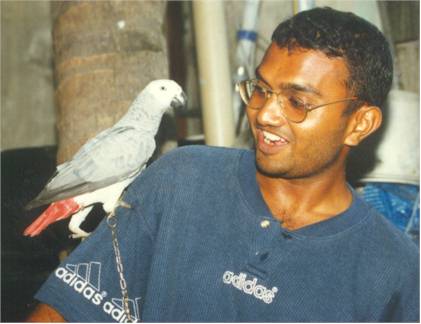
Hosted by Geocities
Hilath's Home Page
Happenings
Feedback:
[email protected]
Parrot:
Lost and Found
I don't mean that it almost died but then it could have died if we had not found it in time.
Here's what I happened.
It was the early days. The parrot still had not befriended my dad. In fact, it was terrified of him cos he was doing some carpentary works at home and was making loud noises with the grinders, etc.
So everytime my dad came near the parrot, it shied away. It even tried to fly away and was only held by the chain on its perch.
This particular day, more than a year ago, the chain was all wound around the perch and the parrot had no more room to move about. Its feet could have got hurt.
So my further loosened the chain, and while in the process of chaining it again, the parrot flew and went into the sitting room. Before my father could close the doors, it flew out and over the roof. And could be seen no more.
We all searched for it all around the area, went into some nearby houses and asked around, and looked and checked the trees around and near the block. But the parrot was nowhere.
I immediately set about putting an ad in Haveeru Daily where I work. I borrowed the digital camera and went to Vega Point where I took the photograph of another African Grey Parrot. (For all the times we had it, we never had taken a photo of our own parrot.) I put the photo in the ad, wrote something like "An African Grey Parrot like this in photo has been lost. It has a chain around its feet and is friendly most of the time. If you ever come across this, please call (my phone number) and we will give you a reasonable reward."
Within three days, we had a call.
The parrot was sitting on a branch on a tree in Aliya School and one of the teachers there, a friend of my bro-in-law, had called him.
An outrageous thing happened too because some people, some of them just kids, had come out of nowhere, and were claiming that the parrot was theirs. They even tried to go up the tree and catch it. The parrot would have surely flown away because it was not friendly with strangers. I realised that it was a mistake to have written in my ad that the parrot was friendly. I should have written something like "Don't try to catch it yourself but inform us ASAP."
Anyway, what saved the parrot was the friend--I've forgotten his name but I think it was Ahmed--he had seen the ad and he knew Yaman. Therefore he knew that all the guys who had gathered there and were laying claim to the parrot were lying. And he prevented anyone from going near the tree and catching it.
I was at Haveeru newsroom that early afternoon when the call came to my home. But since I had not much reporting to do that particular morning, I decided to go out and drop in at my home for a few minutes to have a drink.
When I came home someone told me that my bro-in-law Yaman and my dad were already in Aliya. The person was surprised I didn't get the call.
"What call?" I asked.
"Why, everybody's trying to get you to go and get the parrot down. They won't let anyone else come near the parrot should it fly away."
Yaman and dad must have called me just after I left office. That's why I must have missed their call. So I pedalled on my dark green mountain bike and was near Buruneege when I spotted my dad coming in the opposite direction.
He came towards me and stopped me in the middle of the road.
"This is one time in which I truly wish you had a mobile phone. We've been trying to reach you like hell."
Was I surprised about dad mentioning mobile phones at a moment like this? Mobile phones had just been introduced to Maldives and it was the "in" thing to have mobile phones. It was so fashionable to show off that you owned one of those prized, technological gadgets. But I had resisted buying a mobile phone, claiming I needed my privacy (the telecom company had not introduced caller identity services then.)
Whatever he said next passed by me in my anxiety to rush over to Aliya.
I parked my bike near the wall and went in. The crowd was still there. Little children who were in the classes were looking at us, intrigued by what must be a rare event occuring at the school. Something that snapped them out of their mundane studies.
Yaman and dad had undergone the trouble of carrying the perch to the school grounds and put it under the tree. They were hoping the parrot will see the familiarity of the perch and fly down to eat.
But it was just sitting there. Doing nothing.
I called "Hello" a few times, hoping it would recognise me. But it just sat still. Almost like stone.
I thought it must have been weakened by the lack of food. It was now almost three days since it flew away.
I took off my tie, climbed a water tank under the tree, which led to the roof of a classroom from which I could climb to the tree.
As soon as the parrot saw me on eye-to-eye level, it turned and looked directly at me. And there was recognition on its face. But still it wouldn't budge an inch.
I slowly walked on a big branch that ran directly under the branch on which the parrot was perched. I looked at its feet. The chain was still there. The trick was to get hold of the ring of that chain without frightening it off.
I made every effort at not making any quick motions. Because I saw that even the slight shaking of the branch was unnerving the bird and making it fidgety.
I finally managed to get close enough to touch the bird. Under ordinary circumstances I would never have the nerve of climbing, much less, walking on that precarious branch.
I am afraid of heights. Even at Science Education Centre (SEC), when I was doing my A'Levels, I think I was the only one who never climbed the big mango tree there. While the other guys were walking around on those thick branches, I had the satisfaction of picking mangoes only from the roof or balcony of the classrooms.
I wanted to see whether the parrot will respond positively to me. I picked off some leaves and offered it. Slowly it came towards me, took the leaves from my hand with its beak, and began to chew them apart and dropping them.
Good enough. I knew then that I should try to see whether the parrot will let me touch it. I slowly raised my hand, very slowly, and pulled it close to the parrot's face.
Sure enough, it lowered its head, and indicated it wanted to be scratched. I slowly scratched its head and it just sat that way. Now I knew that I could take it. But still I had to be careful.
All this time, Yaman was shouting to me to grab it. Children and teachers had come out and were watching the fun.
For Yaman and the others down there anxiously waiting for the outcome, I was agonisingly "slow" in grabbing hold of the bird when I practically had it in my hold. They failed to see the reason why I was so "slow" in catching the bird when I had it in my hand.
There was no way I could catch it if it didn't want me to catch it. Call it my own animal instincts but I knew it anyway. Maybe you will need to recognise the characters and traits of living things in order to really understand them, understand their moods. At least that's what I understood from all the times I spend around my African Grey Parrot and I think that's why I understand it more than anyone else, and do things to it that really pleases it, which is the reason why I feel that it is more attached to me still than anyone else even though I now do not get to be around with it because I am in Malaysia.
Just to cite one example, like cats, birds also need to be scratched. So does my African Grey. It likes to be scratched on the head and sideways on the face. What it really hates is when we touch its tail or its wings. If you bring your hand towards it from behind it, it is frightened and even tries to fly away. It is suspicious of things that come from behind. If you want to touch it, you have to touch from the front. But even then, you cannot touch just anywhere. You can only touch its head or beak. It will reluctantly tolerate if you touch its breast but I can see that that even unnerves it.
I slowly pulled my finger into the ring of the chain and held it firmly in my hands. Now I had it in my hand. But I was still not sure whether the bird wanted to be taken.
That's another trait of this parrot. If you put it to a place on which it really likes to be perched, it won't get off and come with you. I found this out when I and Yaman once took it to Henveiru park and let it walk freely on a branch at a Hirundhu tree there. It was so comfortable and so enjoying there, we had to force and drag it down, and even then it was trying to hold onto the branch with its claws, and grabbing onto other small branches with its beak and not letting go. We practically had to open its claws and beaks before we could force it off the tree. And you can see it literally fuming on the face when we did it. Yes, it's true. You can really see on its face when its angry or unhappy.
I braced myself to get off the tree and started walking back towards the trunk. Sure enough the bird didn't want to come. It held fast onto the branch, and when I tried to force open the claws, it caught hold of a smaller branch with its beak and held on. I had to be extra careful now because I had now two tasks in hand. One was getting the bird to let go off its hold. The other was making sure I didn't fall from the tree!
I finally got down the tree, with my parrot. But it was all angry because it didn't want to get down from its comfy perch.
It had actually thinned.
Looked shrunken. When we took home, and put it on the perch, it started eating
the sunflower seeds. It ate continously for more than a half hour! It was
practically starving.
It took about a week before it finally returned to its normal, cheerful, playful mood.
My African Grey Parrot lives on seeds, and because Male doesn't have vegetation that offers the kind of edible seeds that parrots eat, I don't know how long a parrot can survive, if not caught and fed by someone.
But I didn't want that. It could have been a worser fate. If someone caught it, and tried to sell it, it would have taken days to get it sold and what if it died before that, due to mistreatment. It takes only a proper owner to take care of his or her birds properly. And even then most bird-owners don't know the requirements of their pets. They just keep them in a cage, put water and food, and that's it.
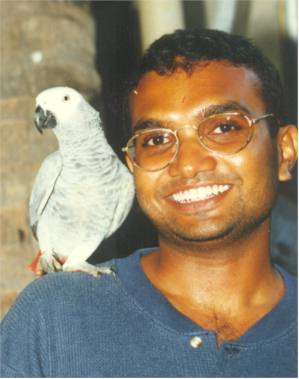
I am very fond of this bird. When I went back to Male in June 1999 after my first semester, I was wondering whether the parrot will recognise me.
I was very careful in not frightening it. For the first two or three days, I just made sure that it saw me frequently so that its memory of me will be triggered. Then I started saying "Hello."
The first night it was looking at me intensely. I wasn't sure whether it was giving me a strange look or it was just amused to suddenly see me after a big absence.
Anyway, after three days, I could wait no more and went near to it and offered my hand. It bent its head and indicated that it wanted to be scratched. Everything was back to normal. I took it off its perch, put it on my arm, and went for a walk around the neighbourhood.
I was back together with my birdy friend.