
|
|
VACANCIES
If you are a Tour Operator or
Independent Tour Leaders who sells
Tour package to Toraja Land or
Sulawesi, for Local Touch with Local
Prices, specialty for Trekking,Culture,
Local Events, Rafting, Bird watcher,
Local
Information, etc . Please contact
Us for your local representative than
You will Pleasantly surprise ! |
|
| |
| |
| |
| |
|

|
|
 |
Like the petals of a windblown
orchid, the unruly peninsulas of Sulawesi reach out into the
Celebes, Molucca, Banda, and Flores seas. Within the borders of
this incredibly-shaped island, produced by the collision of
ancient continents, are found a variety of extraordinary
landscapes. Rugged mist-covered mountains, primal tropical
jungles, emerald-green rice terraces and deep, mysterious lakes
dominate the interior. Along the coast, dazzling
coral reefs encircle dormant
volcanoes jutting dramatically out of the sea. Stretches of
sparkling beach fringed with coconut trees are flunked by rugged
lime stones outcropping that might have come straight from a
Chinese painting |
South Sulawesi
Makassar
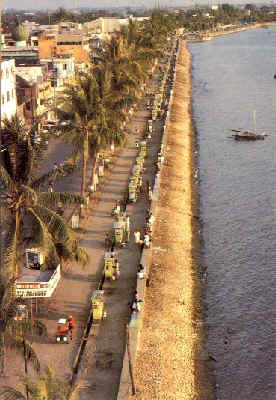 The
bustling city of Makassar is the only Indonesian city port which
actually embraces the sea. It curls along a narrow strip of beached
ridges facing westward to the Makassar Straits. For most travelers, it
is “the prettiest, and perhaps the cleanest-looking, of all in the
islands.” The
bustling city of Makassar is the only Indonesian city port which
actually embraces the sea. It curls along a narrow strip of beached
ridges facing westward to the Makassar Straits. For most travelers, it
is “the prettiest, and perhaps the cleanest-looking, of all in the
islands.”
Bira
 Fishing,
boat building and weaving are the primary commercial activities in
Bira. Its white sandy beaches are now drawing travelers
off the main tourist trail from Makassar to Tana Toraja. There is
swimming, snorkeling, fishing, and dolphin watching (if you can spot
them), but most people stake out a shady corner of the long west
beach to snooze or enjoy a good book. Fishing,
boat building and weaving are the primary commercial activities in
Bira. Its white sandy beaches are now drawing travelers
off the main tourist trail from Makassar to Tana Toraja. There is
swimming, snorkeling, fishing, and dolphin watching (if you can spot
them), but most people stake out a shady corner of the long west
beach to snooze or enjoy a good book.
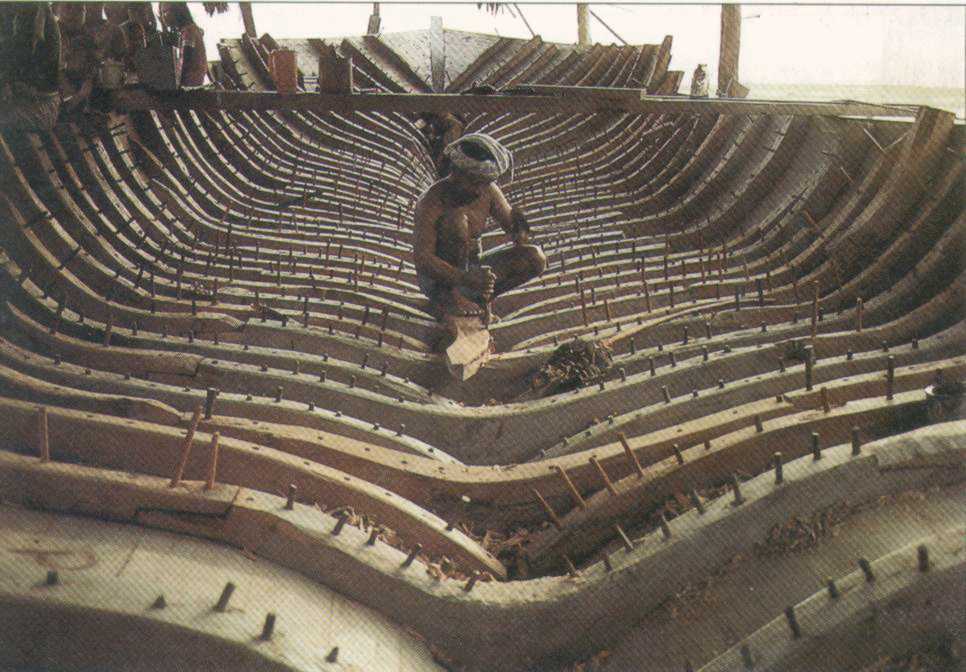
Traditional wooden boats are built all along Sulawesi’s south coast,
but epicenter of the industry is the village of Tana Beru. You can
find hundreds of boats in the bantilang (boathouses) along the beach
here. Tana Beru is the ideal location to witness this ancient skill,
currently undergoing the pressures of modernization.
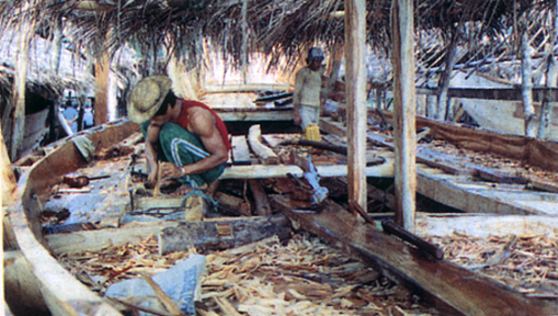 There
are a number of traditional boat types under construction in the
village today. Pajala are small, sharp-stern 9 to 10 meter fishing
boats. Patorani are decked boats from 10 to 18 meters long, used
mainly to fish for torani (flying fish) in the open sea. Paduwakang
are enlarged patorani, fitted with an aft deck (ambeng) and low
foredeck. These are used for extended sea voyages. There
are a number of traditional boat types under construction in the
village today. Pajala are small, sharp-stern 9 to 10 meter fishing
boats. Patorani are decked boats from 10 to 18 meters long, used
mainly to fish for torani (flying fish) in the open sea. Paduwakang
are enlarged patorani, fitted with an aft deck (ambeng) and low
foredeck. These are used for extended sea voyages.
The
most renowned and magnificent boats made in the region are the pinisi.
These large, sleek Makassarese schooners measure 30
meters or more but are sadly less common today because of high
manufacturing costs. Nearly all of the smaller fishing craft and some
construction, but many have been altered to accommodate motors.
Sengkang
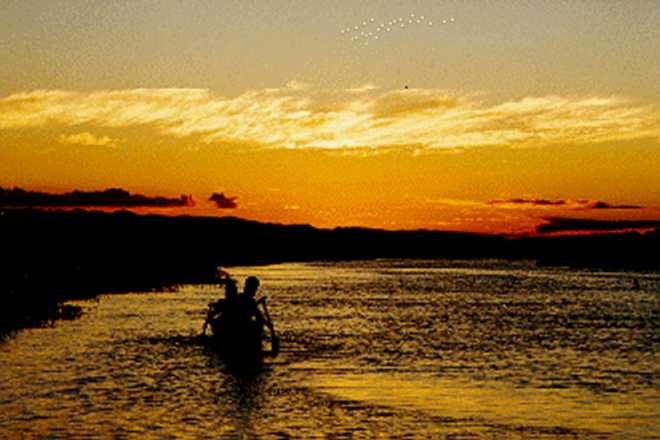 The
lakeside resort of Sengkang between Bone and Pare-pare has only
recently been discovered by foreign tourist. Scenic Danau Tempe, a
large shallow lake fringed by wetlands, is the main attraction and is
best admired on a boat trip. Geologist believe the lake was once a
gulf between southern Toraja and the rest of South Sulawesi. As they
merged, the gulf disappeared and it is thought the lake will
eventually disappear too. The
lakeside resort of Sengkang between Bone and Pare-pare has only
recently been discovered by foreign tourist. Scenic Danau Tempe, a
large shallow lake fringed by wetlands, is the main attraction and is
best admired on a boat trip. Geologist believe the lake was once a
gulf between southern Toraja and the rest of South Sulawesi. As they
merged, the gulf disappeared and it is thought the lake will
eventually disappear too.
There
are floating houses, magnificent bird life, and a range of
commercial activities on the lake. Lake tours usually
take in Batu-Batu on the other side, but the most interesting part
is along the river around Sengkang.
Tana Toraja
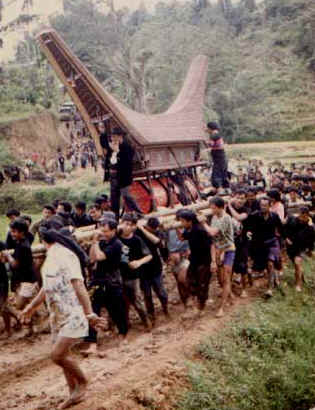 With
majestic panoramas, captivating villages and dramatic ceremonies, Tana
Toraja is the undisputed highlight of any journey to Sulawesi. With
the opening of several tourist-class hotels, the Toraja highlands are
now easily accessible to visitors. In the northern part of South
Sulawesi, Tana Toraja is a cultural treasure of the first order.
Embellished with a unique art
and architecture, the customs and venerable traditions leave lingering
impressions on the traveler’s mind long after the return home. With
majestic panoramas, captivating villages and dramatic ceremonies, Tana
Toraja is the undisputed highlight of any journey to Sulawesi. With
the opening of several tourist-class hotels, the Toraja highlands are
now easily accessible to visitors. In the northern part of South
Sulawesi, Tana Toraja is a cultural treasure of the first order.
Embellished with a unique art
and architecture, the customs and venerable traditions leave lingering
impressions on the traveler’s mind long after the return home.
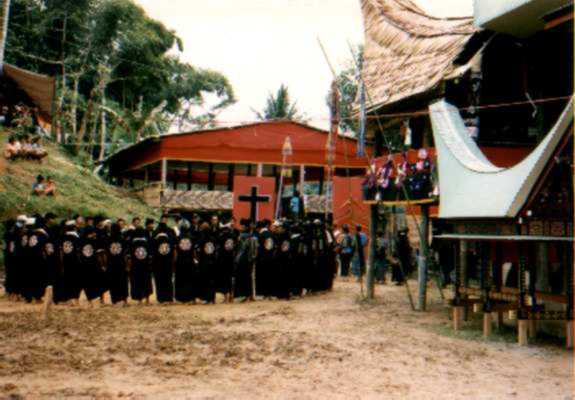 Most
interesting are the ceremonies, especially the grand burial rites,
lasting for days and filled with ritual dances and the sacrificing of
animals. Traditionally, the Torajan lay their dead to rest in graves
and tombs chiseled or carved into steep cliffs, stretching up dozens
of meters. Some contain little balconies on which wooden effigies of
the dead stare down from the face of the cliff. The only access to
these tombs is by way of bamboo ladders. Other burial sites are in
the caves frequently found at the base of the cliffs. Most
interesting are the ceremonies, especially the grand burial rites,
lasting for days and filled with ritual dances and the sacrificing of
animals. Traditionally, the Torajan lay their dead to rest in graves
and tombs chiseled or carved into steep cliffs, stretching up dozens
of meters. Some contain little balconies on which wooden effigies of
the dead stare down from the face of the cliff. The only access to
these tombs is by way of bamboo ladders. Other burial sites are in
the caves frequently found at the base of the cliffs.
Central Sulawesi
Lake Poso
Covering an area of 32,300 hectares and
reaching 450m in depth, Lake Poso is the third largest lake in
Indonesia. It is located 600m above sea level, so the evenings are
pleasantly cool without being too cold. This area is also famous for
wild orchids, especially on the western shores near Bancea.
Togian Island
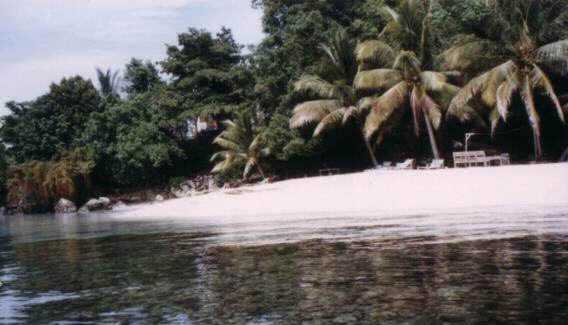 Togian
is a group of wonderful wonderful islands with white sandy beaches,
colorful corals for diving and snorkeling, and a nature preserve
located in the heart of the Tomini gulf. This is the only place in
Indonesia where you can find all three major reef environments -
atoll, barrier, and fringing reefs - in one location. Togian
is a group of wonderful wonderful islands with white sandy beaches,
colorful corals for diving and snorkeling, and a nature preserve
located in the heart of the Tomini gulf. This is the only place in
Indonesia where you can find all three major reef environments -
atoll, barrier, and fringing reefs - in one location.
The
people, the nomadic Bajau people, dive for trepang (sea cucumber),
pearl and other commercially important marine produce, just as they
have done for hundreds, perhaps thousands of years. They are
hunter-gatherers who spend more or less their whole lives on boats,
traveling as families wherever they go.
Morowali
This 225,000 hectare
nature reserve was established in 1980 on the eastern shore of Tomori
Bay in the awake of Operation Drake, a British-sponsored survey of the
endangered species of the area. It rises from islands on the bay and
accessible lowland plains, to densely vegetated peak of up to 2630m
high.
This reserve is home to
around 5000 Wana people, who live mostly by hunting and gathering, and
through shifting agriculture. There are small Wanu settlements at Ranu
and Kayu Poli on the Morowali Plain, but most live in the isolated
highlands. The park is rich in wildlife, such as anoa, maleo birds,
babirusa and several primate species, as well as flora and fauna
unique to Morowali, but unless you are lucky dense jungle is often all
you will see.
North Sulawesi
Manado
and Bunaken
 Manado,
bustling capital of North Sulawesi province, sprawls inland across
low, palm-clad hills around a wide bay fringed with luxuriant typical
vegetation. In the distance, three volcanoes complete the city’s
spectacular setting. Manado is mainly of interest to travellers for
its convenient location as a base for exploring the Tondano region,
and for the splendid underwater scenery of Bunaken. Manado,
bustling capital of North Sulawesi province, sprawls inland across
low, palm-clad hills around a wide bay fringed with luxuriant typical
vegetation. In the distance, three volcanoes complete the city’s
spectacular setting. Manado is mainly of interest to travellers for
its convenient location as a base for exploring the Tondano region,
and for the splendid underwater scenery of Bunaken.
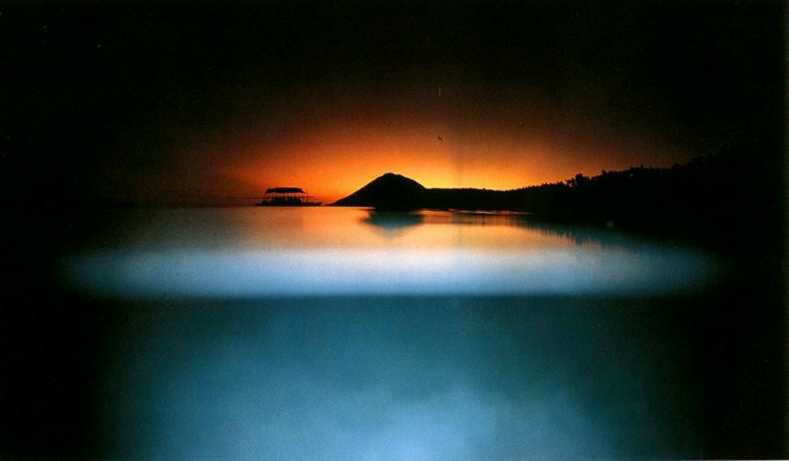 The
wildly varied shapes and colors of the coral off Pulau Bunaken have
become an international snorkeling and scuba-diving attraction.
The flat coral of Pantai Liang takes a dramatic 90 degree turn about
100m offshore, dropping down from one to two meters to dark oblivion.
The area offers several different kinds of dives (drift, deep, and
wreck), the prime attraction are the vertical walls pierced by shallow
caves and crevasses. These
provide shelter and protection for reef fish, and they are also
covered with a layer of invertebrate marine life.
Hard and soft corals, whip corals, sponges and filter feeders
all cling to these walls, offering a dazzling kaleidoscope of colors. The
wildly varied shapes and colors of the coral off Pulau Bunaken have
become an international snorkeling and scuba-diving attraction.
The flat coral of Pantai Liang takes a dramatic 90 degree turn about
100m offshore, dropping down from one to two meters to dark oblivion.
The area offers several different kinds of dives (drift, deep, and
wreck), the prime attraction are the vertical walls pierced by shallow
caves and crevasses. These
provide shelter and protection for reef fish, and they are also
covered with a layer of invertebrate marine life.
Hard and soft corals, whip corals, sponges and filter feeders
all cling to these walls, offering a dazzling kaleidoscope of colors.
|
|