
|
|
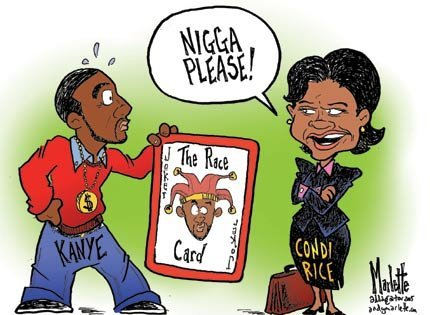
| Contrasting Condoleezza "proper speech" |
Critiques and Annotated Bibliographies
Baugh, John. Black Street Speech. Austin: University of Texas Press, 1983.
In a pro-dialectal argument, Baugh presents the debate if “Black Street Speech”
(African American Language) is a language system. He recommends that “street
speech” be acknowledged as a social dialect. This dialect is characterized by a large
range of linguistic variations from verb usage to effectiveness. It is evident that Baugh
believes that the mastery of any personal dialect based of cultural conditions helps
pave a way to greater personal success. He discusses the comfort level that arises
when African Americans speak a form of the Black English Vernacular. His
introduction implies that speakers are aware of their use of a black dialect around
common speakers and also comments on the ease to code-switch depending upon their
surroundings. Ultimately, Baugh asserts that African American dialects are part of a
larger social foundation that carries the values of any black community.
Bland-Stewart, Linda M. “Difference or Deceit in Speakers of African American
English.” ASHA Leader 10 (2005): 28-31.
Concerned with the perception of African Americans who speak the cultural dialect,
Bland-Stewart refers to the assessment of language disorders. Her research proves
that when Standard English speakers are compared to African Americans dialect
speakers, results do not reflect the speaker’s true abilities due to conflicting language
disparities. These comparisons do not distinguish syntactical or grammatical
discrepancies of the two language systems. Bland-Stewart suggests that African
American English is not a language disorder but simply a language difference. She
presents support that Black English is effective in that it simplifies Standard English
by uniquely eliminating plural number agreement. However, justification is also given
that due to the use of multiple negations, irregular verb usage and the inflection of the
verb “to be” make African American English disorderly in sentence structures. Her
concluding support of endorsing African American English as a language difference
stems from the improper comparison of Standard English to African American
English.
 |
Cummings, Melbourne and Judi Moore Latta. “‘Jesus is a Rock’: Spirituals as
Lived Experience.” Understanding African American Rhetoric. Ed. Ronald
Jackson II and Elaine Richardson. New York: Taylor & Francis Books, Inc.,
2003. 57-67.
Melbourne Cummings and Judi Moore Latta, professors at Howard University,
discuss the symbolism present in Negro spirituals in African-American English. They
claim that spirituals can be traced back to African oral traditions with elements such as
the call and response, and these songs show that despite actions against slaves in
attempts to destroy their sense of community, themes of togetherness reigned
supreme. Spirituals provide African Americans with a means of communication, and
their lyrics include deliberate and indirect messages and a means by which slaves
expressed their religion. Today, seventy-eight percent of African-Americans identify
themselves as Christians, and in analyzing the words of Negro spirituals, one can find
omnipresent remnants of African American cosmology. This includes the centrality of
Jesus, the symbolism of the word “freedom”, and dedication to racial equality.
Through interviews with various African-Americans, Cummings and Latta found that
spirituals allow one to feel a connection between his or her own past and that of the
African-American community as a whole. This source would prove to be valuable to
anyone looking for a well-developed analytical reference that fully explores the
contextual significance of Negro spirituals and their place in both the contemporary
and previous African American experience.
Dillard, J.L. Black English. New York: Random House, 1972.
In a rather opinionated collection of evidence supporting Black English as a developed
dialect, Dillard writes to disprove the stereotypes surrounding African American
speech. He comments on the establishment of Black English as it pertains to
education. While making his argument, he simplifies linguistic terms for the common
reader, and specifically references the differences between a dialect and an idiolect.
Specifically, he theorizes on how the black southern accent or idiolect from slavery
has impacted how white southerners speak today. Dillard supports his points on the
structure and speakers of Black English by discrediting many other researchers. He
attempts to convince readers that lack of historical and social information about Black
speech is why there are handicaps to education programs. He concludes that a new
field of study, social dialectology, has originated from the research of African
American English.
Lippi-Green, Rosina. "What We Talk About When We Talk About Ebonics: Why
Definitions Matter." The Black Scholar 27 (1997): 7-11.
In this article Lippi-Green rejects the negative connotations that come with the
what she refers to as African American English but also identifies with
Ebonics, Black English, and Black Vernacular English. She states that critics
title African American Vernacular English as "slang" and "jargon" which gives
little value to the dialect and is incorrect. She also criticizes public figures such
as Clarence Thomas and Jesse Jackson for speaking against African American
Vernacular English, when they too are speakers of the dialect. She concludes
with the statement that in spite of the stigmatization and discrimination
received from African American Vernacular English, it still persists and
"Clearly, African American Vernacular English speakers get something from
their communities and from each other that is missing in the world that is held
up to them as superior and better."
Means-Coleman, Robin and Daniel, Jack. “Mediating Ebonics.” Journal of Black
Studies 31 (2000): 74-95.
In this article, Coleman and Daniel discuss the fact that a lot of the negative images
about Ebonics and the black culture as a whole come from the media. Since the media
defines most things in society, it demotes Ebonics without considering the relevance
of the historical roots. Coleman and Daniel mediate that due to their displaying
Ebonics as “comedic and ridiculous” the nation has been misinformed about dialect
which about the dialect which has created confusion on what to do to move African
American children toward standard English the misunderstandings and cache of racist
jokes such as “Boobonics”, has eliminated a communicative space for solutions.
Smitherman, Geneva. “Language and African Americans.” Journal of English
Linguistics 32 (2004): 186-196.
In alluding to the Oakland Resolution on Ebonics from 1996 and the “Black English
Case” from Ann Arbor, Michigan from 1979, Smitherman points out the similarities
of the two cases. She proposes that history repeats itself with these cases. Despite the
two cases being miles away from each other and two decades apart, no legislative
progress was made in the implementation of language education policies towards
Black youth. Ebonics was only acknowledged as the primary “language” used by the
majority of students. Smitherman gives justification on why these cases are not as
impacting as Brown v. Board of Education. She states that programs such as the
California Standard English Program or the Language Development Program has
perpetuated the belief that African American English is a corrupt form of English
rather than a variation. The Ann Arbor- King case and the Oakland Resolution both
have shined negative light on African American speech. Smitherman feels that with
this negative image, its time for researchers and educators to start to genuinely
evaluate and recognize language diversity and dialect awareness.
Taylor, Hanni U. Standard English, Black English, and Bidialectalism. New York:
Peter Lang, 1989.
Lang analyzes the personal implications behind speaking Black English. He claims
that Black English is a barrier to the progress of black students. He also argues that
speakers of Black English are perceived as academically unprepared and that the
dialect causes students to have deficient cognitive skills. This lack of perception is
what shapes preconceived notions about blacks and their community. Lang describes
how Black English developed to assimilate blacks and other immigrant groups to de-
creolized societies. Varieties of English created by blacks, specifically African slaves
with slave owners, indicate a social distance between whites and blacks which allow
the black culture to maintain their ethnic identity. The African American personal
language/dialect(s) is a direct reflection of African American image and their cultural
patterns.
Home | History | Important Figures | Criticism | Bibliography | Extra Info | Staff