
|

|
|
History of African American Vernacular English ___________________________________________________________________________________________________________________________
Because of the limited amount of data available on the speech and language of African indentured servants and slaves brought to colonial America and the development of the language of their offspring, linguists have many different theories and hypotheses about the origins of African America English. The creolist theory and the dialectologist theory, are the two major opposing theories on the origins of African American English. There are also many other hypothesis that branch off of these two theories.
Creolist Theory
States that African American English started out as a full fledged creole similar to Gullah, the English-based creoles of Jamaica, Trinidad, Guyana, Hawaii, and Sierra Leone. It was introduced to the American colonies through the large numbers of slaves imported from the colonies of Jamaica and Barbados were creoles were common. In these regions the percentage of Africans ran from 65 to 90 percent. Until about 1999, this was the dominant and most widely accepted view.
Dialectologist Theory
Argue against the creolist theory, and instead assert that the speech of African Americans derives primarily from the dialects spoken by British and other white immigrants in earlier times.
Other hypotheses include:
Mufwene Hypothesis
Salikoko Mufwene believed that the language used by the founders of colonial America had a large impact on the language of Africans and their descendents. He suggested that given the lower proportions of blacks to whites in the founding phase of most colonies, creole continua may actually have formed backwards, with the first generations of Africans acquiring something closer to metropolitan English, and later generations acquiring successively “reconstructed or creolized" varieties as they had less access to white norms and learned increasingly from each other.
Winford Hypothesis
This position is a compromise between the creolist theory and the dialectologist theory. Like the creolist theory, Don Winford views the emergence of current African American English as a gradual affair. However, moving closer to the view of the dialectologists, he argues that African American English was never a creole but it was created by African Slaves who were in contact with the Europeans in the South during the seventeenth century.
The debate between creolists and dialectologists is still going on today with many influences by different linguists. These hy here are just the most prominent and established of many other views by many other linguist including Shans Poplack, Guy Bailey, all having diffent theories slightly different theories that somewhat agree and relate to each other. All linguists agree on one central aspect concerning the evolution of African American English tenable. One of the most recent issues in the debate of African American English is the divergence issues which questions whether or not African American Vernacular English is currently becoming more different from white vernacular dialects in the United States. Today, African American English has been a hotly debated issue which creates issues on topics such as whether or not “Black English” should be taught in predominately black school districts, whether it is indeed a language, and whether certain words within the dialect are acceptable.
| January 26, 1973 | The term “Ebonics” coined by Robert Williams at “Cognitive and Language Development of the Black Child” Conference. |
| 1974 | Lau vs. Nichols asserts the rights of language minority students, implying that students for whom English is not native define that group. |
| 1979 | In the wake of the “Black English trial” California’s state board of education adopted a policy for SEP, titled “Black Language: Proficiency in Standard English for Speakers of Black Language.” Use of the term “Black Language” in this document opens the door to extreme Afrocentric interpretations of Ebonics which influence Oakland’s future policies and decisions. |
| 1992 | Ernie Smith in consultations with the Oakland school district staunchly advocates Ebonics as something other than English. |
| December 18, 1996 | Oakland, California school board passes a resolution defining Ebonics as the native language of 28,000 African American students within that school district. |
| December 24, 1996 | Secretary Riley of the US Department of Education makes the statement “the Administration’s policy is that Ebonics is a nonstandard form of English and not a foreign language” balking at the proposed bilingual interpretation of Ebonics “a spokesman said Federal Law specifically viewed black English as a form of English, not a separate language eligible for Title VII money.” |
| January 1997 | Linguists gather in Chicago for their annual LSA conference and issue a resolution intended to affirm the linguistic integrity and legitimacy of African slave descendants. Their use of the term Ebonics, however, as a synonym for “Black English” is quite different from that of Oakland, who declared that Ebonics was unrelated to English. The media in reporting the continuing dialogue surrounding this issue were largely unaware of this distinction interminology, leading to more confusion in the ensuing months. |
| January 14, 1997 | Representative Peter King (R-N.Y.) drafted a resolution that said in part: “Wheras “Ebonics” is not a legitimate language: Now, therefore, be it Resolved, that it is the sense of the House of Representatives that no Federal funds should be used to pay for or support any program that is based upont he premise that “Ebonics” is a legitimate language. |
| January 15, 1997 | At a special meeting of the Oakland school board, a revised version of the controversial resolutions was passed. A major change stated that Ebonics is “not merely a dialect of English” a different stance from the original document which had claimed that there was no relationship between English and Ebonics. This is significant in that it more closely aligns the position of Oakland with that issued by linguists at LSA. |
| January 23, 1997 | Senator Lauch Faircloth (R-N.C.) speaks next at the Ebonics hearing, decrying the politics of race and their Ebonic surrogates as one of the most “absurd” examples of extreme “political correctness” that he had ever encountered. |
| January 23, 1997 | Representative Maxine Waters (D. Cal.) an African American woman who served as chair of the Congressional Black Caucus, responds directly to Senator Faircloth, expressing her opposition to his statement and affirming her understanding of the Oakland school board’s intention to teach standard English, not Ebonics to its students. |
| January 23, 1997 | The hearing shifts to comments from Oakland educators and an Oakland high school senior of considerable academic distinction. |
| January 23, 1997 | The next speakers are an African American minister, a conservative African American radio talk show host both of whom were highly critical of Ebonics |
| March 3, 1997 | California holds politically contentious hearings that sputter as soon as African American Ebonics detractors accuse members of the California legislature of racially motivated political opportunism at the expense of California’s black students. |
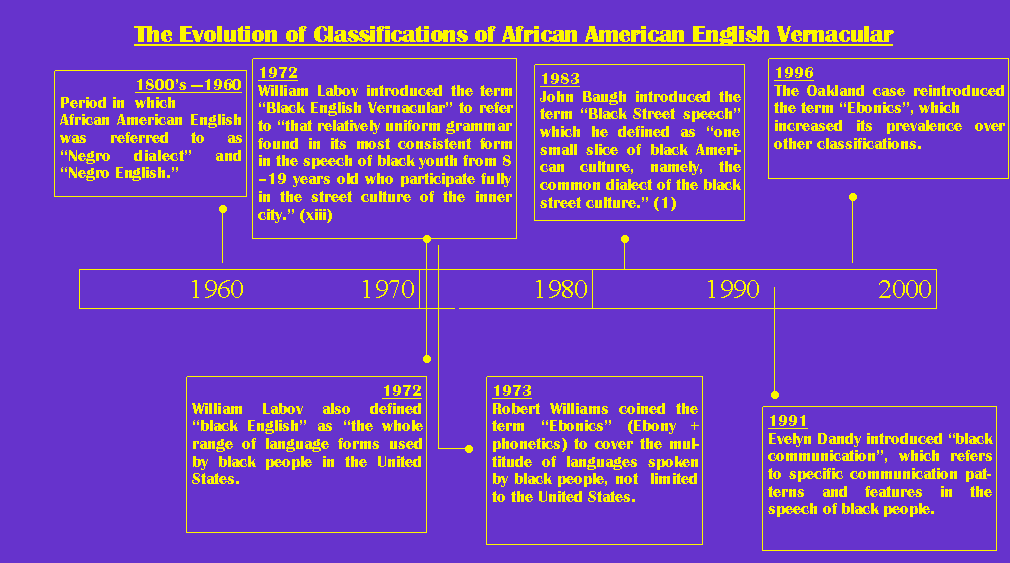
Baugh, John. Black Street Speech. Austin: University of Texas Press, 1983.
Dandy, Evelyn B. Black Communications: Breaking Down the Barriers. Chicago: African American Images, 1991.
Green, Lisa J. African American English: a Linguistic Introduction. New York: Cambridge UP, 2002. 1-11.
Kautzsch, Alexander. The Historical Evolution of Earlier African American English: an Emperical Comparison of Early Sources. New York: Mouton De Gruyter, 2002. 4-6.
Labov, William. Language in the Inner City: Studies in the Black English Vernacular. Philadelphia: University of Pennsylvania, 1972.
Mufwene, Salikoko S., John R. Rickford, and John Baugh, eds. African American English: Structure, History and Use. New York: Routledge, 1998. 154-192.
Home | History | Important Figures | Criticism | Bibliography | Extra Info | Staff