


It is important for the work placement participant to note that every company will have its own standards by which it operates.
These standards are usually well established and may include such things as:
- Standards of workmanship
- Levels of customer service required
- Acceptable safety standards
- Acceptable behaviour in the workshop or on site
- Training
- Timekeeping
- Punctuality
- Reporting procedures
- Corporate or company image.
Employees of each company will be expected to live up to those standards. These standards will also be expected from the work placement participant.
Many companies spend some time with new employees going through these documents in detail to ensure that the new employee fully understands what is expected of him or her. This is known as induction and is often compulsory.
Workplace documents
It is important that you are aware of the existence of certain documentation that may be referred to by the work placement employer.
Mission statement
The mission statement is a broad statement of the company's long-term goals or objectives. For example, the mission statement of Manufacturing Engineering at Granville College is:
To provide quality lifelong learning opportunities for individuals, industry and the community which enhance the skills and productivity of the workforce.
The Manufacturing Engineering at Granville College evaluates this mission statement on a regular basis and actively works towards it as the ultimate objective and its main reason for operation.
Conditions of employment
These documents are usually discussed with the potential employee at the interview stage before employment. They may include such things as:
- Working hours and overtime provisions
- Items that the company will supply
- Allowances and penalty rates
- Termination provisions.
Normally the conditions of employment are laid out in legally binding documents called awards. Awards set out all of the working conditions applicable to a particular industry or enterprise. These conditions may include:
- Annual leave
- Sick leave
- Long service leave
- Part-time and casual employment conditions
- Rates of pay
- Penalty rates
- Allowances
- Superannuation entitlements
Industrial awards may be state registered or federally registered. A state award applies to an enterprise within one state or territory only. Federal awards apply to enterprises that are registered federally.
Some workers are now under individual contracts where they negotiate the terms of their employment with a particular company on a one-to-one basis.
Others are under enterprise agreements which are negotiated collectively by unions or groups representing employees and employers. These agreements affect the entire workforce of an enterprise, a company or an industry. Enterprise agreements use existing awards as the basis for negotiation. Award provisions are not permitted to be traded-off. The Industrial Relations Commission must also agree to the final agreement before it comes into force.
Code of conduct
A code of conduct will outline the behaviour expected of any employee of the company. The statements within this code of conduct will outline items not spelled out in awards or enterprise agreements such as those previously listed, that is:
- Standards of workmanship
- Levels of customer service required
- Acceptable safety standards
- Acceptable behaviour in the workshop or on site
- Training
- Timekeeping
- Punctuality
- Reporting procedures
- Corporate or company image.
Job sheets or job cards
A job card is one way in which a company can track labour and material costs. An employee may be required to complete these cards when allocated or working on a job. This information is then collected and an invoice raised against the customer's account.
Time or job sheet
A time sheet or job sheet is similar to a job card but it usually identifies the worker who has been working on the job and the time allocated to each job. A different job sheet may need to be filled in for each job or there may be a facility to split the time booked against each job on one time sheet.
Bundy, clock or time cards
Many companies employ the use of a Bundy clock. This clock is used to record the time that each employee arrives and leaves. Work placement participants may be required as part of their duties to clock on at the start of a shift and clock off when they leave.
The card is inserted into a slot on top of, or at the bottom of, the clock, and the date, time of arrival or departure is stamped automatically on the card. These cards are then taken by administration staff to allocate payment for each employee or work out changes to be allocated to a particular job.
Most companies have very strict policies relating to clock cards and incorrect use of them can result in dismissal. You must never clock on or off for anyone else.
Sign-on book
Some companies use a sign-on book to track the attendance of employees. The normal practice is for each employee to sign on at the start of a shift and sign off at the end of each shift.
Organisational chart
These documents lay out, in the form of an easy-to-read chart, the structure of the organisation. They easily identify the chain of command within the organisation and allow employees to see at a glance who they are to report to within the company structure. The chart facilitates effective communication among employees and their superiors.
A sample organisational chart is shown below.
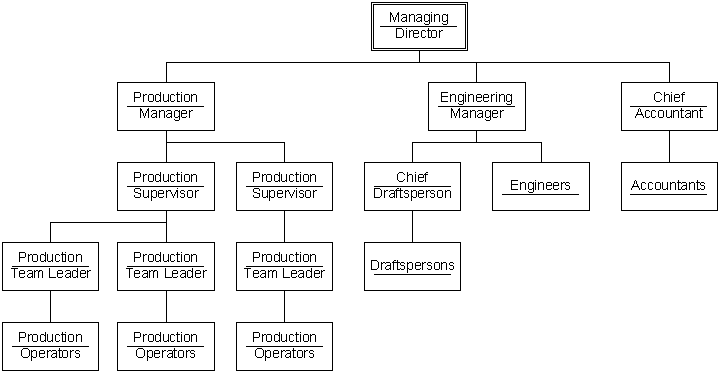
Real organisational charts are much more complex than the one above.
Back to Industry induction