


Other important pieces of legislation that you should be aware of refer to equal employment and anti-discrimination.
The main focus of both of these pieces of legislation is to ensure that people gain opportunities for employment and promotion within a company on equal terms and by merit; and in the wider community, not be subjected to harassment from groups or individuals on the basis of such things as:
- Gender
- Race
- Religious beliefs
- Age
- Skin colour
- Ethnicity
- Sexual preference
- Disability
- Appearance
This type of legislation gives people the right to lodge complaints with the Anti-Discrimination Board or Equal Employment Opportunities Tribunal if they believe they have been harassed or subjected to discrimination within the workplace or during the course of everyday life.
Restricted activities
Many activities within a workplace or on work sites require some form of licensing. In many cases, you must be of a certain age before you can gain accreditation to carry out these duties.
You could be endangering yourself and others if you carry out any such restricted activity without the proper training and if detected by an inspector or other authorised person such as the police, you could be given an infringement notice and fine.
Some of these licensing requirements include:
- Working on electrical installations or machines
- Operating a mobile crane
- Operating a pendant crane
- Driving a motor vehicle
- Operating a ride-on fork truck
- Rigging
- Erecting scaffolds
- Confined space entry
- Operating cherry pickers
- Operating explosive powered tools
- Operating earthmoving equipment such as a backhoe or excavator
- Some welding operations
Restricted activities are not confined to those listed above. If in doubt, ASK.
Reporting of accidents
All accidents, including such things as minor cuts and abrasions, should be reported. Serious complications relating to workers' compensation claims have arisen from minor accidents that have not been reported or reported inaccurately.
Companies will have a policy with regard to reporting of accidents and near misses and this should be followed. They should also have designated first-aid officers who hold accreditation in accordance with WorkCover regulations. These officers are paid an allowance to carry out first aid duties while at work.
First aid kits should have an accident book inside them. Accurate details of the area of the body that has been affected, as well as the first aid treatment administered, should be recorded within this book.
If a near miss occurs, that is, if there is almost an accident but, on this occasion, it was avoided, this must also be reported and the problem rectified before an accident does occur.
Some companies have an accident report form that should be filled in by the line supervisor or leading hand.
Serious injuries involving lost time (minimum 1 week) and workers' compensation, must be reported to WorkCover. This is done through the company by the completion of a special WorkCover Injury form.
Employers must also now make provision for seriously injured workers to return to work as soon as possible after medical assessment and clearance to undertake a period of rehabilitation before returning to normal duties. A rehabilitation program will be formulated between the company rehabilitation officer, the worker's doctor and the worker.
Hazard identification
A hazard is something that has the potential to cause harm. Hazards in the workplace can come from many different sources. Some may be obvious and some not so obvious. It is important that workers be vigilant and recognise the presence of potential workplace hazards.
Hazards may be categorised into five groups. They are:
- Physical
- Mechanical/electrical
- Chemical
- Biological
- Psychological/social
Some obvious hazards could include:
- Electrical
- Mobile machinery
- Moving machine parts
- Chemicals
- Material handling techniques
- Obstructions and trip hazards
Some that are not so obvious may include:
- Confined spaces
- Hazardous locations
- Poor work station design
- Poorly designed work systems (ways of doing a job)
- Harassment
- Stress
The type and severity of the potential of the hazard to do harm will vary greatly with each situation and workplace.
Hazard/risk assessment
The first step in managing hazards in the workplace is to evaluate the hazard. The following simple principles should be applied:
1. Identify the hazard
2. Assess the risk
3. Control the hazard
4. Monitor the hazard
Once the hazard assessment has been carried out, the next step in the action plan is to:
- Discuss all the hazards found
- Compile a completed list of all hazards found
- Determine the priority that these risks should be dealt with.
|
Found a hazard? Think about: |
How severely could it hurt someone? ò |
||
| How likely is it to hurt someone?
ò |
!!! Kill or disable | !! Several days off work | ! First aid required |
|
Very likely Could Happen regularly |
1 | 2 | 3 |
|
Likely Could happen occasionally |
2 | 3 | 4 |
|
Unlikely Could happen but only rarely |
3 | 4 | 5 |
|
Very unlikely Could happen, but probably never will |
4 | 5 | 6 |
The numbers show how important it is to do something.
1 means Do something immediately
6 means Do something when possible.
Hazard management
Hazards and risks are managed using what is called the Hierarchy of Control. The way to manage the hazard will move down the scale. If 1 cannot be achieved, move to 2 and so on.
1. Eliminate the hazard
2. Keep hazard and people apart
3. Change the way the job is done
4. Supply personal protective equipment
General principles for safe work
The following principles may be applied to minimise the risk to you while working:
- Make sure the items that you purchase are safe to use
- Maintain equipment regularly and keep it safe
- Don't use dangerous or faulty equipment
- Use tools, machinery and equipment only for the purpose for which it is intended
- Ensure you are trained in the use of equipment and are supervised properly
- Use safe systems of work (like lockout devices and tagging) to allow the job to be carried out safely
- Maintain and use safety warning devices
- Make sure that everyone understands the dangers associated with the processes, materials and equipment being used
- Label and store things in their correct place
- Maintain and use personal protective equipment where required.
Material Safety Data Sheets (MSDS)
A Material Safety Data Sheet (MSDS) is an information sheet that is used to supply detailed information relating to chemicals and related products. The manufacturer of the products that may be used in the workplace prepares Material Safety Data Sheets. They are available from the manufacturer through the supplier.
The information contained on a Material Safety Data Sheet tells you:
- What is in the product
- Any health affect the product may cause
- First aid procedures
- Precautions to follow when using the product
- Safe handling and storage information
- Emergency procedures to be followed in case of exposure or skills
Material Safety Data Sheets provide vital information for the user of the product. They should be read and understood before using any substance.
The workplace should keep copies of Material Safety Data Sheets for all chemicals used in the workplace. They should be kept in a location that all employees can gain access to.
Safe Work Method Statements
These are documents which detail methods for carrying out specific types of work or tasks. They are developed with the aim of improving health and safety.
Safe work method statements are formulated in consultation with employees, unions on the site or workshop, workplace OH&S committees, OH&S representatives and management. They should:
- Be readily available to all employees who must complete the work
- Clearly list the instructions for completing the task in the most efficient and safe manner
- List any hazards that may be associated with the process, task or machine involved
- Indicate how to prevent injuries while completing the task
- Identify any equipment to be used including personal protective equipment where necessary and how to use and maintain it correctly
- State the procedure in case of an accident
- Be reviewed and updated on a regular basis
- Be provided in community languages wherever possible.
If one of these is issued or pointed out to you, you should take notice of it and follow the instructions carefully.
National standards
Australian Standards are documents produced by Standards Australia. They are usually named AS or AS/NZ followed by a number, for example, 1234.
Almost everything we buy and use in everyday life and at work will conform to an Australian Standard or equivalent standard. There are literally thousands of these documents produced by Standards Australia in conjunction with all stakeholders including government departments, industry groups, advisory bodies, employee representatives including unions and the Australian public.
Australian Standards outline the minimum technical specifications, acceptable levels of quality and performance necessary to produce an article manufactured in Australia. They can also relate to occupational health and safety matters.
Products and materials that conform to Australian Standards may carry the standards mark.
Imported articles are examined for conformance to Australian Standards and are often withdrawn from the Australian market if they do not comply. A good example of this can be seen around Christmas each year when it is usually brought to the attention of the Australian public that certain toys, which have been imported, are withdrawn from sale due to non-conformance to Australian Standards.
Codes of Practice
Codes of practice are documents that assist employees and employers in maintaining safe work practices. Codes of practice provide guidance and practical advise on how to deal with particular hazards, carry out certain operations and assist in the promotion of good OH&S practices.
Codes of practice may be approved by WorkSafe Australia on a national level or by the various state government authorities such as WorkCover NSW.
Generally, Codes of Practice may be used as evidence in court proceedings. Failure of an organisation to comply with the relevant code of practice can be seen as evidence of failure to meet legal requirements.
Some existing Codes of Practice include:
- Safe removal of asbestos
- Manual handling
- Electrical installations on buildings and construction sites
- Personal protective clothing
- Erection of steel-framed buildings
Safety signs
Any safety sign displayed in the workplace should comply with the various Australian Standards with relation to size, shape, colour and use.
To overcome language difficulties of the many people who work in the manufacturing and engineering industry and who are from non-English speaking backgrounds, more and more pictorial signs are now being used. Road signs displaying speed zones are a common example.
Safety signs provide clear communication and are used for the following reasons:
- Prevent accidents
- Warn of health and safety hazards
- Indicate the location of emergency equipment such as fire extinguishers
- Inform workers when and where special safety equipment must be worn.
Mandatory signs
These signs have blue pictograms and black printed messages on a white backgrounds or black printing on a white background with no pictogram. Some examples are EYE PROTECTION MUST BE WORN IN THIS AREA and THIS IS A HARD HAT AREA.
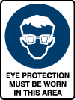
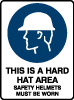
Wherever you see a mandatory sign, the personal protective equipment must be worn or the other message conveyed by the sign must be complied with.
Prohibition signs
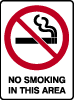
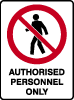
These signs can be identified by a red circle with a diagonal line through it over a black pictogram on a white background. Any writing is in black block letters. The signs prohibit particular types of behaviour, for example NO SMOKING IN THIS AREA and AUTHORISED PERSONNEL ONLY.
Danger signs
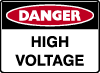
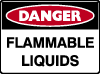
These are posted to indicate a particular hazard that exists in the immediate area. They have a black rectangle at the top with DANGER written in white on a red ellipse. A message stating the particular type of danger is shown below in black block letters on a white background, for example, HIGH VOLTAGE or FLAMMABLE LIQUIDS.
Fire equipment signs
These signs are red with white block type and pictograms. They are used to indicate the position of fire fighting equipment.


Warning signs
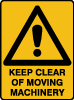
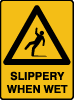
These signs are intended to warn people of a possible hazard that may be present. They are a yellow sign with a heavy black triangle. A pictogram or symbol is placed in the triangle. A message in black block type, such as KEEP CLEAR OF MOVING MACHINERY or SLIPPERY WHEN WET is shown below the triangle.
Emergency information signs
These give information about equipment or facilities for use in emergencies. They are usually green in colour with a white pictogram and block type. Examples are EVACUATION ROUTE and EMERGENCY EXIT.


Safety tags
These are typically fitted to equipment whilst it is being serviced. They show the word DANGER and particular instructions such as DO NOT OPERATE. You must never remove a tag from a machine unless you placed it there yourself and the equipment is now safe to operate. Only the person who fits a tag may remove it.


Manual handling
Many objects in the workplace need to be moved, carried, lifted or stored. Wherever possible, mechanical lifting devices such as trolleys, wheel barrows, pallet jacks, fork trucks, conveyors and cranes can be used to safely lift and move loads from one place to another. However, it may on occasion become necessary to shift loads manually and without the aid of the devices mentioned.
Manual handling is defined in the National Standard for Manual Handling as:
Any activity requiring the use of force exerted by a person to lift, lower, push, pull, carry or otherwise move, hold or restrain any animate or inanimate object.
Manual handling is estimated to cause around one third of injuries requiring compensation within Australia each year.
The Occupational Health and Safety Act puts the onus on employers and employees to ensure that manual handling is done correctly. There is a National Code of Practice for Manual Handling. It outlines best practice in manual handling.
In NSW, limits are placed on the amount of weight that women and young people are allowed to manually lift and carry. These are defined in the NSW Factories, Shops and Industries Act.
Some possible causes of manual handling injuries are :
- Twisting and bending the torso
- Difference between the working heights and worker size and height
- Frequent lifting or stretching over shoulder height
- Insufficient rest periods
- Pulling, pushing or rolling in awkward ways without firm support
- Handling excessive weights
- Stretching
- Uncomfortable and awkward shapes
- Poor grip and posture
- Obstructions in pathways, aisles or work areas
- Slippery or uneven surfaces
- Carrying loads up stairways
- Insufficient space to manoeuvre
- Excessive work rates or sudden changes in work rates
- Lack of mechanical lifting devices
- Insufficient training in lifting techniques
Principles of safe lifting
Safe manual lifting depends on six basic principles:
1. Plan the lift
2. Position your feet
3. Get a firm and secure grip
4. Keep back as straight as possible
5. Position your head and arms
6. Use your legs
Lowering a load
Carrying a load
Pulling or pushing
Two person or team lifting
Personal protective equipment (PPE)
The issue and wearing of PPE is the last resort relative to the hierarchy of hazard control. It should only be employed until a more efficient engineering solution can be found.
Many processes and operations will require the use of PPE. The onus is on the employer to train the operator in the application, necessity, use and maintenance of all PPE to be used.
PPE is available for most parts of the body including head, ears, eyes, respiratory organs (nose, lungs), face, body, arms, legs and feet. The type and degree of protection afforded will be dependant on the type of operation being carried out.
Back to Industry induction