
 |
|||||
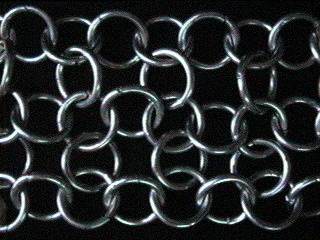
| This pattern is named so gusari, but is most commonly know as Japanese 4-1, since each ring connects to four others. (Though it bears little resemblance to European 4-1) Like all Japanese patterns it has a very lose weave. This makes it good for a hanging decoration, or something loose fitting. It is very easy to make variations on this design by varying the number of rings that passes through each other, or by interweaving different ring sizes and colors. (This is much harder to do with European designs.) The empty space makes this weave light weight and easy to produce. |
|||||
 |
|||||
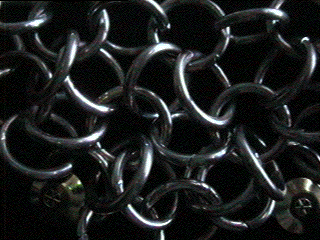
This weave is called asa no ha gusari, or Japanese 6-1. It is not merely the same as so gusari with 6 rings through each one, as the extra rings are actually attached at new angles. It is more dense then Japanese 4-1, and has a more intricate, visually appealing design. It is slightly heavier, but still not as dense as the European weaves. It is also best used to lose, or free hanging patterns. |
|||||
 |
|||||
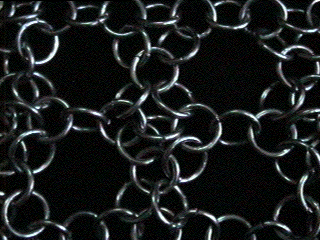
| This variation on the standard Japanese weaves is called Kagome gata gusari. It forms hexagonal open spaces in the design. It is light weight and a good pattern for making large items as the repeating geometric patterns are very visually attractive. |
|||||
 |
|||||
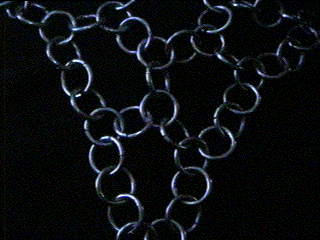
| This pattern is a hybrid between Kagome gata gusari and so gusari. It is sometimes called hexmaile because of the open hexagonal pattern in the weave, or Japanese 3-1. It is the most open pattern, as well as being the most light weight, as it uses fewer rings then any other weave. |
|||||