Inside the Feb/March Issue:
Page 1
Newsletter
Future Fun Stuff
Cool Links
Gabrielle's Grab Bag
Page 2
Book Review
Poetry Corner
Math Challenge
*Page 3*
Current Event
Social Studies-Ancient China
Feb/March, 2006 - Page 3

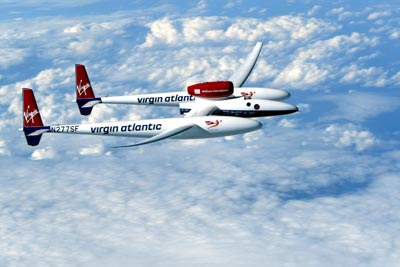
The Virgin Atlantic is a one-man plane. It holds 18,100 pounds of fuel. When Steve launched on Wednesday, the problems began early. Within the first 3 1/2 hours of flight, the plane lost over 2,600 pounds of fuel from a mysterious fuel leak! Many people now doubted that Steve would be able to complete his mission. Steve was determined to continue despite many more difficulties that arose. During the first full day of flight, an electricity malfunction caused the temperature in the cockpit to rise to over 110 degrees Fahrenheit! Steve had to drink a huge portion of his water during those first 24 hours.
Steve battled his sleepiness by taking 10 minute power naps. He fought leg cramps by exercising his legs, in their cramped space, every day. He had to keep track of changing wind patterns all over the globe.
After days of flying, Steve had circled the earth and was back over the air in Florida. Now he had a huge decision to make. Would there be enough fuel to risk the flight over the Atlantic, or should he land in Florida? Steve and his team on the ground decided to go forward. They would need the help of the wind patterns over the Atlantic. The winds had been dying down, but they would need the wind's help to conserve the plane's fuel supply.
Miraculously, Steve made it across the ocean! But on his last leg of the journey, as he started flying over England, the plane's generators failed! With no electricity, Steve had to radio, "Mayday!" With the help of Mission Control, Steve was permitted to make an immediate, emergency landing at Bournemouth Airport, England. While descending, the plane's cockpit froze over! Steve didn't have time to let the ice melt before landing. He had to find the runway while he could barely see out the windows, and with the electricity out, no scanners could operate! To make matters worse, two tires exploded when he touched down! Despite all the dangers, the plane landed and Steve arrived safely! On February 11, 2006, Steve landed at Bournemouth Airport, England, just short of his original goal. Experts confirmed that Steve had beaten his previous long distance record!!! Steve had flown the Virgin Atlantic 26,389.3 miles in 76 hours and 45 minutes. Congratulations Steve Fossett and the team for the Virgin Atlantic
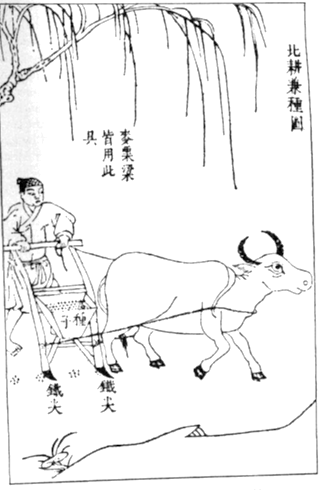
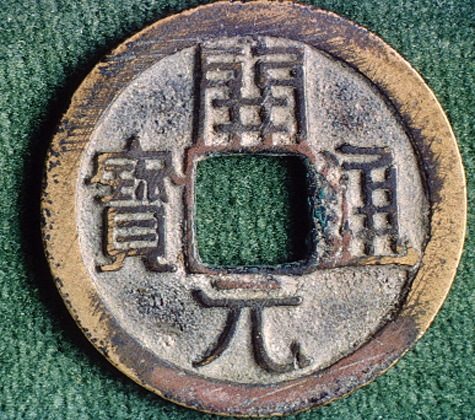
What do all the things in this list have in common?
All of these items were invented, made and used by the Ancient Chinese!
I enjoyed my study of the beginnings of Chinese civilization. I was especially interested in the Qin (pronounced: Cheen) Dynasty and the man they call "The First Emperor"
In the years between 400BC and 221BC, China had many different rulers, many of whom fought each other. About that time, a man named Zhen (pr: Juhng) was the ruler of the Qin people who lived along the western edge of China. Zheng began seizing power over much of China and by 221BC he took his new name, Shi Huangdi, which means "First Emperor." He set up a strong government which ruled over all of China. He put farmers to work building roads across all of China so his armies could easily get to any area where there might be an uprising! To control the borders and put an end to border wars, he ordered the construction of the Great Wall of China.
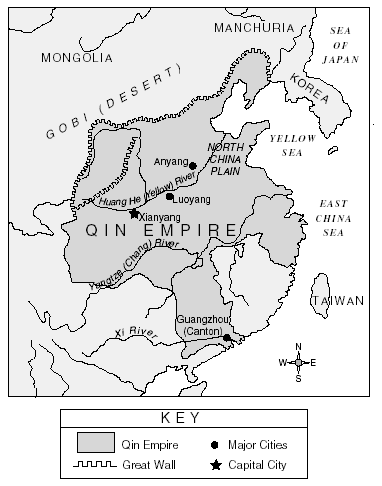
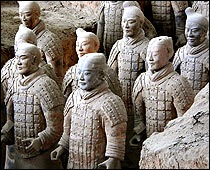
While he was still living, Shi Huangdi had an entire army made out of clay in underground pits. This army was to guard his tomb when he died and to help him rule in the afterlife. Shi Huangdi died in 210BC, and began years of chaos and civil war. His own son was killed and his grandson was not strong enough to keep the empire together. Shi Huangdi had predicted that the Qin Dynasty would last for 10,000 generations, but it only lasted 15 years!
In 1974, a group of Chinese farmers discovered the underground army. Archeologists have uncovered many of the terra cotta statues of soldiers, horses and chariots. No two soldiers look alike and one can only imagine the amount of work that went in to the building of this army.