 |
RUSSIA's Past |
 |
|
|
RUSSIA's Past |
|
|
|
... or should I say "from Soviet Union's past"? First, I was thinking to continue with the stories about big Russian cities and interesting places along the general lines of my previous page called "Some Thoughts about RUSSIA", but then I decided to share some ideas about what was once so inherent and valued in the pre-1992 Russia: money, as it looked, circulated and constituted the essence of many people's dreams at that time, but now became historical relics, antiques, yet often not less valued. The images presented on this page are the images of the actual items from my modest collection. If you wanted to have even more detailed images than presented here, I'll be happy to scan and send them to you. My contacts are on the Front Page. It may take 1-2 weeks before I reply because I keep all the real things in a bank deposit box. If you happen to have some banknotes or coins like those presented on this page and don't mind making a gift, I'll appreciate your contribution to my collection, put it on display here with sincere acknowledgements and thanks. The word “Ruble” comes from the Russian verb (rubit’) that means “to cut” or “to chop” and was introduced as a Russian name for the medieval money “grivni”, that represented parts of the cut silver ingots that were circulated on the territory of Russia in the form of weighed silver until XIV century. This definition is arguable, but prevails (Ref. 1). The history of the ruble is interesting and very long as you see just from the definition above, but I wanted to start telling a little bit about the ruble as it was developing in the Soviet time, from the early 1920’s until 1992, especially from 1961 to 1992. |
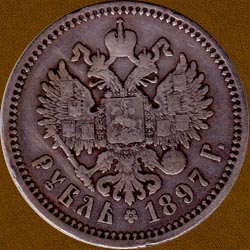
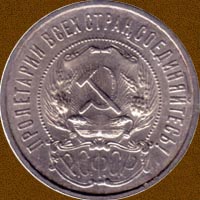
While restoring national economy after the end of the civil war and making efforts to consolidate the linking of town and country, the Soviet government has created a monetary system of its own in the course of its monetary reforms. It was based on the traditional Russian decimal principle. Ruble was steadily stabilized, and during the final phase of the 1922-1924 monetary reform, Soviet coins played an important role of a far greater significance than a mere economic undertaking. New silver coins adorned with the Emblem and motto of the Soviet State were in no slightest degree inferior to those of pre-revolutionary times, and for the multimillion rural population of the country they became a real reliable guarantee of the end of the prolonged and devastating currency disorder once and for all. One of such trusted pre-revolutionary rubles is presented here (Fig. 1) as an example of many different silver coins issued during the reign of the Emperor Nicholas II (1895 - 1917). This coin has an interesting history. It was found by my mother when she was around 7 years old (early 1940's). She gave this coin to my grandmother who kept it until 1990 when it became mine with my mother's permission. I believe this coin was a part of a collection of coins hidden in earth somewhere locally at the restless time of the revolution and the civil war, a collection either unearthed long ago or still hidden. If you are interested in the coins of the Imperial Russia, there are more coins from my collection presented in the CATALOG with nice images, information and some prices. |
|
|
 |
 |
 |
||
 |
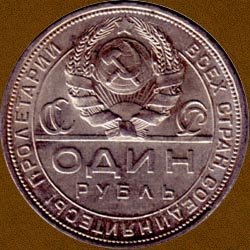
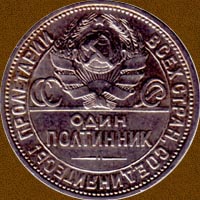
In shape, weight, metal standard and even partly in the general subsidiary silver types, the first coins of the Soviet State were made according to the norms of the pre-revolutionary coinage, familiar for centuries with the population, and at the same time, these carried the Emblem and motto of the Soviet State. The apparent stabilization of the Soviet economy made it possible to entirely abandon the minting of coins in the precious metals for practical circulation in 1931. Silver had filled its role to its best ability and was superseded by nickel coins of a new design (Ref. 2). |
 |
|
|
 |
 |
|
The course of historical development of Russian ruble until 1961 can be found elsewhere (Ref. 3 or 4). Inflation progressing in the Soviet economy in the post-war period, though not officially recognized at that time, led to changes in the monetary system. On 4 May 1960, the Cabinet of Ministers of USSR accepted a resolution # 470 “About changing the pricing scale and replacement of currently circulating money with new money” to announce the exchange of ruble banknotes and coins and to set a new ruble value, with no economic reform introduced. |
||
 |
 |
|
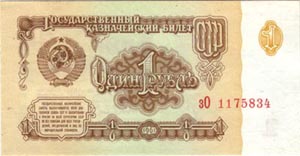
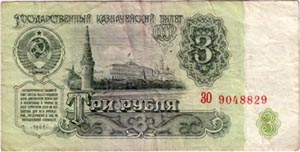
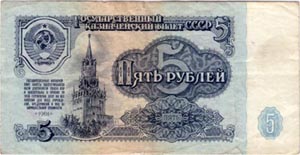
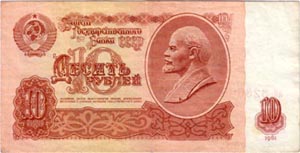
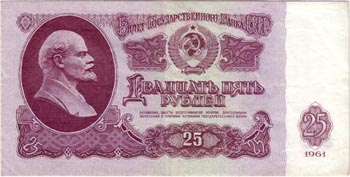
Ruble denomination was carried out in the ratio 10:1 on 1 January 1961, with the ruble value set as 0.987412 g of pure gold. New banknotes of 1, 3, 5, 10, 25, 50 and 100 rubles were introduced (Figs. 6-12), as well as coins valued as 1, 2, 3, 5, 10, 20, 50 kopecks, and 1 ruble. All old banknotes and coins of 1947 issue were exchanged during the period from January to March 1961, except for coins 3, 2 and 1 kopecks that were in circulation up to 1990’s. In addition to these banknotes and coins, many commemorative coins, dedicated to different historical events or jubilees of well-known people, were issued during 1961-1991, mostly to have full circulation, with some being unknown to majority of the population and having only numismatic value. A commemorative coin of 1 Ruble was introduced in 1965 to praise the victory of the Soviet Union in the Great Patriotic War of 1941-1945. Another commemorative coin of 1 Ruble, together with coins of 10, 15, 20 and 50 Kopecks, issued in 1967 was dedicated to the 50th Jubilee of the Great October Revolution. Yet another 1 Ruble coin was issued in 1970 to commemorate the 100-year anniversary of V.I. Lenin’s birthday. |
||
 |
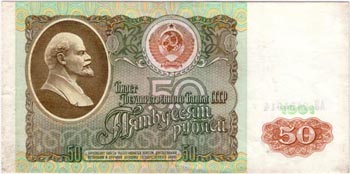 |
|
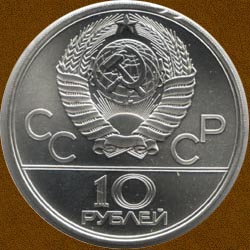
An interesting and valuable set of coins was issued in 1977-1980 to commemorate the XXII Summer Olympic Games in Moscow in 1980. Altogether, 45 coins were issued, 6 coins of 1 ruble denomination (so called "Olimpiiskii Rubl'" or "Olympic Ruble") in nickel alloy (1 in 1977, 1 in 1978, 2 in 1979 and 2 in 1980), 28 coins of 5 and 10 ruble denomination in silver (6 in 1977, 8 in 1978, 7 in 1979 and 7 in 1980), 6 coins of 100 ruble denomination in gold (1 in 1977, 2 in 1978, 2 in 1979 and 1 in 1980), and 5 coins of 150 ruble denomination in platinum (1 in 1977, 1 in 1978, 2 in 1979 and 1 in 1980). One of these coins, 10 Ruble coin of 1979 designed by Ermakov and molded by Ivanov, shows a "Basketball" snapshot (Fig. 3). |
||
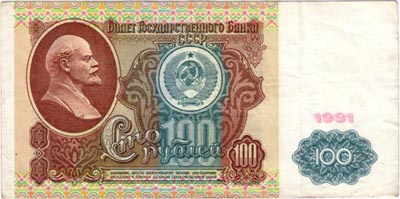 |
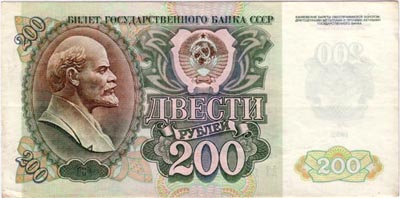 |
|
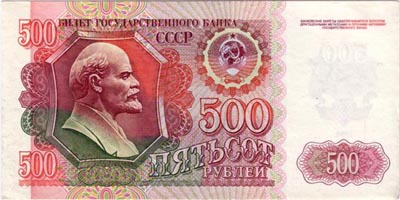 |
||
SOME INTERESTING FACTS - CHECK YOUR KNOWLEDGE: | ||
(a) 100 dollars for each 1000 rubles exchanged, (b) 100 ruble fine, (c) 5 years in prison, (d) death penalty? |
(a) ten ruble banknote, (b) ten thousand ruble banknote, (c) ten million ruble banknote, (d) ten billion ruble banknote? |
|
1) Fengler, H., Gierow, G., Unger, W. Transpress Lexikon Numismatik. Transpress, VEB Berlin, 1976. 2) Spassky, I.G. The Russian Monetary System. Jacques Schulman N.V., Amsterdam - C, 1967. 3) Russkii Rubl': Dva veka istorii (Russian Ruble: Two centuries of history). Pod red. N.P. Zimarina. Moskva, Progress-Akademiya, 1994. 4) Vsye o Den'gakh Rossii (Everything about Russian Money). Pod redaktsiei A. Khandrueva. Moskva, Konkord-Press, 1998. |
||
|
|
 |
 |
 |
|
|
 |
 |
 |
 |
 |
 |
 |
||
 |
 |
 |
 |
 |
 |
 |
|
|