Again, surprisingly, the answer (d) is correct. It is well known that paper money clearly represents the economic and financial situation at any particular moment in any particular country or a region. Thus, issue of banknotes with denomination in millions and billions monetary units in Germany in 1920's, one hundred thousand Leys in Romania in 1946, and one billion Pengoe in Hungary in 1946 reflected the non-stable economic situations in these countries. Russia is no exception. In Russia, itself, the banknote denomination never was higher than five hundred thousand rubles (in mid-1990's), with one hundred thousand ruble banknotes being the highest denomination banknotes in 1920's. However, in 1921, the government of the Trans-Caucasian Soviet Federative Socialist Republic, which was part of the Soviet Union in 1920's, issued One Billion Ruble banknotes and Ten Billion Ruble banknotes. These banknotes, looking very much alike the 1910's One Hundred Ruble banknotes of the Russian Empire, were circulating throughout the territory of the former Russian Empire and were supposed to be accepted everywhere (Ref. 4).
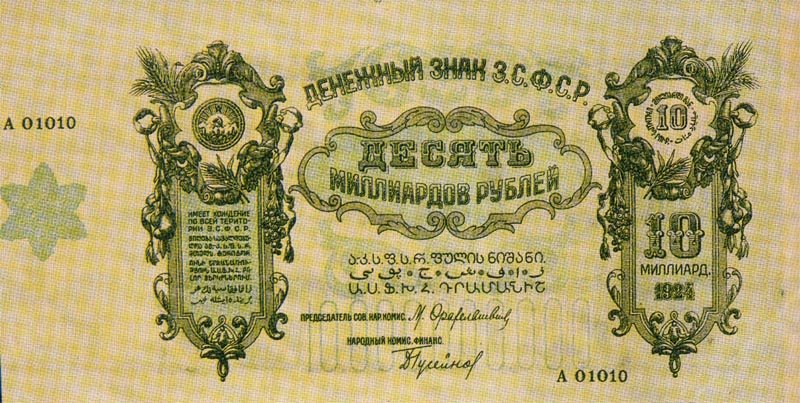
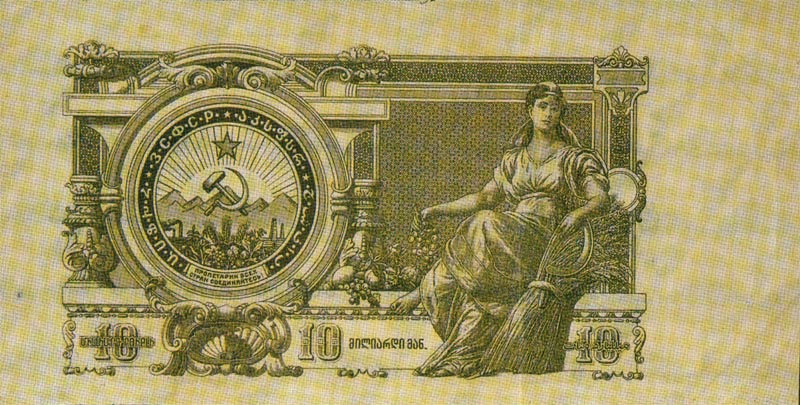
The images are taken from Ref. 4.