Golden eagle
Aquila chrysaetos
The golden eagle is one of the most magnificent birds of prey in Ireland.
Statistics:
Body length: 79-88cm, Wingspan: 190-227cm, Weight: 3-6kg. Females are much larger than the males.
Physical Description:
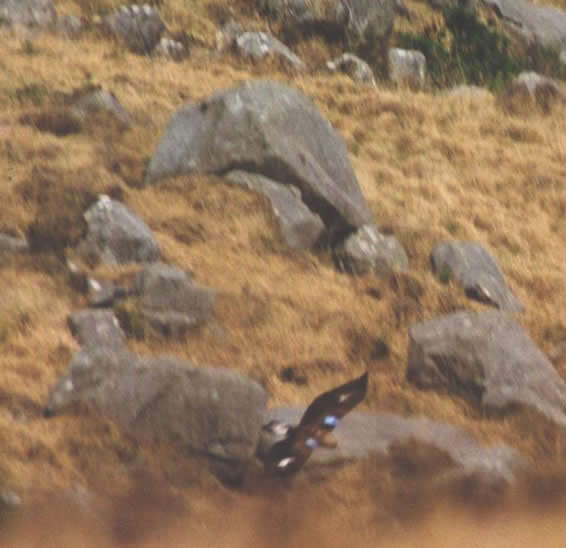
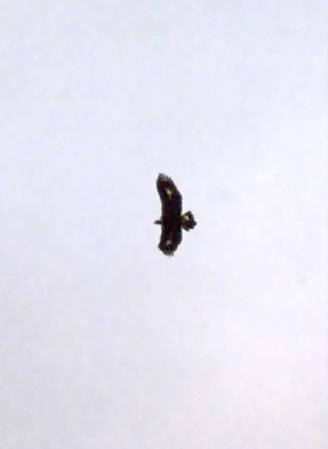
Adults are a uniform brown colour with a paler brown head, but juveniles have a white patch on the base of the tail and on the underside of the wings. They have a square tail and fully-feathered legs.
Distribution:
They range across Europe, Asia, N. Africa and N. America. In the UK & Ireland, they are predominantly found in the Scottish Highlands and in County Donegal.
Habitat:
These large raptors prefer mountainous, often treeless, habitats, although they require large trees or rock faces for nesting.
Diet:
Golden eagles hunt medium-sized mammals, such as rodents, rabbits, hares and young deer. They also hunt birds (particularly grouse), and occasionally feed on reptiles. They often feed on carrion (particularly sheep and lambs).
Behaviour:
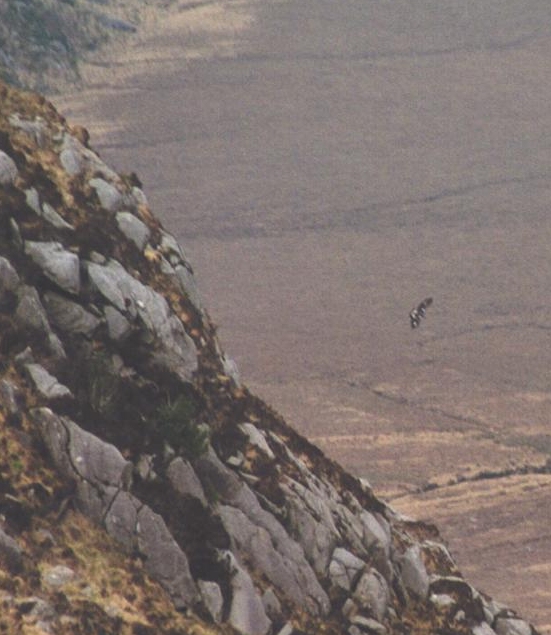
They can remain in the air for hours at a time and have a graceful, soaring flight, with the wing-tips slightly upturned. Golden eagles attain speeds of 128 km/h (80 mph) although they average 48 km/h (30 mph). They are resident birds and do not migrate. Golden eagles have exceptionally good eyesight, and when prey has been spotted, they dive down to seize and kill the victim with their curved talons. Sometimes, a pair will hunt together, with one bird chasing the prey to exhaustion and then the other swooping in for the kill. Golden eagles mate for life and pairs tend to have territories of up to 56 square km (35 square miles).
Reproduction
A nest up to 2m wide is built of sticks and branches and lined with greenery, and the same nest is often used year after year. The female typically lays two (although sometimes three) eggs asynchronously, which she incubates for 41-45 days. The older chick commonly kills the younger chick, but in years when food is abundant, both chicks may survive. After 65-80 days the chicks fledge, although they may continue to be fed by the parents for a further couple of months.
Conservation status:
Golden eagles are not considered to be threatened, even though they have been heavily persecuted in the past. As well as being shot and poisoned by gamekeepers and farmers for the threat they pose to livestock, numbers have been severely affected by pesticides such as DDT. Golden eagles are sensitive to human disturbance and will abandon their nests if harassed. There are about 440 pairs in Scotland and generally just one pair in the Lake District.
Voice:
Golden eagles are not very vocal but they will sometimes emit a barking call or a twee-o cry.
Listen to the sound of a golden eagle here
|