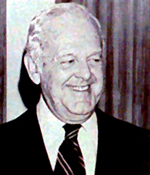
| In 1980, Liam Dolan, after extensive, exhaustive research,
published his epic work entitled, "Land War and Evictions in
Derryveagh". The author of this book has, in that work, painted a
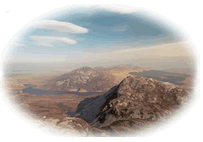
vivid word picture of the setting and the terror, agony and sorrow
so well that the reader is transported back in time to the shores of
Lough Barra and the mountains of Derryveagh to become a witness to
these events described by one eye witness as "indescribable".
Adair, of Scottish descent, was a well to do land speculator from
Queen's County, who, on visiting the District in 1857, observed that
"He was enchanted by the surpassing beauty of the scenery" In August
of that year, we learn that he made his first purchase of property
in the Glenveagh area. He later acquired over 28000 acres to create
the Adair Estate. This included Gartan, Glenbeagh and Derryveagh.
After the initial purchase in the Glenveagh area, Adair began
building up his estate gradually and in doing so he purchased what
is termed "fee-farm" rights to Derryveagh. This gave him the right
to receive from the grantor all the rents collected from the
Derryveagh tenants, but not ownership of the land or the so called
"sporting" (hunting and fowling) rights
The failure to take title to the land and obtain "Sporting
Rights" triggered an incident that might have been a contributing
factor in Adair's decision to clear out the Derryveagh tenants a few
year later and in so doing to wipe out the hopes, dreams and fond
memories of 244 human beings. It so happened that a year after he
purchased the right to the rents of the Derryveagh tenants, he
decided one day to indulge in his favourite sport of fowling on
"his" Derryveagh property. About a dozen or so tenants resented and
resisted what they regarded as a trespass on "their" land. They
proceeded to beat the bushes to spoil his sport and finally created
a ring of persons at 50 paces around him and maintained that ring
when he would move. This action infuriated Adair and he threatened
them with his fowling gun. As he left the scene, he informed the
tenants that "They would pay dearly". Eventually, that prediction
came true, not just for the 12 present but for the entire Derryveagh
population of 47 families. In 1859, Adair acquired title to all of
Derryveagh and was in a position, if he so desired, to carry out his
threat.
All the heads of families in the Derryveagh District presented
themselves to Adair in Glenveagh Cottage on December 20,1860 so that
he might personally accept their rent. He, however, had another
motive and that was to inform them, one at a time, that he was
contemplating "Rearranging the farm boundaries". These dreaded words
gave them the first inkling of the evictions that would occur early
in the following year.
On St. Patrick�s Day in 1861, Adair obtained a Writ of "Habere"
giving him the right to take possession of the land and houses in
Derryveagh. The stage was set for the drama that ensued. Adair,
fearful that he might meet organized resistance, demanded and
received a force of a 203 man Constabulary and "Inspectors" to carry
out his vicious plan. In addition, he hired a 10 man "Crowbar
Brigade" from County Tyronne all for the purpose of carrying out his
evictions. The terror was executed between the Eighth and Tenth of
April 1861.
An eye witness , apparently a Reporter from a Local Newspaper
which, in the story of the agony of the widow McAward, encapsulates
the heart-rendering agony of the 47 families evicted. It reads:
"The family of the Widow Mc Award was the first to face the
terror of the Crowbar Brigade. The Sheriff, accompanied by Adair's
new Estate Manager, approached the house where the poor Sixty Year
old woman lived with her six daughters and one son and 'Long before
the house was reached, loud cries were heard, piercing the air and
soon the figures of the poor widow and her daughters were observed
outside the house where they gave vent to their grief in strains of
touching agony. Forced to discharge an unpleasant duty, the sheriff
entered the house and delivered up possession to Mr. Adair's
steward, whereupon a Crowbar Brigade of six men who had been brought
from distance immediately fell to with right good will to level the
house to the ground. The scene became indescribable. The bereaved
widow and her daughters were frantic with despair and throwing
themselves on the ground, they became almost insensible, and
bursting out in the old Irish wail - then heard by many for the
first time - their terrifying cries resounded along the mountains
for many miles. They had been deprived of their only shelter - the
little spot made dear to them by association of the past - and with
bleak poverty before them and with only the blue sky to shelter
them, naturally they lost all hope and those who witnessed their
agony will never forget the sight.'"
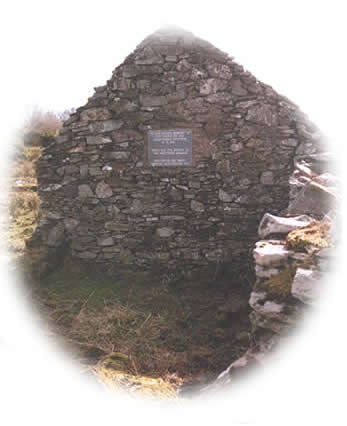
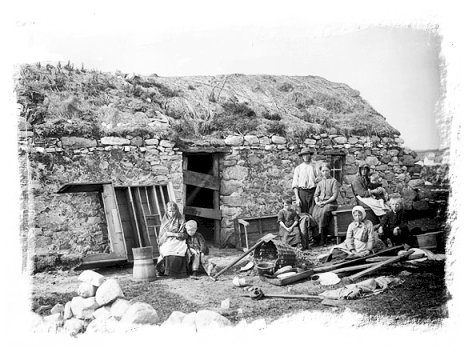
The official Derryveagh Eviction Report tells us that there were
46 houses from which 47 families were evicted. 159 children were put
out on the road. 28 homes were unroofed or levelled with only 4
families temporarily readmitted. 11,602 acres of land were seized.
The total number of persons having only the sky for their shelter
was 244. The author continues to relate the sad tale:
"By two, Wednesday afternoon, the terrible work had been
accomplished and a deathly silence descended over the whole area.
The Derryveagh District had been cleared of people and Adair had
accomplished what the ravages of the Great Famine had failed to do.
The Londonderry Standard of April 10, 1861 gives us the names and
townlands of the victimized families. These are:
ALTNADOGUE
- Hugh Sweeney and two sons.
- James Sweeney, his wife and eight children.
- Owen Sweeney, his wife, mother and eight children.
ARDATUR 6 families of 32 persons to Workhouse. One family
found to be wandering through the ruins of house Carr Family
returned to former proprietor of the estate named Mr Johnston where
they had once worked.
- Daniel Mc Award, his wife and six children.
- Charles Doohan, his wife, son and two grandchildren.
- William Doohan, his wife and four children.
- John Doohan, his wife and five children.
- Connell Doohan and his wife.
- Patrick Curran, his wife and five children.
BINGORMS Hanna Mc Award, widow and six children.
- Joseph Mc McCormick and five children.
CASTLETOWN Castletown a townland named after the cashel
which is still in existence had an acreage of 251 acres. Of theses
206 were mountain.11 families on the 45 arable acres. One house
still standing owned by John Friel, let remain Five families were in
Workhouse - one of which, John Doherty a widower aged 80, died
within 1 week of admission. Remaining families in Casheltown were
still in neighbourhood.Family of Robert Burke had moved in with John
Friel Robert Burke's wife old and sickly, and requiring immediate
attention.
- Bryan Doherty, his child, mother and sister.
- Hugh Coll, his wife and four children.
- Patrick Devenny, his wife and two children.
- John Friel, his wife and two children.
- Michael Friel, his wife and two children.
- Robert Burke and his wife.
- Charles Callaghan
- John Moore, his wife and two children.
- Manus Rodden, his brother and two sisters - all orphans.
- Bernard Callaghan, his mother and brother.
CLAGGAN
- John Bradley, his wife and three children,allowed to stay as
weekly tenant, the two other families moved in with him.
- Michael Bradley, his wife and four children.
- Catherine Conaghan, widow and two children.
DRUMNALIFFERNEY 2 families named Ward. Owen Ward and
family of 6 got shelter with relatives in an adjoining parish. Mary
Ward and children sent to workhouse.
- Owen Mc Award, his wife and four children.
- Mary Mc Award, widow and three children.
MAGHERNASHANGAN
- James McMonagle, his wife and six children.
-
- John Brady, his wife and five children.
-
- Francis Bradley, his wife and five children.
-
- Patrick Bradley, his wife and four children.
-
- John and Fanny Bradley - deaf and dumb - allowed to remain in
possession at least temporarily.
-
- Roger O'Flanigan, his wife, mother and four children.
SRUHANGARROW 3 families,two of which went to the
Workhouse, third family named Callaghan - still in neighbourhood and
stayed with relatives.
- Edward Sweeney and his three children.
- Daniel Doherty, his wife, father and two children.
- Bryan Doherty, his wife and four children.
STAGHALL
- Daniel Friel, his wife, child, mother and father.
- William McAward, his wife and two children.
- James Doherty, his wife and child.
- James Lawn, his wife and nine children.
WARRENTOWN
- Edward Coyle, his wife and child.
- Knocker Friel, his wife and six children.
- Knocker Kelly and two others.
- William Armstrong and three children.
- Alexander Lawn, his wife and four children, evicted to
workouse in Letterkenny.
- Rose Dermott - Orphan -evicted and house levelled
By April 13, 1861 some of the victims had left the District. Many
found shelter with neighbours in defiance of Adair's edict or with
tenants on estates of neighboring landlords. Forty Two persons
however, ended up at that last stop, the poorhouse or workhouse as
it was called. A Mr. Michael O'Grady, a Sydney, Australia
representative of the London Insurance Company, together with
others, founded the Donegal Relief Committee. Funds were collected
for all in Donegal who would like to start a new life in Australia
with the fund paying their passage and purchasing a farm for them.
In January of 1862, many of the younger Derryveagh victims took
advantage of this offer and departed for Australia, first by train
to Dublin accompanied by Father James McFadden, the parish priest in
Falcarragh. He later became famous as the Patriot Priest of
Gweedore. Father Mc Fadden gave a moving farewell address at a
dinner arranged for them in a Dublin Hotel. 143 persons from
Derryveagh, now joined by 130 Gweedore residents, boarded the
Steamer, Lady Eglinton, headed for Liverpool on the first leg of
their journey. They later sailed to the Land of the Southern Cross
where each family was given a plot of land to cultivate. Here they
began a happier and successful life. Their Descendants are numerous
in this land of opportunity.
The story goes that when Adair moved out the valley he came as
far as the Wards house. On entering, he discovered that the house
was occupied by two 'dummies' (deaf mutes). " The track of the Lords
hand is on this house", he said "and I will go no further". That is
apparently how the evictions came to an end.
Mr Dolan tells us that John George Adair died of natural causes
in 1885 and that his wife had the face of a large rock inscribed
with his name and the inscription "Brave, Just and Generous". One
night, during a raging thunderstorm, a bolt of lightning struck the
rock and sent it crashing in bits to the bottom of the lake. May he
rest in peace. |