 |
|
|
|
|
|
|
|
|
|
|
|
|
|
|
|
|
|
|
|
|
|
|
|
|
|
|
|
|
|
|
|
|
|
|
|
|
|
|
|
|
Signalling. |
|
|
|
As already mentioned, the railway will be fully signalled when completed. There is a flaw here as I won't be able to have interlocking made for the levers so the points and signals will not be interlocked, making it dangerous when an engine is running round and another train is asked to go to that particular station. All Bell Codes and Regulations will date from 1936 and 1972, making things a little confusing with signalling Bell Codes which don't have a regulation applying to them (i.e. Home Signal defective which is 8-2 and was introduced in 1960). If you would like to view the Codes and the Regulations then click on the orange thumbnails at the bottom of the page. |
|
|
Simple Regulations that are common knowledge throughout signalling are listed below.
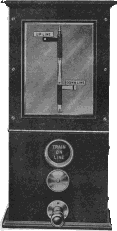
Use of block instruments, bells and gongs. �These must be used exclusively for the purposes shown in the Block Regulations, and must not under any circumstances be used for conversing. They must only be used by the signalman or other person specially appointed for the duty.
The movements on the block instruments must be made carefully, and the beats on the bells or gongs must be made slowly and distinctly, the pauses between the sets of beats being clearly marked. The correct bell code must always be sent (except where instructions are issued to the contrary). |
|
|
Repetition and acknowledgement of signals. � Except where instructions are issued to the contrary, as in Regulations 5, 8, 9, 10and 12(f), all signals must be acknowledged by repeating them, and no signal should be considered as understood until it has been correctly repeated to the signal box from which it was received. When any signal is not acknowledged, then that signal must be repeated again at short intervals until it is acknowledged correctly. |
|
|
|
Normal position of block indicators. �When the block instruments are not in use, the line must be considered blocked, the indicators having three positions being �vertical,� or �neutral,� and those having two positions showing the authorised neutral position.
Bell codes taken from an original copy of The Great Western Railway Regulations for Train Signalling on Single and Double Lines from August 1936. Copied from Section4: Regulations for Train Signalling on Single Lines by the Train Staff or Train Staff and Ticket Block System. |
|
|
|
 |
|
|
|
Beware of lots of pages in the regulations, it will take you a while going through them! |
|
|
|
Regulations for Train Signalling over a Single Line Operated By the Train Staff System. |
|
|
|
|
|
 |
|
|
|
Bell Codes. |
|
|
|
|
|
|
|
|
|
|
|
|
|
|
|
|
|
|
|
|
 |
|
|
|
Regulations for Working a Single Line operatedby the Train Staff System. |
|
|
|
|
|
|
Though Morse code was not supposed to be used, boxes that had no telecommunications sometyimes used Morse to communicate during accidents, etc. Click HERE to learn Morse Code and how to use it. |
|
|
|
News. |
|
Home. |
|
Links. |
|
|
|
|
|
About The GHLR. |
|
|
|
|
Site Map. |
|
|
|
|
Pictures. |
|
|
|
|
|
|
|
|
Rolling Stock. |
|
|
|
|
|
|
|
|
Locos. |
|