| The Geometry of Space-Time: A Teaching Package |
| JARGON FREE/ DETAILED |
| >>The General Theory of Relativity (GR): The Key Ideas |
| >>The Bending of Light: Proof of GR? |
| >>Non-Euclidean Geometry: Space, but not as we know it |
| >>Exotic Geometry: A look at the Universe around us |
 |
 |
|
|
| Force is measured in Newtons (N): |
| Newton's Second Law: |
|
|
|
|
| Mathematically, the law reads: |
| What does this mean in the physical world? |
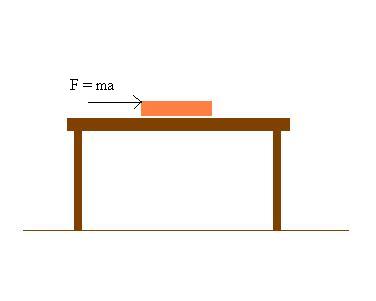
| A force is a push or pull on an object that is a result of that object interacting with another object. Let us revisit the example of the physics book on the edge of the table and for simplicity, let's also assume that the table is frictionless. The equation above represents the unbalanced force that you apply to the left-hand side of the book. So the book will move along the table: |
 |
 |
 |
| Force = mass x acceleration |
| The equation states that: one Newton is the amount of force required to give a 1kg mass an acceleration of 1m/s^2. If the book were to have a mass, m = 2kg, then it would take 2N to accelerate it to 1m/s^2. |