| The Geometry of Space-Time: A Teaching Package |
| JARGON FREE/ DETAILED |
| >>The General Theory of Relativity (GR): The Key Ideas |
| >>The Bending of Light: Proof of GR? |
| >>Non-Euclidean Geometry: Space, but not as we know it |
| >>Exotic Geometry: A look at the Universe around us |
| Link.1.1. Sir Isaac Newton |
| Isaac Newton put forth a variety of laws which explain why objects move (or don't move) as they do. These three laws have become known as Newton's three laws of motion. |
| Newton's Laws: In more detail |
| The first law is sometimes referred to as the law of inertia. It states: |
| An object at rest will remain at rest, and an object in motion will remain in motion unless they are acted on by an unbalanced force. |
| So the law describes two situations. Consider the first one, an object at rest will remain at rest,..If there is a physics book resting on a table then the book is at rest relative to you. There are two forces acting on that book. Because they cancel each other out, the book will not move. Do you know what these two forces are? |
| If you look carefully at diagram.1 you will notice that the arrows representing the forces are both of the same length. This is because they are of the same magnitude. If the book was very heavy then the table would no longer be able to provide stability as the pull of gravity would overcome the force provided by the table. The latter scenario is an example of an unbalanced system of forces. Press next to learn more about this. |
 |
|
|
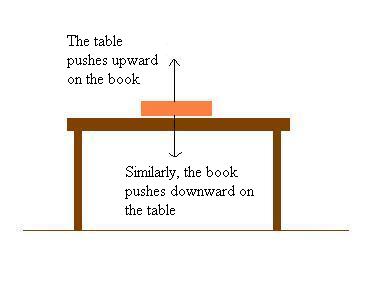 |
| The two forces are the downward pull of the Earth's gravitation and the upward force provided by the table: |
 |
|
|
 |
 |
| This animation really needs sound to work best...click on the pic to hear the sound |