| The Geometry of Space-Time: A Teaching Package |
| JARGON FREE/ DETAILED |
| >>The General Theory of Relativity (GR): The Key Ideas |
| >>The Bending of Light: Proof of GR? |
| >>Non-Euclidean Geometry: Space, but not as we know it |
| >>Exotic Geometry: A look at the Universe around us |
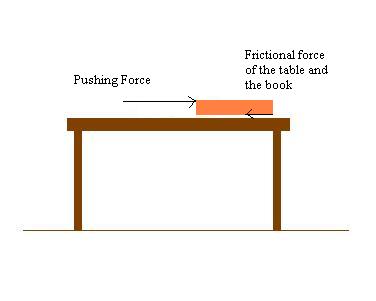
| We only need consider the horizontal components as we know that the vertical components are in equilibrium (i.e. all forces balance). You can see that the push you give the book is much bigger than the frictional force, provided by the material the table and book are made from, that tries to oppose it. The result is that the book will accelerate to the right and fall from the table. |
| Imagine an ice hockey puck in the centre of an ice rig that has just been given a push and is now moving along with a constant velocity, v. |
| We know from before that the vertical forces are balanced so once again we only need to consider the horizontal components. We have chosen an ice rig because ice can be considered frictionless (it's not a true representation of its physical properties but for this experiment we only need the concept of a frictionless surface). As there is no force apposing its motion, the puck will continue on a straight path at its current velocity, v. Only if an external force, say a hockey stick, were to apply it self to the puck will its present velocity change. So, for objects that are in equilibrium with their surroundings, acceleration, a = 0 |
| and velocity will remain constant. This, in essence, is Newton's first law. |
 |
| So this thought experiment has helped clarify the first part of Newton's first law, how about the second part? "An object in motion will remain in motion unless it is acted on by an unbalanced force"? |
 |
 |
|
|
 |
|
|