Networking Swarm Robots with Inexpensive Commercial 802.11 Hardware

With the present advances in robotic vehicles, real applications for multiple robots performing tasks over a large area is becoming a hot topic.  However, the control and intercommunication of a swarm of robots is a complicated issue.  No standard commercial hardware solution exists that is capable of providing networked communications that can switch configurations on the fly.  Also communication needs to be automatically relayed for nodes that are in contact with the main group of nodes but out of range of the recipient node.  This document outlines two methods that could provide networking in the described environment.

Present Networking Methods
Most wireless networking methods in use today such as Bluetooth or IRDA do not have the range required to control multiple robots over a large area.  Many schemes offer good bandwidth but all suffer from short range. 802.11 however does give fair range estimates for unobstructed line-of-sight.  Most companies claim that the smallest 802.11b wireless access point or wireless bridge will give a range of at least 1000 feet at 1 Mbps in an outdoor unobstructed line-of-sight environment.  The D-Link 800AP+ specifies a range of 1000 feet while the LinkSys WET11 specifies a range of 1800 feet.  This range can be increased by replacing the small pigtail antenna with a larger antenna or a directional antenna.  (The use of an external antenna will however void the WET11 warranty so is not suggested with this unit.)

Networking in 802.11b can be configured in two ways.  The most common networking method is the standard where all nodes connect to one access point.  The other method which is peer-to-peer (or sometimes mislabeled as ad-hoc) where each node can communicate with each other node.  Most access points or bridges support both modes.  These two methods support many applications but neither is capable of relaying communication to or from nodes outside the range of others.

Note: A company called Mesh Networks offers a solution that automatically creates relay networks on the fly.  They offer the software protocol in devices that use the 802.11b RF specifications and another flavor RF that has a range of 3 miles.  However, Mesh Networks is currently looking for large companies to partner with and only offers the long range product in a kit that costs 60 thousand dollars.

Relaying or Range Extension
D-Link is currently producing an inexpensive wireless bridge, model 800AP+, that can work as a normal access point or can be configured as a relay station that extends the range of a network.  The fact that this device can be configured remotely over the network with a web interface opens possibilities for swarm communication.

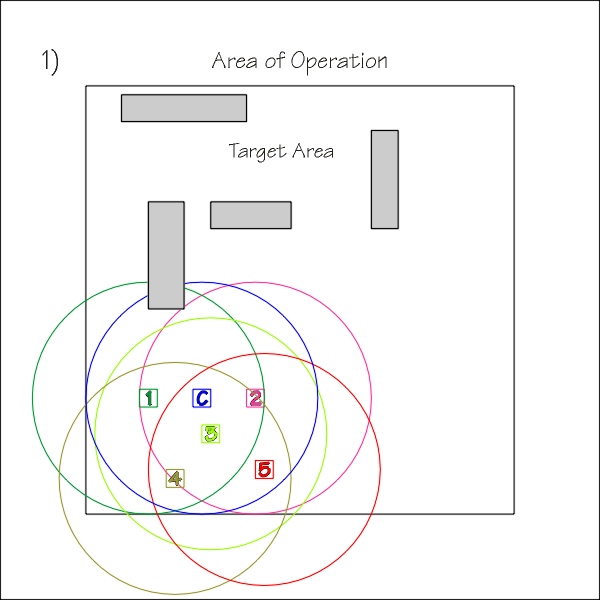
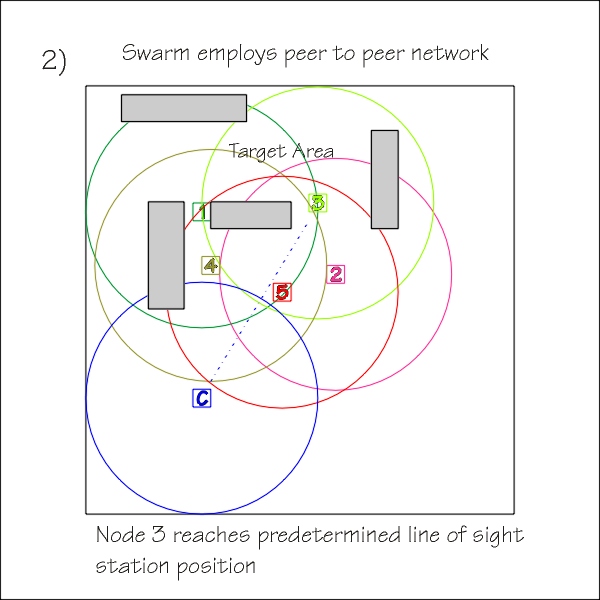
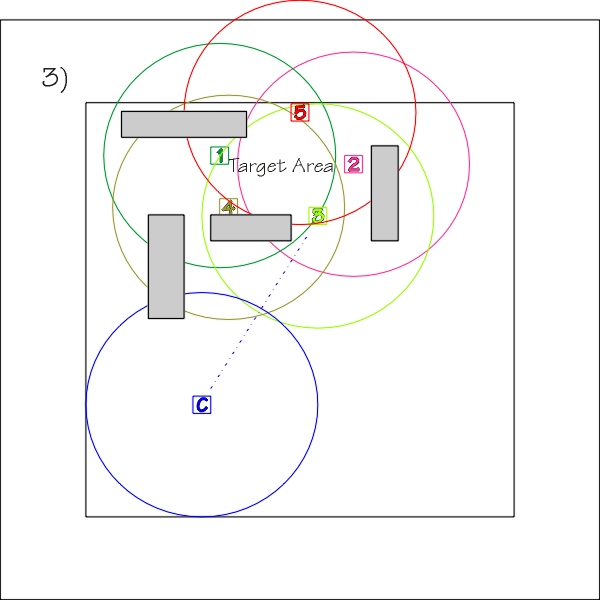
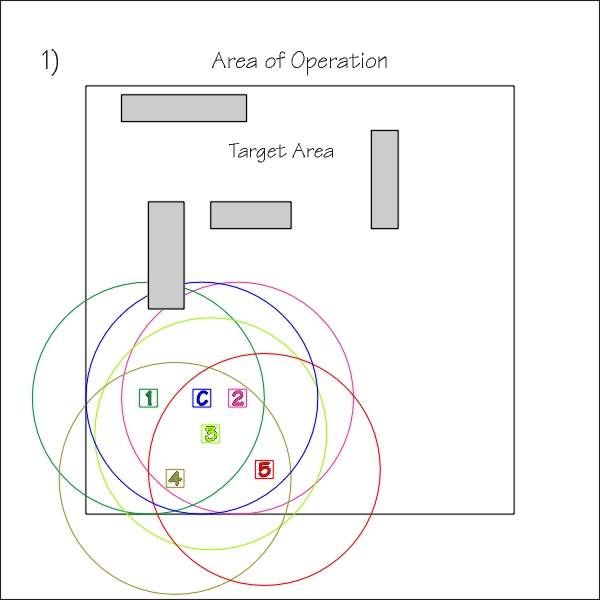
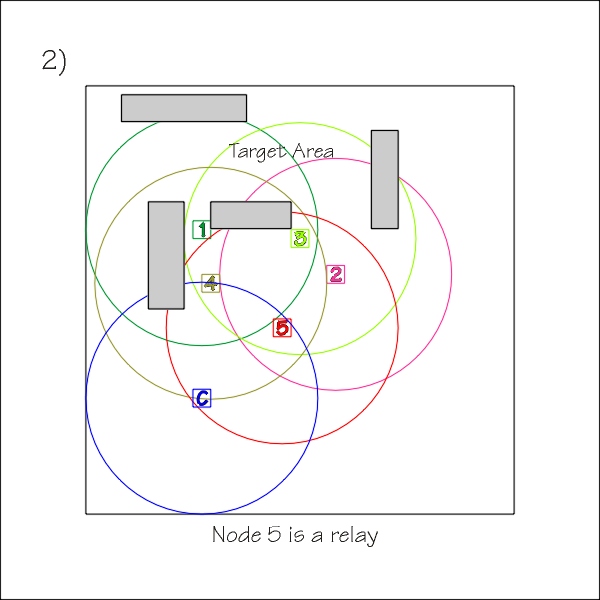
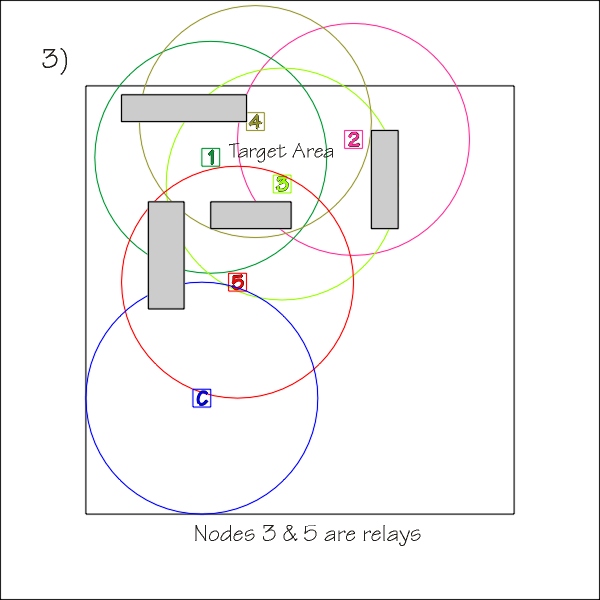
Two methods for extending the range of a network will be examined.   In these two scenarios there are 5 robots (numbered 1 through 5) communicating interactively and one controller (labeled 'C').  Each is shown in a different color.  The ring of the same color shows the range of an agent's network.   It is assumed that the controller has a map view of the area of operation.  Each robot reports its position to the controller whose map view is updated in real time.  The controller can issue commands to each robot or the swarm as a whole.  Commands to individual robots would include "stop", "move to a point", and "become a relay".

Note: these methods are untested.  this document should not be used for proof of feasibility.  The D-Link 800AP+ only relays other D-Link wireless signals.  The 800AP+ may not work in a peer-to-peer configuration.


Scenario 1: Full Time Controller Communication

In this scenario the controller has command of the robots as they move toward the target.


1) The controller issues a command to the swarm to secure the target area.  In this case secure means to occupy.  All robots are within the network range of the controller.
1a)

2) As the swarm moves toward the target area, nodes begin to move out of the range of the controller.  As this happens the controller commands certain robots to become relay stations.  These stations may be moved to maximize distance from the  controller.
1b)

3) As the swarm approaches the target area two nodes are needed as relays to ensure communication with the controller.  Three of the five are free to explore the target while two must remain stationary.
1c)


Scenario 2: Controller Communication only at Target

In this scenario the controller has command of the robots when they arrive at the target.


1) The controller issues a command to the swarm to secure the target area.  In this case secure means to occupy.  All robots are within the network range of the controller.
2a)


2) As the swarm moves away from the controller network communication is lost.  The swarm may communicate among itself using peer-to-peer networking.  One robot arrives at a point that has network coverage over the target area and direct line of sight of the controller.  It deploys a directional antenna to establish communication with the controller.
2b)

3) When the swarm moves into the target area they are all under control of the controller.  Only one station must relay network traffic back to the controller and remain stationary.
2c)

Project Description | Design Documents | T/2 Information | Resources | Photo Gallery | Sponsors


Last Update: July 1, 2003
Copyright (c) Smart Sensors for Autonomous Robots Design Group, 2003

Hosted by www.Geocities.ws

1