|
|||||

|
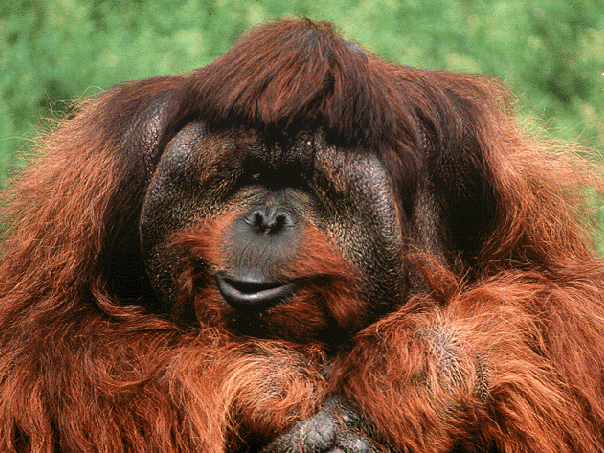
Orangutans, or pongo pygmaeus, are considered highly intelligent. In the Malay language, the word "orangutan" means "person of the forest." Perhaps because 97% of the orangutan's genetic makeup is the same as a humans. They have four long fingers plus an opposable thumb. Their feet have four long toes plus an opposable big toe. These creatures can grasp things with both their hands and their feet, making them the largest arboreal ape. The largest males have an arm span of about 7.5 feet. Orangutans have a large, bulky body, a thick neck, very long, strong arms, short, bowed legs, and no tail. They are about 2/3 the size of the gorilla and are mostly covered with long reddish-brown hair. |
One can easily tell the difference between maleand females. Both genders have a large head with a prominent mouth area. But adult males have have large cheek flaps, which get larger as the ape ages. Males can weigh up to 220 pounds and measure up to 4.5 feet, while females can only weigh up to 120 pounds and be as tall as3.5 feet; that's half of the male atonomy. Males, as well as females, are very solitary. They tend to fight with other males in order to protect their territory, thus protecting their food source. Male orangutans become fully mature at about 15 years of age. At this age, males break their solitude only to mate. Here the males large throat (laryngeal) sacs come into play. The sac is most well developed in males and gives resonance to their long calls. These long calls warn other males to stay out of their territory and attract females who are also ready to mate. |
Females are sexually mature at 8 to 10 years of age, but aren't able to have offsprings until the age of twelve. They tend to have one offspring every 6 to 7 years and may be fertile until they are 30 years old. As it was said before, females are solitary creatures, having only its offspring as its companion. Baby orangutans typically weigh 4.5 pounds when they are born. A young orangutan maintains constant physical contact with its mother for the first year of its life. It may occasionally encounter another young orangutan or may play with an older sibling, but usually its mother is its sole companion. Most of what orangutans need to know to survive, they learn by watching their mothers. At 2 years of age, a young |
|
orangutan will begin to leave its mother for short periods of time. However, it never ventures too far and still shares a sleeping nest with her. Young orangutans are usually weaned at 3-4 years of age, but some may nurse longer. They typically spend 5-6 years with their mothers. When a male orangutan finally leaves his mother, he usually emigrates from his mother's home range. A young female orangutan will also establish her own home range, but it typically overlaps with her mother's range. Orangutans live to about a total of about 45 years in the wild; in captivity they can live to 50 years or more. |