
|
|||||

| |
|
The orangutans live in a rain forests in Sumatra and Borneo. Each rainforest is slowly diminishing, due more to human fault than to nature's. The World Wildlife Fund (WWF) has declared that Borneo could lose most of its forests in less than ten years, with the destruction driven by rampant logging, fires and the encroachment of plantations. In the last twenty years, 80% of the orangutan habitat has been lost. One-third of the orangutan population was lost in the wild fires of 1997 and 1998. |
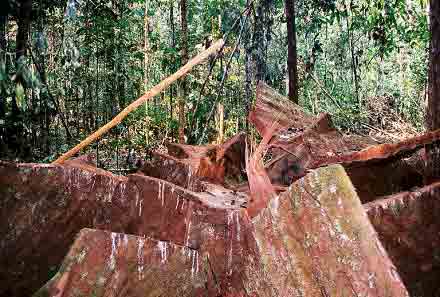 |
Borneo, the third largest island in the world, was once covered with dense rainforests. With swampy coastal areas fringed with mangrove forests and a mountainous interior, much of the terrain was virtually impassable and unexplored. In the 1980s and 1990s Borneo underwent a remarkable transition. Its forests were levelled at a rate unparalled in human history. Borneo's rainforests went to industrialized countries like Japan and the United States in the form of garden furniture, paper pulp and chopsticks. Initially most of the timber was taken from the Malaysian part of the island in the northern states of Sabah and Sarawak. Later forests in the southern part of Borneo, an area beloging to Indonesia and known as Kalimantan, became the primary source for tropical timber. |
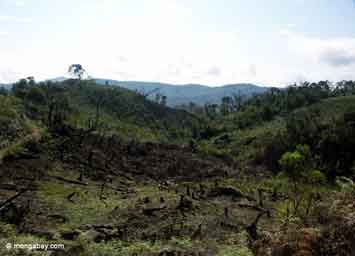
Today, only half of Borneo's forest cover remains, down from 75% in the mid 1980s. Around 1.3 million hectares of forest are destroyed every year. Studies have shown that every year 1000 more orangutans disappear, mostly due to deforestation. But its not only orangutans. More than 210 mammals, including 44 which are found nowhere else in the world, but in Borneo. Between 1994 and 2004 at least 361 new species were discovered and new ones are constantly being found. A recent report, by Dr. Lisa Curran has shown more clearly and to what degree deforestation has grown every year. |
 |
|
The report estimates that "protected" lowland forests have decreased by more than 56 percent, meaning some six and a half million acres are gone forever. Parks supposedly off limits to loggers have fallen as laws are ignored by timber barons with political conncections, while large areas of forest in Borneo have been cleared for palm oil plantations that, in many cases, have yet to be planted. Tree production in the Dipterocarpaceae family, the main family of canopy trees in Borneo, is inextricably linked to the arrival of El Niño. Dipoterocarps synchronize their reproduction, called masting, to the onset of the El Niño Southern Oscillation, which occurs approximately once every four years. The traditional climatic conditions of an El Niño year stimulate fruiting and flowering in the dipterocarps and are imperative for regional seed production, and ultimately, forest regeneration. Individual trees may carry up to 120 fruits and the trees have been known to synchronize over a scale of 370 million acres. |
Yet intensive logging in Borneo over the past two decades has taken a major toll on this reproductive cycle. In 1991, seed production was around 175 pounds per acre. By 1998, this number had plummeted to 16.5 pounds per acre. According to research, logging appears to reduce local density and biomass of mature trees and also limits the spatial extent of masting and inhibits the forest's normal response by disrupting soil conditions. Extended drought stress is another effect. The reduction of seed results is a loss for the forest, the animals, and the people. A loss for the people because seeds from dipterocarp trees generate about $25.8 million annually for local residents, but seed harvesting is in direct competition with commercial logging -- a much more profitable business. Due to the scarcity of forest |
 |
and dipterocarps in non-protected areas, seeds consumers -- both human and animal -- are increasingly eating dipterocarp seeds before they germinate, threatening the long-term viability by reducing the reductive capacity of these forests. In other words, if trees keep disappearing, soon this profitable business will go down the train. Besides a damaged economy, tourism would also decline |
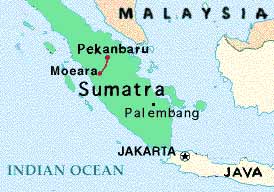 |
Sumatra is the sixth largest island of the world (about 470,000 km²) and is the largest island entirely in Indonesia (two larger islands, Borneo one of them, are partially in Indonesia). To the southeast is Java, separated by the Sunda Strait. To the north is the Malay Peninsula, separated by the Straits of Malacca. To the east is Borneo, across the Karimata Strait. West of the island is the Indian Ocean. The island is the world's 8th highest island, although only the third highest in the Indonesian archipelago.
The interior of the island is dominated by two geographical regions: the Barisan Mountains in the west and swampy plains in the east. |
The backbone of the island is the Barisan mountains chain. The volcanic activity of this region endowed the region with fertile land. It also contains deposits of coal and gold. To the east, big rivers carry silt from the mountains. Even if it is mostly unsuitable for farming, the area is currently of great economic importance for Indonesia: it produces oil from both above and below the soil—palm oil and petroleum. Most of Sumatra used to be covered by tropical rainforest, but economic development coupled with corruption and illegal logging has severely threatened its existence. Conservation areas have not been spared from destruction, either. Like Boreo, Sumatra is slowly stripping itself of its life. November 2, 2003- A little, small village, a popular tourist center where one could see orangutans, was compleatly leveled due to a flash flood. Over 200 have died, almost 300 children and about 200 babies have been left shelterless. The blame? Illegal loggers. President Megawati Soekarnoputri, with no hesitation, placed responsibility for the disaster on the shoulders of illegal loggers in the nearby Leuser National Park. Her environment minister, Nabiel Makarim, described the illegal loggers as terrorists, but said there was little they could do. Environmentalists say that illegal logging has stripped the area of much of the tree cover and other vegetation which would normally absorb water during the rainy season. Longgena Ginting, executive director of WALHI, Indonesia's largest environmental group, said "At least 85 percent of the floods and landslides in Indonesia are caused by illegal logging. The Bukit Lawang flood should serve as an alarm to the Government." But despite all this evidence against the "terrorists", the Indonesian Government concluded that it was a natural disaster, with illegal logging merely one causal factor, but not the main factor. But Sumatra, being much like Borea, is a developing country. It's filled with corruption and unstable living conditions. The people there are too busy with their own survival to care for that of another. |